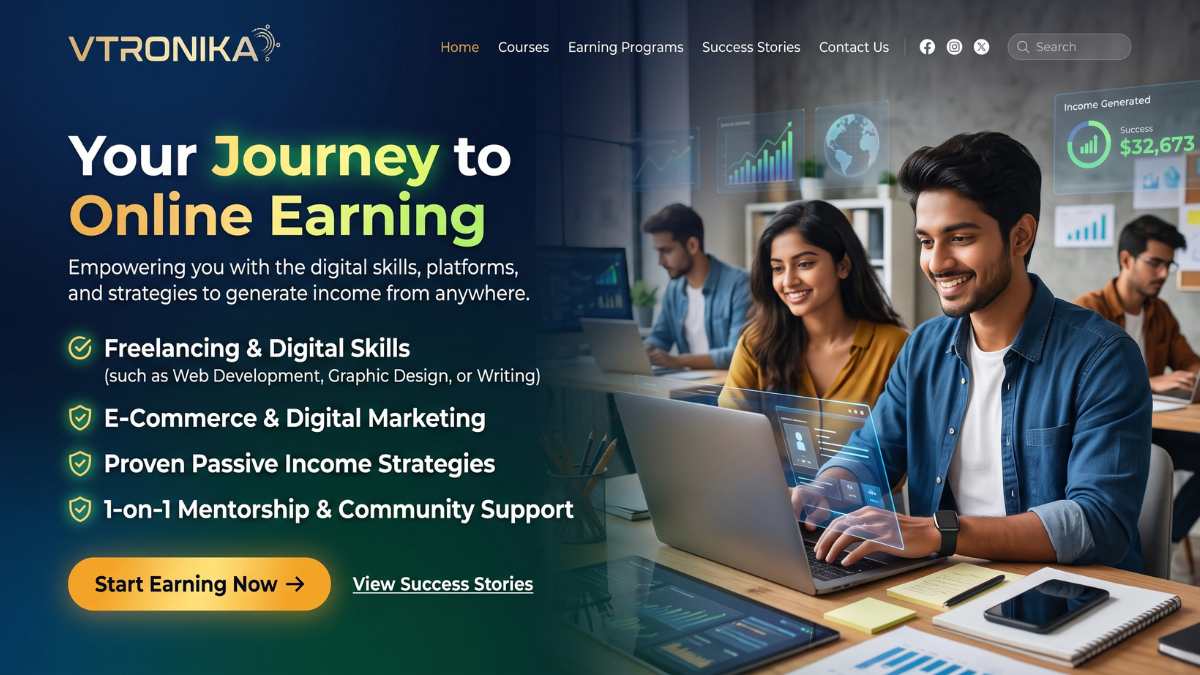
Article 1: Identifying High-Income Digital Skills in the Modern Global Market
The foundation of any sustainable online career rests on mastering skills that directly affect a client’s bottom line: revenue generation, cost reduction, or operational efficiency. In the global remote economy, generalist skills face intense price competition, while specialized, high-leverage proficiencies command premium rates.
High-value areas include full-stack web development, specialized UI/UX design, performance media buying, conversion-focused copywriting, and AI workflow integration. Instead of offering broad virtual assistance, professionals who specialize in building automated sales funnels or writing email sequences for subscription software solve distinct, expensive business problems. Mastering one core skill—complemented by baseline knowledge of data analytics and client communication—transforms remote work from a race-to-the-bottom hourly trade into a high-value consulting practice.
Article 2: Establishing a High-Converting Freelance Presence on Upwork and LinkedIn
Transitioning from an aspiring freelancer to a booked professional requires strategic positioning. Marketplaces like Upwork and professional networks like LinkedIn reward clarity, proof of competence, and targeted problem-solving over generic, broad resumes.
A high-converting freelance profile functions as a dedicated sales page. The headline must state the exact transformation provided, such as “B2B SaaS Copywriter Increasing Trial-to-Paid Conversions” rather than “Content Writer.” Case studies should follow a structured problem-action-result framework, supported by verifiable data like percentage revenue increases or reduced acquisition costs. On LinkedIn, sharing technical breakdowns of recent projects and commenting on industry developments establishes organic inbound authority, attracting enterprise clients without relying exclusively on competitive job boards.
Article 3: Proposal Engineering – How to Win Premium International Clients
The difference between freelancers competing on price and those securing four-figure retainers lies in the proposal. Most clients receive dozens of copy-pasted cover letters that focus entirely on the applicant’s credentials rather than the client’s operational problem.
A winning proposal opens by addressing the client’s specific bottleneck, demonstrating that the scope was analyzed before typing. It provides a brief diagnostic assessment, outlines a two-to-three-step action plan, and links two relevant case studies that prove past execution. Including a custom 60-second video walkthrough of their website or platform establishes immediate credibility. Concluding with a clear, low-friction call-to-action—such as offering a brief discovery chat—keeps communication focused and shifts the interaction from an interview to a strategic partnership.
Article 4: Monetizing Intellectual Property – The Digital Asset Framework
Active freelancing provides immediate cash flow, but it remains bounded by the number of working hours in a week. True scale requires packaging your knowledge into digital assets that can be replicated and distributed with near-zero marginal cost.
Digital assets include comprehensive video courses, design system UI kits, Notion business operating systems, code libraries, and industry-specific documentation templates. The creation process begins by identifying repetitive problems solved for freelancing clients and structuring that workflow into a modular, self-paced resource. Distributed through platforms like Gumroad, Lemon Squeezy, or self-hosted Shopify portals, these assets sell repeatedly to a global audience without requiring ongoing 1-on-1 labor.
Article 5: Affiliate Marketing Architecture – Building Evergreen Authority Hubs
Affiliate marketing remains a dependable passive income model when built on genuine domain expertise and long-term search intent. Rather than relying on short-lived social media links, sustainable affiliate income relies on authoritative content hubs that answer specific, high-intent purchasing questions.
Successful creators focus on high-ticket B2B software, specialized equipment, or recurring subscription services that offer lifetime commissions. Content strategies center on in-depth product comparisons (“Tool A vs. Tool B”), teardowns, and implementation tutorials where the software serves as the natural solution. By optimizing these assets for search engines and capturing visitor emails via lead magnets, the platform builds an evergreen revenue engine that compounds in value over time.
Article 6: Programmatic SEO and Content Monetization – Scaling Web Traffic
Publishing individual blog posts manually limits the speed at which a publishing platform can scale. Programmatic Search Engine Optimization (pSEO) leverages structured databases, modular page templates, and automated workflows to publish hundreds of landing pages targeting long-tail search queries.
A well-architected pSEO project identifies recurring search patterns, such as “best software integrations for [industry]” or “remote salaries in [city].” By pulling reliable data from APIs or custom datasets into dynamic templates, publishers create useful, data-dense resource directories. Monetized through high-yield ad networks (like Mediavine or Raptive) and direct contextual sponsorships, these authority hubs generate consistent passive revenue while requiring minimal ongoing maintenance.
Article 7: Modern E-Commerce Models – Private Label vs. Lean Dropshipping
The global e-commerce landscape has matured beyond low-quality, slow-shipping arbitrage models. Today’s digital consumers demand fast delivery, transparent branding, and dependable customer service, requiring entrepreneurs to choose an e-commerce infrastructure carefully.
Lean dropshipping serves as an effective testing ground for validating product demand, creative angles, and audience metrics without holding heavy inventory. However, sustainable brand equity requires transitioning winning products into private-label operations. By securing direct manufacturing relationships, ordering custom packaging, and utilizing third-party logistics (3PL) fulfillment centers, brands reduce delivery times and improve customer retention. Complete control over product quality and presentation increases customer lifetime value and safeguards the business against marketplace volatility.
Article 8: Paid Acquisition Mastery – Scaling Meta and TikTok Ad Funnels
Even an exceptional e-commerce storefront or digital product will struggle without a predictable customer acquisition channel. Relying exclusively on organic reach is slow and vulnerable to platform algorithm shifts; scalable businesses pair organic efforts with paid media buying.
A modern paid advertising engine relies on creative volume, clear hooks, and data-driven iteration across Meta Ads Manager and TikTok Ads. Marketers test diverse creative formats—including user-generated content (UGC), direct comparison charts, founder stories, and problem-solution demonstrations—to pinpoint low-cost conversions. Once an ad set proves profitable, budgets scale horizontally across lookalike audiences and broad targeting, while automated retargeting funnels re-engage abandoned carts, securing a stable return on ad spend (ROAS).
Article 9: Email Marketing and Retention – Maximizing Customer Lifetime Value
While paid ads attract new visitors, customer retention and repeat purchases generate the highest profit margins in digital commerce. Acquiring a new customer costs significantly more than retaining an existing one, making email and SMS marketing essential infrastructure for online businesses.
High-converting lifecycle marketing relies on automated email sequences: welcome series that introduce brand values, abandoned checkout recovery sequences offering time-sensitive incentives, and post-purchase educational flows that enhance product experience. Supplementing automated sequences with weekly editorial newsletters or seasonal product drops keeps the brand top of mind. Because email lists are fully owned channels, they protect business revenue from social media algorithm changes and rising ad costs.
Article 10: The Hybrid Online Business Model – From Freelancer to Digital Media Enterprise
The most resilient online entrepreneurs do not restrict themselves to a single business model; they build an integrated, multi-tiered digital ecosystem. Each revenue stream supports and reinforces the others, creating a durable business.
The journey typically begins with freelancing, which provides immediate cash flow, hones market-tested skills, and exposes real-world business bottlenecks. Those insights are then distilled into digital products and niche e-commerce brands, funding automated paid media campaigns. Finally, the audience gathered along the way fuels authority blogs and affiliate engines. By connecting active services, proprietary products, and passive distribution channels, you construct an adaptable online enterprise built for long-term independence and recurring revenue.