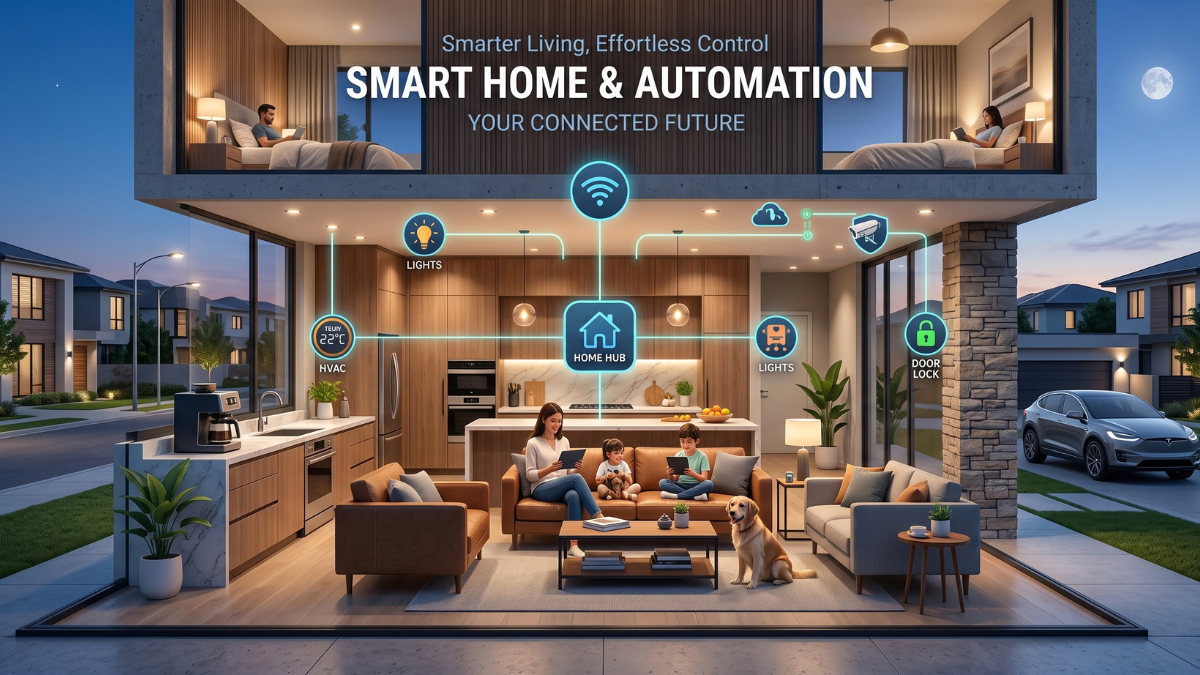
Here is a comprehensive 10-article series on “Smart Home & Automation: Smarter Living, Effortless Control, Your Connected Future.” Each article covers an essential pillar of residential automation, from protocol foundations to automated ambient living.
1. Unified Protocols: How Matter and Thread Break the Smart Home Walled Gardens
For over a decade, consumer home automation suffered from fragmented ecosystems. Homeowners had to balance disparate systems—Apple HomeKit, Google Home, Amazon Alexa, and SmartThings—navigating incompatible radios and fragile third-party cloud bridges. The arrival of the Matter application standard and Thread networking protocol fundamentally changes this dynamic, delivering an interoperable, vendor-agnostic smart home foundation.
Matter runs as a universal software layer over Wi-Fi, Ethernet, and Thread, allowing certified hardware from different manufacturers to communicate locally without requiring proprietary cloud servers. Thread operates as an ultra-low-power, self-healing IPv6 mesh network: every mains-powered Thread device (such as a smart plug or light switch) acts as a mesh extender, eliminating dead spots and taking heavy device loads off your household Wi-Fi router. The practical result is instantaneous response times, unified local setup via simple QR code scanning, and the freedom to buy devices based on quality rather than ecosystem labels.
2. Adaptive Lighting and Circadian Rhythm Optimization
Modern automated lighting goes far beyond basic on/off scheduling from a smartphone screen. Intelligent lighting systems leverage dynamic spectrum tuning and localized micro-dimming to align indoor illumination directly with natural human biology, supporting productivity throughout the day and deeper sleep at night.
Using astronomical clocks and local solar position data, smart lighting architectures automatically adjust both lumen intensity and color temperature in real time:
- Morning: Crisp, cool blue-white tones (5000K–6500K) trigger cortisol suppression to enhance focus and alertness.
- Mid-Day: Balanced, high-CRI illumination maintains daytime visual clarity for work and household tasks.
- Evening: Lights transition seamlessly toward warm amber hues (2200K–2700K), eliminating blue-wavelength exposure to promote natural melatonin production.
- Night Modes: Integrated sub-cabinet and baseboard lighting activates at ultra-low output (1%–5%) via bed-exit sensors, guiding nighttime movement through hallways without disrupting night vision.
3. Precision Climate Control, HVAC Zoning, and Indoor Air Quality
Heating and cooling represent the single largest consumer of household electrical energy. Smart climate ecosystems replace solitary, dumb wall thermostats with distributed, multi-sensor climate networks that tailor air delivery room by room.
Smart thermostats coordinate with motorized register vents, variable-speed heat pumps, and localized temperature/humidity sensors to eliminate hot and cold zones across multi-story layouts. In parallel, indoor air quality (IAQ) sensors continuously sample volatile organic compounds (VOCs), $CO_2$ levels, and PM2.5 particulate densities. If elevated contaminants are detected—whether from high-heat cooking, cleaning chemicals, or outdoor wildfire smoke—the smart HVAC system automatically engages energy recovery ventilators (ERVs), opens automated fresh-air dampers, and cycles air purifiers until baseline clean air metrics are restored.
4. Multi-Layered Perimeter Defense: Autonomous Residential Security
Smart residential security has evolved from passive recording boxes into proactive, edge-computed defense systems that neutralize threats before physical breaches occur. Rather than simply alerting you after a break-in, a modern security perimeter uses distributed intelligence to deter intrusion.
The defense stack operates across several integrated tiers:
- Outer Perimeter: Smart cameras running on-device computer vision differentiate between passing wildlife, delivery couriers, and unauthorized prowlers lingering along boundary lines.
- Access Control: Keyless deadbolts utilize 3D facial recognition, encrypted fingerprint sensors, or NFC/UWB digital wallet keys, permanently deprecating physical lock picking while generating revocable, time-restricted access passes for guests.
- Internal Verification: Contact sensors on doors and windows cross-reference acoustic glass-break detectors and interior mmWave radar.
- Autonomous Deterrence: Upon detecting a confirmed perimeter trespass, the ecosystem automatically flashes landscape floodlights, locks motorized interior barriers, sounds multi-point sirens, and transmits encrypted event video with verified telemetry directly to emergency dispatch.
5. Whole-Home Energy Orchestration: Solar, Storage, and Microgrids
As utility rates surge and power grids face increasing strain, automated energy management transforms homes from passive consumers into autonomous, resilient microgrids. At the center of this transition are smart electrical panels that replace legacy mechanical breaker boxes with digitally addressable, monitored circuits.
These systems analyze real-time utility tariff structures, solar panel output, and residential battery storage reserves. During peak rate hours (Time-of-Use tariffs), the home automatically switches off high-load circuits—such as pool pumps, water heaters, and electric vehicle (EV) level-2 chargers—while drawing home power directly from stationary lithium-iron-phosphate (LFP) home batteries. When grid outages strike, the smart panel sheds non-critical circuits in milliseconds, reserving vital battery reserves exclusively for refrigeration, medical equipment, and security hardware.
6. From Motion Detection to mmWave: The Rise of True Ambient Presence
First-generation smart homes relied heavily on Passive Infrared (PIR) motion sensors. These sensors suffered from a critical functional flaw: they required active physical movement. If a resident sat down on a sofa to read a book or worked silently at a desk, the PIR sensor registered the room as empty, abruptly plunging the space into darkness.
Millimeter-wave (mmWave) radar technology eliminates this frustration entirely. By emitting high-frequency electromagnetic waves, mmWave micro-sensors detect microscopic physiological vibrations, including the slight rise and fall of a person’s chest during breathing. This micro-precision enables:
- Indefinite Presence Tracking: Room automations remain active regardless of whether the occupant is moving, sitting still, or sleeping.
- Spatial Micro-Zoning: A single mmWave sensor can divide a room into specific grid zones—turning on a desk lamp when you sit at your workstation, and switching to accent lighting when you move to the reading armchair.
- Fall Detection: In assisted-living settings, ceiling-mounted mmWave arrays identify sudden vertical drop trajectories, instantly dispatching caregiver assistance without requiring the resident to wear a pendant or call button.
7. Acoustic Automation and Invisible Architectural Sound
Smart home audio has evolved beyond visible countertop plastic speakers into high-fidelity, room-by-room architectural audio that integrates invisibly into ceilings and wall cavities. These systems deliver personalized acoustic zones that adapt to daily activity.
Using localized microphone arrays and spatial room calibration, smart multi-room audio automatically tunes its acoustic output to the unique physical dimensions and soft furnishings of each room. Music playback or intercom calls follow residents via presence tracking, handing off streams from the kitchen to the home office as you move. Furthermore, specialized vibration exciters installed behind drywall allow walls themselves to become acoustic transducers, producing rich ambient soundscapes or structural active noise cancellation without a single speaker grille or cable cluttering the living space.
8. Smart Water Infrastructure: Leak Mitigation and Micro-Metering
While electrical automation receives the bulk of attention, unmitigated water leaks cause significantly more catastrophic property damage each year than electrical fires. Automated water management introduces closed-loop intelligence to residential plumbing.
Ultrasonic inline smart water meters monitor whole-home fluid dynamics, measuring water flow down to single-drop micro-leaks within walls or underground supply lines. When flow patterns deviate from normal household baseline usage—such as an unattended garden hose running continuously or a washing machine supply burst—the system acts automatically:
- Immediate Shutoff: A motorized ball valve shuts down the main municipal water supply within seconds.
- Point-of-Use Detection: Wireless point sensors placed beneath sinks, dishwashers, and water heaters trigger local alarms while instructing the central shutoff valve to isolate the home.
- Predictive Diagnostics: During quiet overnight hours, the system performs autonomous pressure-decay tests, identifying pinhole pipe degradation years before it can cause structural rot or toxic mold blooms.
9. Frictionless Kitchens and Domestic Robotics
The smart kitchen and living areas are evolving from passive food-storage and cleaning areas into collaborative environments that offload domestic labor. Modern kitchen automation integrates inventory tracking, computer-vision appliances, and autonomous cleaning robots into a coordinated ecosystem.
Induction ranges communicate wirelessly with smart overhead range hoods, modulating extraction fan speeds in real time based on cooking heat and aerosolized oils. Smart ovens employ internal thermal probes and optical sensors to identify food types, self-regulating cooking stages to prevent overcooking. Meanwhile, robotic floor vacuums leverage LiDAR navigation and 3D obstacle avoidance to map floor plans, auto-emptying dustbins and self-cleaning mop pads using plumbed fresh-water and drain lines embedded cleanly inside custom cabinetry.
10. The Private Smart Home: Local Processing and Data Sovereignty
As homes become saturated with microphones, optical sensors, biometric scanners, and occupancy logs, personal privacy and data sovereignty become paramount. Transmitting continuous domestic data to corporate cloud servers introduces cybersecurity liabilities, subscription fees, and vendor lock-in risks.
The cutting edge of home automation is moving decisively toward local-first computing. High-efficiency edge processors and open-source platforms (such as Home Assistant running on local micro-servers) keep all operational logic, presence logs, and camera video processing strictly inside your local home network. Machine-learning algorithms process voice recognition and facial analysis on local chips, eliminating cloud round-trips. By severing dependency on external servers, the local-first smart home operates with sub-millisecond response latency, retains 100% functionality during internet outages, and ensures your domestic life remains completely private.