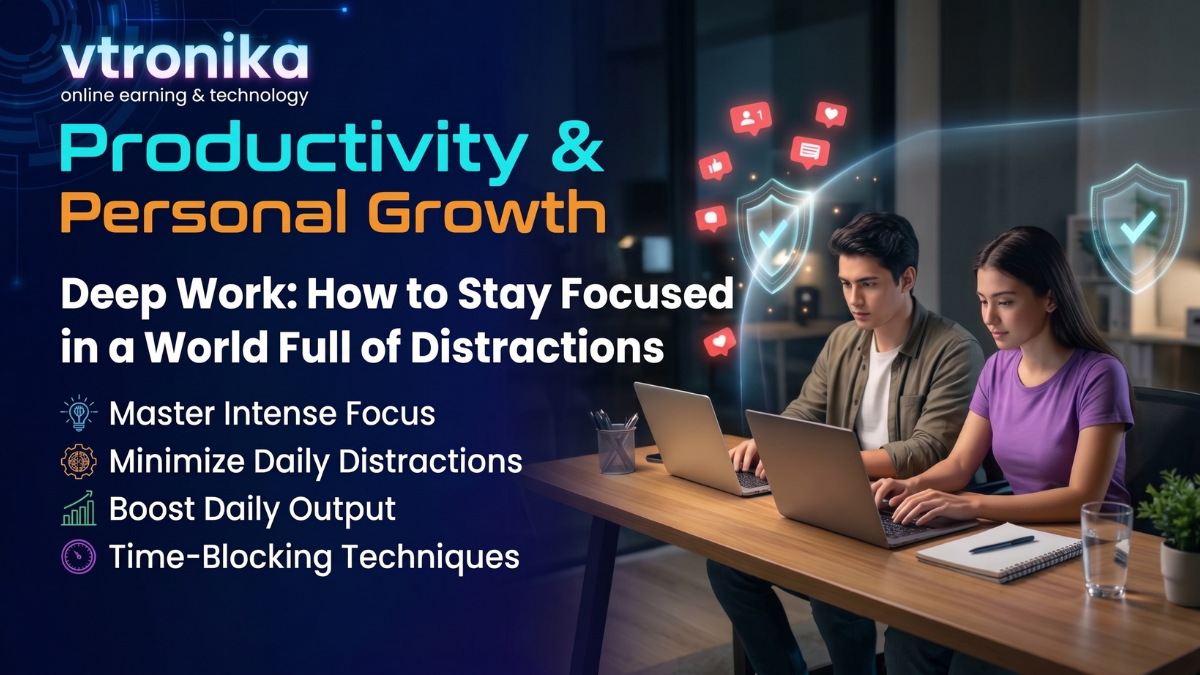
Article 1: The Attention Economy – Why Deep Work Is the Ultimate Superpower
We live in an attention economy where human focus is the primary commodity being bought, sold, and manipulated. Social media platforms, streaming networks, and advertising algorithms employ behavioral psychologists to design feedback loops engineered to capture your gaze and fragment your consciousness.
In this hyper-distracted landscape, the ability to perform Deep Work—focusing without distraction on cognitively demanding tasks—has transitioned from an admirable trait to a rare and lucrative economic superpower. Most knowledge workers spend their days trapped in “shallow work”: answering minor emails, attending performative meetings, and reacting to instant messages. These activities create the illusion of productivity while producing zero long-term enterprise value.
Those who can escape shallow busywork to think deeply, master complex systems rapidly, and solve ambiguous problems occupy a tier of their own. Deep work is the engine of rare, valuable output. When you master your attention, you remove yourself from commoditized labor and build a durable competitive moat.
- Core Focus: Attention sovereignty in a distraction-monetized world.
- Key Mechanism: Cognitive scarcity—rare skills demand focused, uninterrupted practice.
- Strategic Takeaway: If you do not consciously design your focus, algorithms will design your distraction for you.
Article 2: The Cognitive Science of Attention Residue
The human brain is biologically incapable of parallel cognitive processing. What culture casually celebrates as “multitasking” is, in neurological reality, rapid task-switching. Every time you glance away from an analytical report to check a quick Slack notification or email ping, your brain pays a heavy neurological tax known as attention residue.
Coined by business professor Dr. Sophie Leroy, attention residue demonstrates that when you transition from Task A to Task B, your cognitive bandwidth does not cleanly follow. A thick layer of your working memory remains anchored to the previous task:
[Task A: Deep Coding / Writing]  --->  [Quick 5-Second Inbox Check]  --->  [Return to Task A]
                                                   |                                 |
                                        Attention fragments            Severe Attention Residue:
                                        Brain switches context         Takes 15-20 mins to regain flow
Even a five-second interruption leaves mental residue that degrades cognitive efficiency for up to twenty minutes. The worker who checks their communication channels every ten minutes is effectively operating at a self-inflicted cognitive deficit, burning mental stamina without making real progress on hard tasks.
Article 3: Architectural Philosophies – Choosing Your Deep Work Schedule
Deep work cannot be sustained on vague intentions; it requires an operational philosophy that matches your professional constraints and personal lifestyle. Depending on your responsibilities, you can adopt one of four distinct scheduling archetypes:
- The Monastic Philosophy: Eliminates or radically minimizes all shallow obligations. Practitioners often disconnect from digital networks for weeks or months at a time. Ideal for novelists, theoretical researchers, and specialized system architects.
- The Bimodal Philosophy: Divides life into clearly delineated phases of deep immersion and normal communication. For example, spending four consecutive days completely offline to build a core feature, followed by three days handling administrative backlogs and client meetings.
- The Rhythmic Philosophy: Transforms deep work into a daily, unbroken habit. You schedule a fixed 90-to-120-minute block at the exact same hour every single morning before touching an inbox or phone. This is the most practical model for corporate professionals and freelancers.
- The Journalistic Philosophy: Shifts rapidly into deep work mode on an ad-hoc basis whenever an unexpected 30-to-60-minute gap appears in the schedule. Highly demanding, requiring substantial mental discipline to trigger instant focus on command.
Pick a philosophy that matches your environment, anchor it to your calendar, and defend those blocks as non-negotiable professional appointments.
Article 4: The 90-Minute Ultradian Rhythm – Structuring High-Yield Sprints
The brain operates on natural biological waves known as ultradian rhythms. Just as our sleep cycles oscillate through REM and non-REM states in roughly 90-minute intervals, our waking consciousness moves through cycles of high-frequency alertness followed by biological down-regulation.
Attempting to sit at a desk and maintain razor-sharp focus for eight continuous hours violates human physiology, leading to diminishing returns and mental exhaustion.
The optimal daily deep work protocol follows an interval architecture:
- Warm-up (5 Minutes): Clear physical desk, open only target project files, review the single objective for the session.
- Peak Cognitive Sprint (75–85 Minutes): Absolute immersion in a single, high-difficulty challenge with zero notifications or browser tab switching.
- Parasympathetic Decompression (20–30 Minutes): Complete mental disconnection. Avoid social media or email during this window; walk outside, stretch, hydrate, or look out a window to allow your brain to consolidate information and replenish dopamine reserves.
Two well-executed 90-minute sprints of genuine deep work generate more needle-moving progress than eight hours of reactive, interrupted office sitting.
Article 5: Environmental Architecture – Ruthless Friction Engineering
Willpower is an exhaustible biological resource. Relying on sheer willpower to resist social media algorithms, group chats, and open-plan office chatter guarantees failure. High performers do not possess superhuman discipline; they practice friction engineering.
Friction engineering works on two axes: maximizing resistance for undesirable habits while minimizing resistance for high-value work:
- High-Friction Distraction Barriers:
- Place your smartphone in a physical lockbox or an entirely different room during focus blocks.
- Use software-level domain blockers (such as Freedom or Cold Turkey) that require complex passwords or device reboots to override.
- Log out of all social, messaging, and entertainment platforms at the end of every working day to make browsing require manual effort.
- Zero-Friction Deep Work Triggers:
- Prepare your desktop the evening before, leaving only the primary document or IDE open on full screen.
- Establish an environmental anchor: a specific pair of noise-canceling headphones, a designated focus playlist (such as binaural beats or ambient drone), or a specific desk lamp that signals to your subconscious that deep work has begun.
Shape your physical and digital surroundings so that focus becomes the path of least resistance.
Article 6: The Dopamine Detox – Retraining the Brain to Tolerate Boredom
Modern digital entertainment platforms have hypersensitized our neural reward pathways. Every click, refresh, like, and ping delivers a micro-dose of dopamine, conditioning the brain to expect constant novelty. When you attempt to sit down to write code, analyze financial sheets, or draft complex strategy documents, the task feels agonizingly slow and boring by comparison.
If every moment of boredom—waiting in an elevator, standing in line for coffee, or pausing at a red light—is met by reflexively pulling out a smartphone, your brain loses its baseline tolerance for cognitive friction.
Constant Novelty Seeking  --->  Low Dopamine Threshold  --->  Inability to Endure Focus
Deliberate Boredom        --->  Reset Dopamine Baselines --->  Comfortable with Deep Friction
To rebuild your attention span:
- End Reflexive Scrolling: Deliberately leave your phone in your pocket when waiting in line or sitting idle. Practice simply observing your immediate surroundings.
- Schedule Internet Blocks: Instead of scheduling your focus times and letting internet use run continuously, flip the dynamic: keep your computer offline by default, and schedule narrow 15-minute windows specifically dedicated to network browsing.
- Embrace the Discomfort of the First 10 Minutes: Recognize that the initial ten minutes of a deep work block will feel uncomfortably sluggish. Once your prefrontal cortex overrides the impulse for quick dopamine, you cross the threshold into flow.
Article 7: Taming the Communication Beast – The Asynchronous Protocol
The primary destroyer of deep work within modern workplaces is the expectation of hyper-responsiveness. Instant messaging platforms like Slack, Microsoft Teams, and WhatsApp have normalized an environment where an unread message demands a response within three minutes, fragmenting the workday into endless micro-conversations.
Reclaiming your focus requires implementing a disciplined asynchronous communication protocol:
- Batch Your Inboxes: Check emails and internal communication channels only twice or three times a day at pre-determined windows (e.g., 11:30 AM and 4:30 PM), never first thing in the morning.
- Write “Process-Centric” Messages: When replying to inquiries, eliminate back-and-forth ping-pong by anticipating the entire workflow:“Instead of asking ‘What time works for you?’, write: ‘I am available Tuesday at 10 AM or Thursday at 2 PM. If neither works, please book directly on my calendar link. Once confirmed, I will send the working document 24 hours prior.’ “
- Normalize the Delayed Response: Reset team and client expectations by clearly establishing that you work asynchronously during morning focus hours, reserving rapid real-time engagement for actual emergencies via phone calls.
Article 8: Measuring Focus Metrics – Depth Hours Over Vanity Metrics
In physical fitness, progress is tracked using precise metrics: weight lifted, miles run, heart rate variability, and caloric expenditure. In knowledge work, professionals routinely evaluate their performance using vanity metrics: the volume of emails cleared, the number of meetings attended, or total hours seated at a desk.
To master deep work, you must track lead indicators rather than vanity outputs:
| Metric Type | Vanity Indicator (Low Value) | Lead Depth Metric (High Value) |
| Volume Tracking | 100 emails sent / 8 Slack channels checked | Number of completed, unbroken 90-minute focus sprints |
| Time Tracking | 9 hours logged at an office desk | Exact hours spent working with zero network connectivity |
| Output Tracking | Attended 5 cross-functional alignment calls | Completed 1 primary project milestone (e.g., code shipped, chapter drafted) |
Keep a physical scorecard or a minimalist spreadsheet on your desk. At the end of every workday, log a single number: Total Deep Work Hours Completed. Aiming for a realistic, high-quality benchmark of 3 to 4 true deep hours per day will outproduce an unfocused 10-hour workday every time.
Article 9: The Shutdown Ritual – Ending Cognitive Overhang
A major impediment to deep focus during the workday is anxiety spilling over from unresolved projects. Conversely, an inability to cleanly disconnect at night bleeds mental fatigue into the following morning’s focus sessions. This persistent mental hum is known in psychology as the Zeigarnik Effect—the tendency of the brain to fixate obsessively on uncompleted tasks.
To quiet this cognitive overhang, execute a strict, standardized Shutdown Ritual at the close of every working day:
- Review Inboxes & Inputs: Do a rapid final scan of inboxes, calendar events, and sticky notes to confirm no urgent deadlines are falling through the cracks.
- Update the Master Plan: Move pending tasks into your master task manager with a clear next physical action step attached to each item.
- Plan Tomorrow’s Deep Work Priority: Explicitly decide on the single high-leverage objective you will tackle during your very first focus block the next morning.
- Verbal / Physical Termination: Close your laptop, shut off your desk lights, and state a fixed phrase aloud (e.g., “Shutdown complete”).
This ritual gives your brain psychological permission to power down completely, ensuring your cognitive reserves replenish overnight for the next day’s deep work.
Article 10: Deep Living – Extending Focused Attention to Life Beyond Work
Deep work is ultimately not just a corporate productivity framework; it is an orientation toward life itself. A person who spends their working hours distracted, reactionary, and frazzled inevitably carries those fragmented mental habits into their personal relationships, hobbies, and emotional well-being.
Living deeply means applying deliberate attention across all human experiences:
- Deep Conversations: Giving friends, partners, and children undivided attention without checking a screen beneath the dining table.
- Deep Rest: Engaging in genuine leisure—reading complex literature, playing an instrument, walking in nature, or cooking from scratch—rather than numbing the senses with passive short-form video feeds.
- Deep Presence: Cultivating the mental stillness required to appreciate quiet moments without needing constant digital stimulation.