Article 1: The Wellness Continuum – Reframing Health Beyond the Absence of Disease
For generations, medicine and culture defined health through a negative lens: you were deemed “healthy” simply if you lacked an acute pathology, a diagnosed illness, or a measurable biological defect. True wellness, however, operates on a dynamic continuum. At one extreme lies active illness and biological depletion; at the center sits neutral baseline survival; and at the far right lies vibrant well-being—characterized by sustained energy, emotional resilience, sharp cognition, and a profound sense of purpose.
[Pathology / Disease]  <───>  [Neutral Baseline]  <───>  [Optimal Well-Being]
  Physical Symptoms             No Active Illness           High Cellular Energy
  Chronic Exhaustion            Sub-Clinical Fatigue        Emotional Sovereignty
  Systemic Distress             Reactive Adaptation         Existential Vitality
Viewing health as an active pursuit shifts your relationship with daily habits. You stop making lifestyle adjustments out of fear of illness and begin designing them to elevate your functional ceiling. This journey is not a fixed destination or an all-or-nothing milestone; it is an iterative, self-correcting practice that balances your biological constraints with your psychological values.
- Core Focus: Transitioning from reactive sickness prevention to proactive vitality engineering.
- Key Mechanism: Recognizing that sub-clinical friction (brain fog, low-grade lethargy, irritability) signals an imbalance long before clinical markers appear.
- Strategic Takeaway: Health is not something you “fix” once; it is the compound interest of daily biological and cognitive investments.
Article 2: The Neurobiology of Modern Burnout – Decoding Chronic Stress
Modern life constantly activates ancestral survival circuits without providing the physical resolution they were designed for. In biological terms, the Hypothalamic-Pituitary-Adrenal (HPA) axis evolved to mobilize glucose, elevate blood pressure, and suppress digestion so you could survive an immediate physical predator. Once the danger passed, your physiology returned to equilibrium.
Today, chronic stressors are conceptual and unending: overflowing inboxes, high-stakes project deadlines, algorithmic notifications, and economic pressure. Because the brain cannot distinguish an existential predator from an urgent work email, the nervous system remains trapped in sympathetic overdrive:
- Sustained Hypercortisolemia: Persistent elevations in circulating cortisol impair glucose uptake in skeletal muscle, promote visceral fat storage, and break down hippocampal neurons responsible for working memory.
- Neurotransmitter Depletion: Continuous stress depletes tyrosine and tryptophan stores, impairing the synthesis of dopamine and serotonin and leading to emotional numbness, anhedonia, and mental fatigue.
- Immune Dysregulation: Long-term sympathetic activation downregulates circulating lymphocytes while driving systemic low-grade inflammation, leaving you vulnerable to frequent viral infections.
Recovering from burnout requires looking beyond surface-level leisure. It requires actively down-regulating biological threat circuits through somatic practices and firm psychological boundaries.
Article 3: Somatic Regulation – Practical Tools to Down-Regulate Your Nervous System
When stress strikes, trying to talk yourself into calming down rarely works. The rational prefrontal cortex is largely offline during intense sympathetic activation. Because 80% of vagal nerve pathways are afferent—carrying sensory data upward from the body to the brain—you must use the physical body to alter your mental state.
[Sympathetic Spike: Panic / Fight-or-Flight]
                    │
         Somatic Interventions:
  • Physiological Sighs (Baroreceptor reflex)
  • Peripheral Gaze Shift (Optic flow reset)
  • Cold Water Diving Reflex (Trigeminal stimulation)
                    │
v───────────────────┴───────────────────v
[Parasympathetic Activation: Rest & Restoration]
- The Double-Inhale Physiological Sigh: Take two rapid, deep inhalations through the nose—the first filling the lungs, the second topping them off to re-inflate collapsed alveoli—followed by a long, slow exhalation through the mouth. Two to three cycles immediately lower heart rate via the baroreceptor reflex.
- Pan-Panoramic Vision: Mental fixation is anatomically linked to foveal (tunnel) vision. Deliberately softening your focus to take in your entire peripheral field—noticing the ceiling, floor, and side walls without moving your eyes—quiets the brainstem’s alerting circuits.
- Thermal Vagal Reset: Immersing your face in a bowl of cold water (10–12°C / 50–54°F) for 15 seconds stimulates the trigeminal nerve, triggering the mammalian dive reflex to rapidly reduce heart rate and calm systemic agitation.
Article 4: Nutritional Psychiatry – Fueling the Gut-Brain Communication Axis
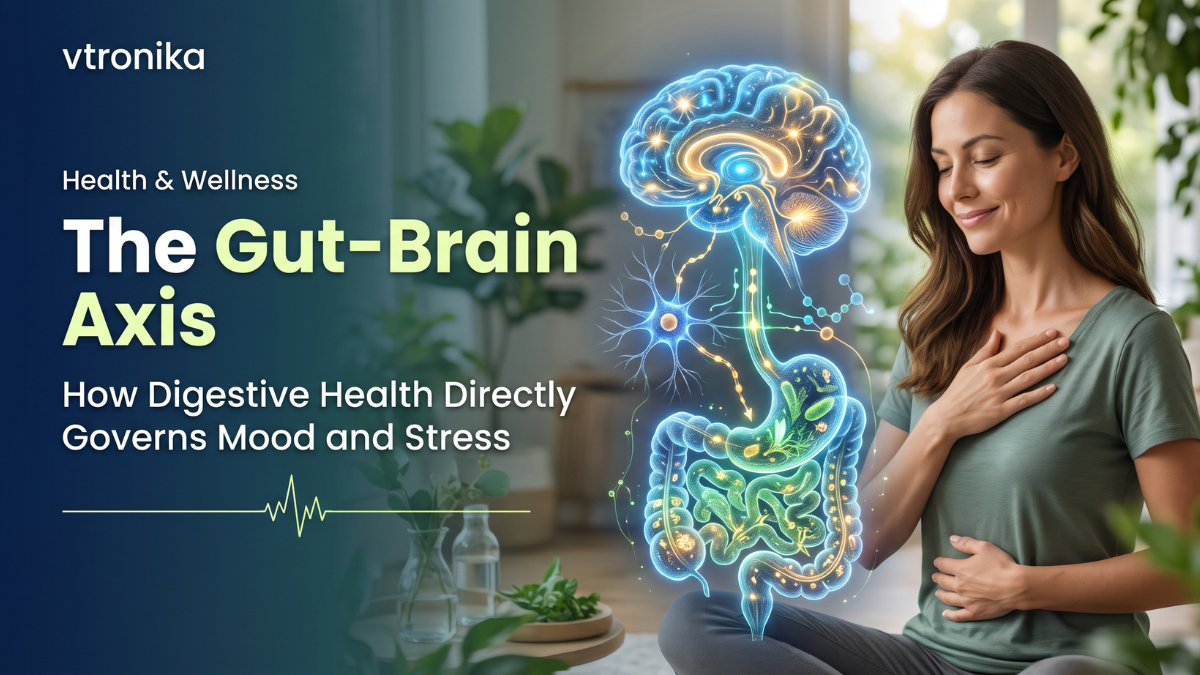
The foods you eat directly shape your neurochemistry. The enteric nervous system (ENS), consisting of over 500 million neurons lining the gastrointestinal tract, communicates continuously with the central nervous system via the vagus nerve and circulating metabolites.
Over 90% of your body’s serotonin and roughly 50% of its dopamine are synthesized in the digestive tract, mediated by diverse bacterial colonies:
| Nutrient Class | Whole-Food Source | Neurochemical / Physiological Mechanism |
| Prebiotic Soluble Fiber | Rolled oats, cooked and cooled potatoes, leeks | Fermented into butyrate, which repairs the blood-brain barrier and lowers neuroinflammation |
| EPA/DHA Omega-3s | Wild salmon, sardines, mackerel, chia seeds | Fluidizes neuronal membranes, facilitating smooth neurotransmitter receptor signaling |
| Polyphenols | Blueberries, 85%+ dark chocolate, green tea | Feeds beneficial Akkermansia microbes and protects brain tissue from oxidative stress |
| Magnesium & Zinc | Pumpkin seeds, raw almonds, spinach | Functions as essential enzymatic cofactors for GABA synthesis and NMDA receptor balance |
Eliminating ultra-processed foods rich in refined seed oils and industrial emulsifiers stops the erosion of the gut’s mucosal barrier, preventing bacterial toxins from leaking into systemic circulation and triggering chronic low-grade anxiety.
Article 5: Circadian Medicine – Harnessing Light, Sleep, and Cellular Clocks
Every cell in your body contains an internal biological clock governed by clock genes. These peripheral clocks are synchronized by the suprachiasmatic nucleus (SCN) in the hypothalamus, which takes its primary timing cues from environmental light exposure. Modern indoor living disrupts these natural cycles, leaving us under-illuminated by day and over-illuminated by night.
[07:00 AM] Sunlight Exposure  ──> Melatonin Suppressed ──> Cortisol Peak / Alertness
[02:00 PM] Natural Daylight    ──> SCN Synchronization  ──> Sustained Cognitive Focus
[09:00 PM] Screen / Blue Light ──> Melatonin Blocked    ──> Delayed Sleep Phase & Light Rest
To restore optimal circadian rhythms:
- The Morning Photon Anchor: Step outside within 30 minutes of waking and view natural sunlight for 10 to 15 minutes. This triggers an early cortisol pulse that clears morning grogginess and sets an internal timer for evening melatonin production.
- The Evening Photonic Curfew: Dim overhead lights 90 minutes before bed, switching to low-placed, warm amber or red spectrum lighting. This prevents blue and green wavelengths from tricking your brain into thinking it is midday.
- Consistent Meal Windows: Eating late at night forces your liver and pancreas to stay metabolically active when they should be resting. Closing the kitchen 3 hours before sleep allows the core body temperature to drop, deepening slow-wave restorative sleep.
Article 6: Cognitive Reframing – Disrupting Rumination and Cognitive Distortions
Mental suffering often stems less from external events and more from the unexamined narratives the mind builds around them. The human brain is naturally biased toward negativity, an evolutionary adaptation that prioritized spotting physical threats over enjoying peaceful moments.
In modern life, this bias frequently manifests as cognitive distortions that fuel chronic stress:
- All-or-Nothing Thinking: Framing minor mistakes as complete failures.
- Reframing: “This specific deliverable fell short, but it gives me clear data on what to adjust for the next iteration.”
- Emotional Reasoning: Assuming that feeling anxious proves an immediate catastrophe is coming.
- Reframing: “My nervous system is activated right now, but a feeling is a biological state, not an objective forecast.”
- Personalization: Taking responsibility for external outcomes entirely outside your control.
- Reframing: “I am accountable for the quality of my inputs, not for other people’s emotional reactions or market conditions.”
Practicing cognitive defusion—noticing thoughts as transient mental events rather than absolute truths—creates the psychological space you need to choose an intentional response over an emotional reaction.
Article 7: Functional Movement – Physical Activity as Preventative Medicine
For decades, exercise was framed primarily as a tool for aesthetic transformation or caloric expenditure. Modern exercise physiology reveals that movement is fundamentally a neurological and metabolic intervention. When skeletal muscles contract, they act as an endocrine organ, secreting signaling proteins called myokines into the bloodstream.
Myokines, such as interleukin-6 (acting in an anti-inflammatory capacity during exercise) and irisin, travel across the blood-brain barrier to stimulate Brain-Derived Neurotrophic Factor (BDNF). BDNF acts like fertilizer for the brain, promoting neuroplasticity, strengthening synaptic connections, and shielding the hippocampus against stress-induced atrophy.
A balanced weekly movement routine:
- Zone 2 Cardiovascular Base (150 mins/week): Steady-state exercise (jogging, brisk incline walking, cycling) performed at a conversational pace. This builds mitochondrial density, optimizes fat oxidation, and lowers resting cardiovascular strain.
- Resistance Training (2–3 sessions/week): Compound functional movements (squats, deadlifts, presses, rows) that preserve lean muscle mass, protect bone mineral density, and enhance insulin sensitivity.
- Daily Incidental Movement: Walking 8,000 to 10,000 steps throughout the day to stimulate venous blood return and prevent the postural stiffness that comes from prolonged sitting.
Article 8: Social Buffering – Relational Health and Emotional Safety
Human beings are neurobiologically wired for connection. In evolutionary psychology, separation from the tribe signaled imminent physical danger, which is why social isolation triggers the same biological alarm systems as physical threats.
The landmark Harvard Study of Adult Development, spanning over eight decades, identified a clear pattern: the strength and quality of your relationships is the single most powerful predictor of lifelong health, cognitive sharpness, and happiness, outranking cholesterol levels, wealth, and genetics.
[Authentic Social Connection]  ──> Oxytocin & Endorphin Release ──> Amygdala Dampening
[Chronic Social Isolation]    ──> Elevated Systemic Cytokines  ──> Accelerated Aging
- The Biology of Social Buffering: Sharing an emotional burden with a trusted peer releases oxytocin, which suppresses amygdala hyperactivity, lowers blood pressure, and reduces cortisol output.
- Relational Hygiene: Protecting your emotional health requires managing relationships intentionally. Distance yourself from chronic cynicism and drama, and invest energy in relationships built on mutual support, shared values, and vulnerability.
- Firm, Compassionate Boundaries: Healthy relationships require clear boundaries. Saying “no” to unreasonable demands protects your physical and mental bandwidth, preventing the resentment that slowly poisons valuable partnerships.
Article 9: Cultivating Contentment – Gratitude, Purpose, and Overcoming Comparison
Modern culture runs on manufactured dissatisfaction. Consumer economies and social media feeds thrive by convincing you that your current life, appearance, and achievements are inadequate, locking you into an endless hedonic treadmill where every milestone is immediately overshadowed by the next ambition.
Breaking this cycle requires intentionally cultivating contentment:
- Targeted, Specific Gratitude: Generic affirmations like “I am grateful for my life” fail to stimulate deeper neural pathways. Instead, practice targeted gratitude: name a specific individual, recall an exact moment of support, and reflect on the concrete effort they made. This targeted reflection activates the medial prefrontal cortex, reinforcing feelings of security and connection.
- Shifting from Status to Meaning: Chasing external markers of status (wealth, job titles, public praise) provides fleeting dopamine spikes followed by swift crashes. True contentment comes from intrinsic goals: mastering a craft, serving your community, caring for family, and living in alignment with your personal values.
- Deliberate Digital Fasting: Social comparison algorithms are designed to expose you to the top 1% of global outcomes 24/7. Stepping away from algorithmic feeds for 24 to 48 hours resets your reference points and restores appreciation for your everyday life.
Article 10: Building an Anti-Fragile Life – Daily Integration and Self-Compassion
A common pitfall in personal wellness is perfectionism. People often adopt rigid wellness regimens—strict diets, two-hour gym routines, uncompromising meditation schedules—only to abandon everything the moment an unexpected work crisis or personal emergency disrupts their plan.
A truly sustainable wellness journey must be anti-fragile: it should bend without breaking when life gets complicated.
[Rigid Perfectionism]      ──> Disrupted by Crisis ──> Total Collapse & Guilt
[Anti-Fragile Framework]  ──> Dynamic Scaling   ──> Baseline Protected, Continuity Kept
Implementing a minimum viable routine (MVR):
- The “Floor and Ceiling” System: Establish high-energy targets (your “ceiling”—e.g., a 60-minute gym workout followed by 20 minutes of reading) alongside non-negotiable baselines (your “floor”—e.g., a 10-minute bodyweight routine and 5 minutes of focused breathing). When emergencies strike, fall back to your floor rather than dropping the habit entirely.
- Self-Compassion as an Operating System: Treat setbacks as neutral data rather than moral failures. If you miss a workout, eat poorly, or lose your temper, avoid self-criticism. Analyze what triggered the lapse, adjust your environment, and re-engage with your next choice.
- The 24-Hour Reset Rule: Never allow an off-track day to turn into an off-track week. Reclaim your momentum with a single positive action: a 15-minute morning walk, a nutrient-dense lunch, or turning the lights off 30 minutes earlier.