1. The Historical Origin: The 1789 French Assembly Seating Plan
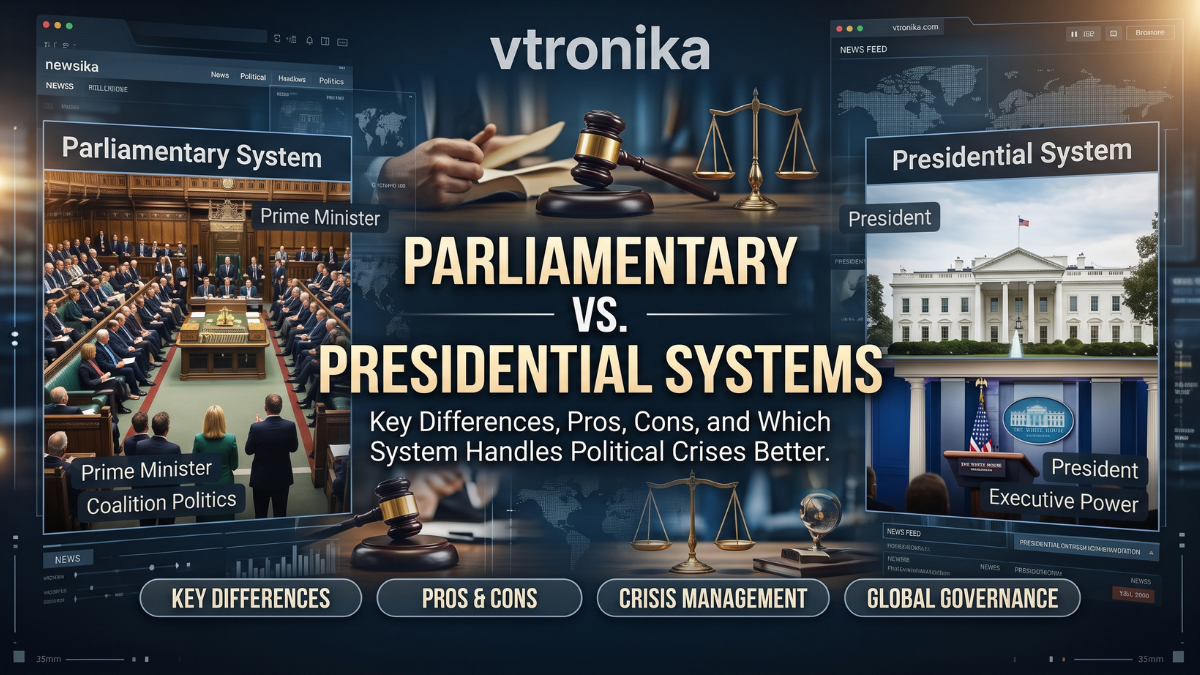
The terms Left-Wing and Right-Wing trace directly to a physical seating arrangement in the French National Assembly during the revolution of 1789. When drafting a new constitution, delegates divided geographically around the assembly president:
- To the Right: Supporters of King Louis XVI, the Catholic clergy, and the aristocratic order gathered together. They favored preserving inherited hierarchy, religious authority, and monarchical prerogatives.
- To the Left: Reformers, anti-clerical revolutionaries, and radical republicans congregated. They demanded the abolition of feudal titles, universal male suffrage, and institutional equality under the law.
This historical seating map created an enduring political shorthand: the Right became associated with tradition, institutional continuity, and hierarchy, while the Left became synonymous with systemic change, civil liberties, and collective equality.
2. Core Economic Philosophies: Redistribution vs. Free Markets
The sharpest ideological contrast between Left and Right lies in how each envisions wealth creation, economic ownership, and market regulation.
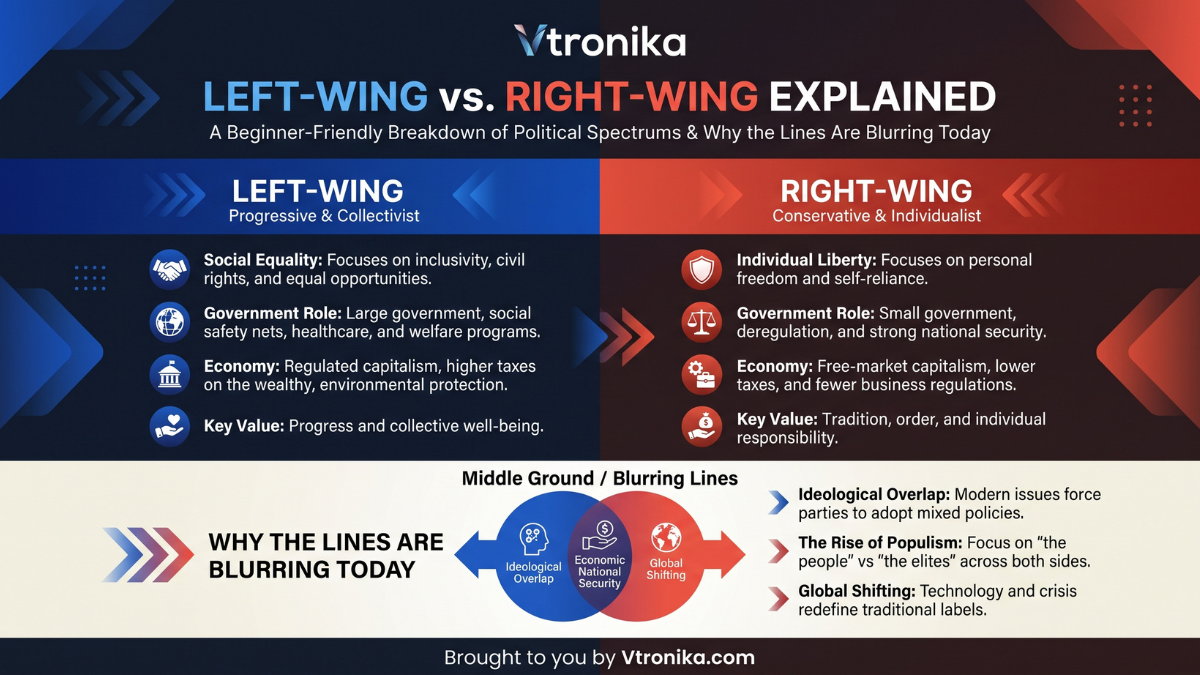
| Attribute | Left-Wing Economics | Right-Wing Economics |
| Primary Goal | Minimizing inequality and eliminating poverty. | Maximizing economic output, enterprise, and personal wealth. |
| View of the Market | Prone to monopolies, wealth hoarding, and worker exploitation if unregulated. | Efficient, dynamic engine of innovation governed by supply and demand. |
| Role of the State | Active intervention via public utilities, progressive taxes, and labor laws. | Limited intervention, deregulation, low corporate taxes, and privatization. |
| Safety Net | Universal healthcare, state pensions, subsidized higher education, and jobless benefits. | Targeted safety nets emphasizing personal responsibility and private charity over entitlement programs. |
Left-leaning economic policy asserts that without state intervention, capital concentrates at the top. Conversely, right-leaning economics argues that heavy taxation and red tape stifle entrepreneurship and drag down economic growth.
3. Social and Cultural Values: Progressivism vs. Traditionalism
Beyond balance sheets and tax codes, the spectrum defines how societies should organize moral, cultural, and community life.
The cultural Left embraces progressivism, social justice, and pluralism. It views inherited societal norms through a critical lens, arguing that traditional frameworks have historically marginalized minority groups, women, and unconventional identities. Consequently, left-wing social policy champions expanded civil rights, secular public institutions, multiculturalism, and bodily autonomy.
The cultural Right champions social conservatism, cultural preservation, and institutional stability. It treats longstanding institutions—such as traditional family structures, religious heritage, patriotic civic identity, and localized community customs—as essential anchors against moral decay and social fragmentation. Right-leaning social philosophy maintains that rapid cultural upheaval damages societal cohesion and weakens the moral baseline necessary for a stable civilization.
4. The Role and Scope of the State: Collective Welfare vs. Individual Liberty
At the heart of political philosophy sits a fundamental question: What is the government for, and how much authority should it wield?
- The Left’s Conception of Freedom (“Positive Liberty”): Proponents argue that an individual cannot be truly free if they are crushed by medical debt, trapped in wage poverty, or lacking basic education. Freedom requires the state to actively guarantee material security so people can realize their potential. State authority is thus seen as a collective tool for liberation.
- The Right’s Conception of Freedom (“Negative Liberty”): Proponents define freedom primarily as the absence of external coercion. Freedom means being left alone by government regulators, tax collectors, and state mandates. From this perspective, an expanding state apparatus invariably encroaches on private property and individual choice, making limited government the prerequisite for genuine human freedom.
5. Beyond the 1D Line: Mapping Politics on the 2D Political Compass
Reducing political belief to a single linear axis forces wildly divergent philosophies into the same bucket. A two-dimensional Political Compass resolves this by separating economic distribution from civic authority.
The vertical axis tracks social governance:
- Authoritarian Left: Believes in state-controlled or planned economies paired with strict social enforcement and centralized command (e.g., traditional state-socialist models).
- Libertarian Left: Combines cooperative, decentralized economics with complete personal, expressive, and social autonomy (e.g., democratic socialists, anarcho-syndicalists).
- Authoritarian Right: Combines capitalist market structures with rigorous state enforcement of social order, border control, and national hierarchy.
- Libertarian Right: Advocates for radical free-market capitalism paired with near-total individual autonomy and the near-complete elimination of state regulation (e.g., classical liberals, anarcho-capitalists).
6. The Rise of Working-Class Right-Wing Populism
For over a century, the industrial working class formed the bedrock of left-wing parties and labor unions. Over the past two decades, this demographic alignment has largely flipped across North America, Europe, and Latin America.
As mainstream center-left parties pivoted toward educated urban professionals, tech hubs, and cosmopolitan cultural causes, industrial workers in manufacturing and resource extraction felt abandoned. Right-wing populist leaders seized this vacuum by championing economic protectionism, industrial tariffs, domestic energy production, and tighter border controls—policies once championed by traditional labor unions. This realignment has produced a political landscape where conservative parties often secure victories in former industrial union heartlands.
7. The Neoliberal Consensus: When Mainstream Parties Converged
The blurring of political lines began in earnest during the 1990s with the rise of the “Third Way” movement, led by figures such as Bill Clinton in the United States and Tony Blair in the United Kingdom.
Center-left parties largely conceded the economic debate to center-right free-market principles. They embraced financial deregulation, free-trade globalization, privatization of state assets, and public-private partnerships, while retaining a commitment to socially progressive causes. This convergence produced a technocratic consensus where both mainstream parties managed the global capitalist economy in similar ways, differing primarily on cultural issues. For millions of voters, the distinction between mainstream Left and mainstream Right felt increasingly procedural rather than substantive.
8. “Woke Capitalism” and the Corporate-Left Realignment
Historically, the political Left viewed multinational corporations with skepticism, while the Right defended corporate power and deregulation. Today, cultural battles have scrambled this dynamic:
- Corporate Progressive Branding: Global brands frequently champion Diversity, Equity, and Inclusion (DEI) initiatives, environmental sustainability (ESG) criteria, and progressive social causes in their marketing campaigns.
- The Right’s Anti-Corporate Turn: In response, modern conservatives often attack corporate executives, accusing them of pushing cultural agendas at the expense of local communities and traditional values. Some conservative lawmakers have even deployed state regulatory power or revoked tax exemptions against outspoken corporations.
- The Left’s Dilemma: Progressive activists remain suspicious of “performative activism” from Fortune 500 companies, yet find themselves periodically allied with corporate legal teams challenging restrictive social legislation.
9. Technocracy vs. Populism: The New Vertical Axis
The traditional Left-Right contest is increasingly eclipsed by a vertical divide: The Establishment (Technocracy) versus The Anti-Establishment (Populism).
            Technocracy / Global Institutions
            (Expert-led, Globalist, Multilateral)
                         ▲
                         │
        Left-Wing ◄──────┼──────► Right-Wing
                         │
                         ▼
             Populism / Local Sovereignty
          (Worker-led, Nationalist, Skeptical)
The technocratic pole emphasizes reliance on unelected scientific advisory panels, central banks, multilateral bodies (like the WHO, WTO, and IMF), and judicial consensus. Conversely, the populist pole—present on both the radical Left and the nationalist Right—views these elite institutions as self-serving cartels that subvert popular sovereignty. Today, a populist leftist and a populist conservative often share more distrust of intelligence agencies and global corporate mergers than they share with establishment moderates inside their own formal parties.
10. Emerging 21st-Century Battlegrounds: AI, Surveillance, and Biosecurity
The defining political debates of the coming decades do not map neatly onto 18th-century French parliamentary seating plans. Novel, rapid technological developments are creating strange political bedfellows:
- Digital Privacy and State Surveillance: Civil-libertarian leftists and constitutional conservatives frequently unite against warrantless state data collection, facial recognition rollouts, and central bank digital currencies (CBDCs).
- Artificial Intelligence Governance: Technocratic centrists push for international regulatory regimes, while technological accelerationists on both the libertarian Right and open-source Left demand decentralized model development free from state monopolization.
- Public Health and Biosecurity Mandates: Debates over pandemic lockdowns, vaccine mandates, and emergency powers cut across old party platforms, pitting advocates of centralized epidemiological management directly against decentralized proponents of bodily autonomy and personal liberty.