1. The Hourly Billing Trap: Why Trading Time for Money Caps Creative Growth
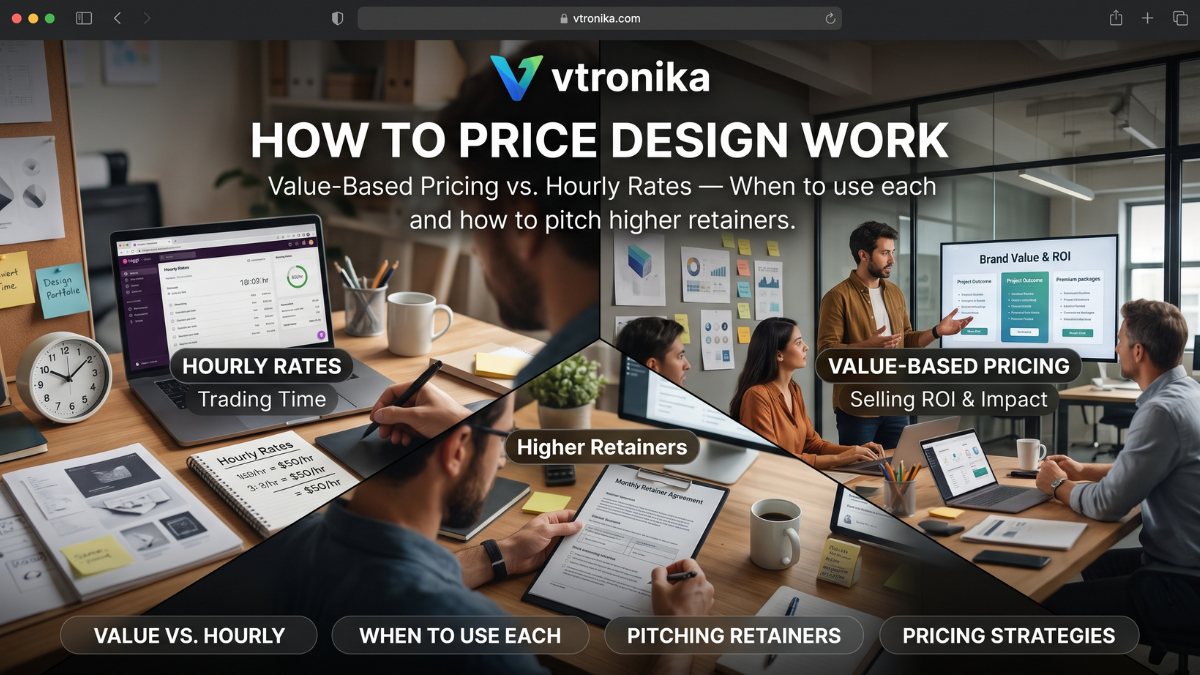
Hourly billing is the default entry point for most freelance designers, yet it harbors a structural flaw: it penalizes efficiency, mastery, and technological leverage.
When billing by the hour, an inexperienced designer who takes 40 hours to build a substandard brand guideline earns four times more than an expert who executes a refined, commercially viable system in 10 hours. As a designer’s pattern recognition sharpens, design libraries mature, and execution speed accelerates, billable hours decrease. Raising hourly rates provides only short-term relief; clients inevitably hit psychological ceilings where an individual’s rate appears excessive relative to standard wage benchmarks.
[Hourly Model]      Speed & Efficiency Increase  ──►  Fewer Billable Hours  ──►  Reduced Revenue
[Value-Based Model] Speed & Efficiency Increase  ──►  Faster Delivery       ──►  Higher Profit Margins
Beyond income limitations, hourly billing turns client reviews into adversarial time audits. Instead of evaluating whether a visual identity positions their product effectively, clients review timesheets, question software rendering durations, and contest the necessity of iterative exploration.
2. Demystifying Value-Based Pricing: Monetizing Commercial Upside
Value-based pricing uncouples compensation from labor hours, anchoring project fees directly to the estimated financial, operational, or strategic value delivered to the client’s enterprise.
This framework operates on a foundational rule: Clients do not buy typography, color palettes, or vector paths; they invest in commercial outcomes.
- A retail direct-to-consumer (DTC) packaging overhaul is not evaluated by the hours spent inside Adobe Illustrator, but by its ability to increase retail shelf velocity and average order value (AOV).
- A software application redesign is valued by its impact on user churn reduction and free-to-paid conversion rates.
If an e-commerce redesign is projected to lift a company’s baseline sales by $400,000 annually, a $40,000 design fee represents a 10:1 return on investment (ROI). Under this model, the designer operates as an equity-producing strategic partner rather than a transactional production vendor.
3. Comparative Framework: Hourly vs. Value-Based Pricing
Neither model is universally applicable across every design engagement. Choosing the correct pricing mechanism depends on project ambiguity, client revenue scale, and measurable impact.
| Evaluation Metric | Hourly Billing Model | Value-Based Pricing Model |
| Primary Metric | Input time, execution duration, and technical labor. | Business outcomes, revenue expansion, and risk mitigation. |
| Best Client Type | Early-stage pre-revenue startups, internal production overflow, agencies. | Established enterprises, capitalized brands, funded ventures. |
| Scope Definition | Open-ended, volatile, ill-defined, or continuously moving. | Clearly demarcated, milestone-oriented, and goal-driven. |
| Revenue Ceiling | Strictly capped by calendar hours ($24\text{ hrs/day} \times \text{rate}$). | Variable; scales with the economic size and upside of the client. |
| Client Scrutiny | High friction around timesheets, task breakdowns, and speed. | Minimal scrutiny on hours; intense focus on strategic milestones. |
| Designer’s Risk | Very low; every recorded minute of labor is compensated. | Moderate to high; relies on accurate scoping and outcome delivery. |
4. The Value Discovery Call: How to Uncover the Real Numbers
Value-based pricing cannot occur without an initial discovery conversation that extracts the prospective client’s core business metrics and underlying commercial pain points. Designers must shift their line of questioning from aesthetic preferences to financial realities:
- Identify the Cost of Inaction: “If this brand redesign or UI overhaul is delayed by six to nine months, what does that cost the business in lost market share, customer churn, or recruitment friction?”
- Quantify the Growth Target: “What specific revenue, fundraising, or conversion milestone needs to be unlocked for this project to be viewed by your executive team as an unquestioned success?”
- Calculate Customer Lifetime Value (LTV): “What is the gross margin and lifetime value of a single newly acquired customer?”
When a founder confirms that their average customer LTV is $5,000 and the current onboarding flow loses 30% of prospects, increasing onboarding conversions by a fraction of that leakage translates into hundreds of thousands of dollars in annual revenue. That explicit financial admission establishes the anchor against which your project proposal is priced.
5. Structuring Value-Based Proposals: The 3-Tier Option Strategy
Presenting a single, take-it-or-leave-it price creates a binary decision: “Should we hire this designer or not?” Offering a Three-Tier Option Proposal shifts the client’s internal deliberation to: “Which tier best fits our strategic objectives?”
Option 1: Core Foundation (Anchored to immediate operational need)
- Baseline visual identity, core responsive components, essential brand asset library.
- Solves the primary immediate bottleneck.

Option 2: Comprehensive Strategic System (Target tier for most clients)
- Everything in Option 1 + end-to-end design system, launch marketing collateral, packaging dielines, and team design tokens.
- Accelerates time-to-market and streamlines vendor handoffs.

Option 3: Enterprise Acceleration & Market Dominance (Premium anchor)
- Everything in Option 2 + on-site executive workshop, interactive prototyping, conversion-rate optimization testing, and 60 days of dedicated launch oversight.
- Eliminates execution risk and scales operational speed.
The third tier serves as an anchor. Even if the client bypasses Option 3, its presence frames Option 2 as a balanced, high-value investment.
6. The Psychological Hurdle: Quoting Five- and Six-Figure Design Fees
Transitioning from charging $500 for a logo to $25,000 or $50,000 for an identity system is primarily a psychological and positioning challenge rather than an artistic one.
When quoting high fees, design professionals observe four foundational rules:
- Never Give Instant Verbal Estimates: Deflect pricing questions on introductory calls. State clearly: “Because our engagements are tailored around commercial targets rather than pre-packaged templates, I cannot responsibly quote a figure until I analyze your technical scope and business goals.”
- Present Proposals Live: Never email a static PDF proposal into a corporate vacuum where it can be skimmed straight to the final invoice page. Present proposals via live video walk-through, reading the client’s stated business challenges back to them before revealing the price options.
- Say the Number and Stop Talking: State the investment tier clearly and maintain silence. Beginners often rush to offer preemptive discounts or justify line items out of nervous discomfort. Let the client process the proposal and respond first.
- Anchor Against Traditional Alternatives: Remind clients that hiring an established branding agency often starts at $150,000 with significant bureaucratic overhead, while hiring a full-time senior design lead involves benefits, payroll taxes, equipment, and recruiting costs.
7. The Freelance Trap: Escaping the Feast-or-Famine Cycle with Retainers
One-off project billing forces designers into a perpetual cycle of feast or famine: intense sprints of client work followed by unpaid weeks of cold outreach, portfolio updates, and business development.
Traditional Freelance Cycle:
[Prospecting] ──► [Closed Deal] ──► [Overworked Delivery] ──► [Zero Revenue] ──► [Panic Prospecting]

Retainer-Based Stability:
[Predictable Monthly ARR] ──► [Focus on Client ROI] ──► [Long-Term Strategic Impact & Retention]
A retainer is an ongoing, subscription-based agreement where a client pays an agreed recurring fee at the beginning of each billing cycle to secure dedicated capacity, strategic direction, and regular design execution. Retainers transform variable project income into predictable monthly recurring revenue (MRR), stabilize cash flow, and allow designers to focus on deep, iterative improvements rather than constant client acquisition.
8. Structuring High-Value Retainers: Capacity and Outcomes Over Bundled Hours
A common mistake when setting up retainers is selling them as discounted packages of billable hours (e.g., “20 hours a month for $2,000”).
Hourly retainers cause structural friction:
- Clients track minutes, demand rollover hours for unused allocations, and question efficiency.
- Unused hours turn into operational liabilities that complicate scheduling.
Instead, structure retainers around Strategic Deliverables and Guaranteed Capacity:
- Guaranteed Turnaround Windows: Standardize delivery times, such as a guaranteed 48-hour sprint review for marketing assets or campaign collateral.
- Defined Execution Pipelines: Establish a “one-active-request-at-a-time” pipeline. The client maintains an active queue in a shared management tool (such as Notion or Linear); as one initiative is finalized, the next moves into production without renegotiating contracts.
- Strategic Advisory Access: Include a bi-weekly or monthly visual strategy call to review conversion performance, critique marketing asset performance, and align on upcoming product launches.
9. The Retainer Pitch: How to Transition Project Clients into Recurring Revenue
The ideal moment to secure a monthly retainer is not before a project begins, but immediately following the successful delivery of a major project, when trust and satisfaction are highest.
Follow this 4-step transition workflow:
- Conduct a Formal Post-Launch Review: Walk the client through the finalized deliverables, highlighting completed milestones, project wins, and technical assets ready for deployment.
- Highlight the “Maintenance Gap”: Explicitly outline the operational risks ahead: “Now that the new visual identity and design system are live, the primary risk is fragmented execution across social channels, pitch decks, and digital ads by disparate teams.”
- Present the Retainer as Brand Governance: Position your continued involvement as insurance: “To prevent brand erosion, keep assets cohesive, and give your internal marketing team priority design execution every month without hiring a full-time in-house lead, we can establish a recurring monthly advisory and production partnership.”
- Offer a Low-Friction Pilot: Suggest an initial 3-month commitment: “Let’s run a 90-day pilot at $5,000 per month. At the end of the 90 days, we’ll review the output, verify the workflow, and adjust the engagement as needed.”
10. Long-Term Client Retention: Measuring, Reporting, and Expanding Retainers
Retainers are not passive subscription fees; they require proactive value demonstration to prevent client churn. If a client goes three consecutive weeks without receiving clear communication, the retainer will be viewed as an expendable line-item expense during the next internal budget review.
- Issue Monthly Executive Summaries: Send an executive summary highlighting completed deliverables, ongoing design sprint statuses, and the commercial impact achieved (e.g., ad variants shipped, packaging files approved, design tickets resolved).
- Maintain an Iterative Optimization Backlog: Never wait for the client to generate tasks. Audit their live touchpoints, identify outdated sales decks, find inconsistent social assets, or flag friction points in their checkout flow, and propose solutions directly into the queue.
- Annual Scope Adjustments: As the client’s team expands and production volume scales, review the agreement. Shift the conversation from maintenance toward enterprise-level design systems, conversion optimization sprints, and dedicated junior designer oversight, steadily moving the retainer from a mid-tier monthly contract to a central operating partnership.