Article 1: The 20-Year Nostalgia Pendulum — The Biological Cadence of Revivals
Fashion history moves in predictable generational waves, famously recognized in cultural sociology as the “20-Year Rule.” A silhouette rarely transitions directly from modern to retro; it travels through distinct phases of ubiquity, saturation, visual fatigue, ridicule, and eventual nostalgia. Approximately twenty years after a trend subsides, a cultural threshold is crossed: the generation that was too young to participate in the original movement rediscovers it as an authentic discovery, while senior designers entering creative leadership positions draw emotional comfort from the visual markers of their youth.
This biological and psychological cycle explains why late-1990s and early-2000s low-rise waistlines, metallic fabrics, and cargo pockets returned with force during the 2020s, mirroring how the 1970s heavily inspired late-1990s collections. The 20-year pendulum provides the fashion industry with a predictable emotional rhythm, offering familiarity wrapped in the illusion of novelty.
- The Fatigue-to-Craving Pipeline: It takes two decades for the collective visual memory to reset, transforming outdated aesthetics back into desirable archives.
- Creative Director Priming: Designers in their late 30s and 40s instinctively pull from childhood subcultures when building runway collections.
- The Purity of Secondhand Discovery: Emerging youth embrace past decades without the emotional fatigue or contextual baggage carried by those who lived through them originally.
Article 2: The Hemline Index & Economic Anxiety — Reading Market Psychology on the Catwalk
Formulated in the 1920s by economist George Taylor, the “Hemline Theory” proposed that skirt hemlines rise during economic expansions and drop during financial crises. While modern macroeconomic relationships are more nuanced, the psychological premise remains valid: fashion acts as a sensitive barometer for consumer optimism, financial stability, and societal anxiety.
In times of economic contraction, inflation, or geopolitical stress, runways pivot toward functional pragmatism. Designers lean heavily into utilitarian workwear, trench coats, heavy wools, and muted neutrals—a movement recently termed “Quiet Luxury.” These styles project fiscal prudence, security, and permanence. Conversely, postwar and post-recession eras reliably trigger explosive celebrations of volume, bright pigments, and exposed skin, demonstrating how financial buoyancy fuels expressive sartorial risk.
- Recessionary Utilitarianism: Economic downturns trigger surges in durable tailoring, muted neutral color palettes, and archival investment pieces.
- Post-Crisis Hedonism: Economic recoveries unleash high-contrast color palettes, shorter hemlines, and celebratory evening wear.
- Sartorial Insulation: Heavy outerwear, layered textures, and high collars visually mirror society’s psychological desire for protection during uncertain times.
Article 3: Post-Crisis Hedonism — The Roaring Twenties vs. The 2020s Dopamine Rush
History documents that major global catastrophes—pandemics, wars, and systemic crises—are consistently followed by explosive counter-reactions on the runway. The 1920s flapper era was directly forged in the crucible of the 1918 influenza pandemic and World War I. After years of sensory deprivation, quarantine, and grief, society shed restrictive Victorian corsetry in favor of drop-waist dresses, fringed hemlines, jazz-era cosmetics, and sheer celebratory decadence.
A century later, the early 2020s experienced an identical psychological trajectory. Following extended lockdowns, isolation, and domestic loungewear fatigue, the fashion industry erupted into “dopamine dressing.” Runways were flooded with neon satins, micro-mini skirts, sheer mesh paneling, and high-shine sequins. The subconscious human impulse after collective trauma is to reaffirm life through visible self-expression and uninhibited theatricality.
- Sensory Rebound: Prolonged periods of confinement produce an appetite for high-saturation pigments, tactile textiles, and dynamic movement.
- Deconstruction of Restrictive Layers: Post-crisis generations discard confining daytime garments in favor of breathable, liberating silhouettes.
- Nightlife Resurgence: Evening wear, party dresses, and avant-garde makeup surge as celebratory nocturnal social gatherings return.
Article 4: The 1970s Counterculture & Bohocore — The Romantic Urge to Escape
The 1970s was an era defined by oil embargoes, environmental awareness, anti-war protests, and widespread disillusionment with institutional governance. Satorially, this friction birthed two major counter-movements: relaxed bohemian eclecticism (earth tones, flowing prairie dresses, flared denim, macrame) and rebellious punk (leather, hardware, distressing). Both represented a rejection of sterile corporate uniformity in favor of nature-aligned freedom.
Whenever society encounters modern environmental dread, urban burnout, or digital exhaustion, 1970s “boho-chic” resurfaces on the runway. Designers resurrect romantic peasant blouses, patchwork shearling, artisanal crochet, and wide-leg flares. This recurring aesthetic taps into the pastoral urge to escape technological surveillance and concrete jungles, offering wearers a visual connection to handcrafted, earth-centric living.
- Pastoral Escapism: Botanical patterns, fluid chiffons, and loose fringe mimic the freedom of pastoral retreats away from urban centers.
- Artisanal Craftsmanship: Hand-woven crochet and visible leather stitches stand in sharp contrast to mass-produced, machine-made commodities.
- Earthy Warmth: Olive greens, mustard yellows, and rustic terracottas provide visual comfort during periods of industrial stress.
Article 5: 1980s Power Dressing — Economic Ambition, Feminism, and Broad Shoulders
The 1980s was an era of intense corporate deregulation, Wall Street expansion, and the mass entry of women into executive boardrooms. To navigate male-dominated corporate hierarchies, women’s fashion adopted exaggerated structural silhouettes. Pioneered by designers like Giorgio Armani, the 1980s “power suit” featured padded, oversized shoulders, high-waisted pleated trousers, and sharp lapels designed to take up physical and psychological space.
The recurring resurgence of 1980s power tailoring coincides with key cultural discussions surrounding female leadership, corporate equity, and personal empowerment. Modern luxury runways regularly resurrect razor-sharp, boxy blazers and strong-shouldered coats. Reinterpreting the power suit allows wearers to communicate authority, assert personal space, and present a formidable visual shield in professional settings.
- Shoulder Width and Dominance: Broad shoulder pads widen the upper torso, establishing an authoritative presence in crowded professional rooms.
- The Corporate Uniform Subverted: Transforming masculine suiting fabrics (pinstripes, heavy worsted wools) into sharp statements of modern femininity.
- Architectural Defensiveness: Sharp angles and structured chest plates protect the wearer’s vulnerability, commanding immediate professional respect.
Article 6: 1990s Minimalism — The Anti-Excess Aesthetic Reset
By the late 1980s, the fashion world had become saturated with bright neon prints, towering hair, excessive padding, and flashy logo branding. In reaction to this sensory overload, the 1990s introduced a deliberate aesthetic palate cleanser: severe minimalism. Championed by designers like Helmut Lang, Jil Sander, and Calvin Klein, this movement stripped fashion back to monochromatic palettes, spaghetti-strap slip dresses, architectural bias cuts, and raw denim.
Minimalism regularly returns to the runway whenever consumer culture hits peak saturation. In an era overrun by digital noise, social media micro-trends, and rapid fast-fashion churn, 1990s minimalism acts as a psychological refuge. Clean lines, quiet neutral tones, and unadorned silhouettes allow the wearer’s mental bandwidth to recover, celebrating the beauty of restraint over commercial excess.
- Sensory Decluttering: Neutral palettes (black, cream, slate, beige) strip away visual friction, calming an overstimulated mind.
- Form Follows Function: Emphasizing pure garment geometry, clean drape, and fabric quality over decorative surface embellishment.
- Anti-Status Subtlety: Communicating confidence through under-dressing, rejecting loud outward branding in favor of subtle luxury.
Article 7: Y2K Cyber-Futurism — Technophobia, Hope, and the Digital Horizon
The turn of the millennium was an era charged with both anxiety and technological optimism. As personal computers entered households and the internet emerged, fashion between 1998 and 2003 reflected a mixture of space-age dreams and Y2K computer crash fears. The result was an eclectic mix of futuristic metallics, iridescent nylon, micro sunglasses, low-slung cargo pants, and asymmetric hardware.
The revival of Y2K fashion among modern Gen Z consumers is one of the most visible digital phenomena of recent runway seasons. Beyond the eye-catching visual elements, this revival represents a yearning for the internet’s early era—a time when digital technology felt experimental, playful, and decentralized, rather than monopolized, algorithmic, and surveillance-heavy.
- Technological Optimism: Chrome finishes, silver foils, and technical plastics channel the playful, hopeful early days of digital culture.
- Playful Proportions: Exaggerated low-rise waistlines combined with compact micro-tops challenge formal proportions with youthful irreverence.
- Gamified Styling: Layering multiple casual garments (skirts over trousers, statement belts, keychains) mirrors the customizable nature of video game avatars.
Article 8: The Military Utility Loop — Wartime Innovation and Urban Preparedness
Many staples of the modern wardrobe—the trench coat, bomber jacket, cargo pant, field jacket, and combat boot—originated as functional military clothing. Engineered for extreme weather, physical survival, and durability, these pieces seamlessly integrated into civilian life following World War I and World War II, later adopted by subcultures from London mods to 1990s grunge musicians.
Runways regularly return to military and utilitarian aesthetics during periods of geopolitical conflict, climate disasters, and urban anxiety. Modern luxury brands incorporate ripstop nylon, multi-pocket modular vests, tactical webbing, and heavy tread lugs. Wearing utilitarian clothing satisfies a subconscious desire for readiness and physical capability, equipping individuals with a sense of psychological preparedness for modern urban life.
- Tactile Readiness: Modular storage pockets, carabiners, and weather-proof membranes offer tangible utility that reinforces personal self-reliance.
- Subcultural Reclamation: Subverting uniform military garments into symbols of anti-war dissent and countercultural expression.
- Durability Over Trendiness: Investing in heavy cotton twills and reinforced stitching that promise resilience against everyday wear and tear.
Article 9: The Compression of the Trend Loop — How Algorithms Broke the 10-Year Epoch
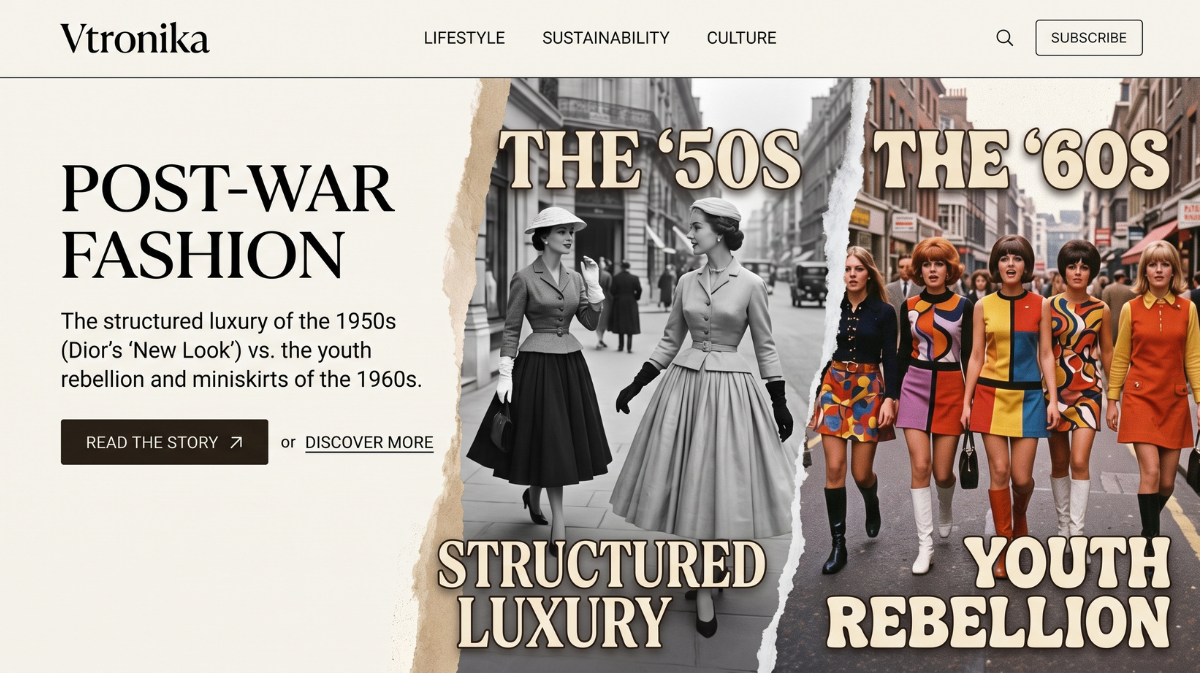
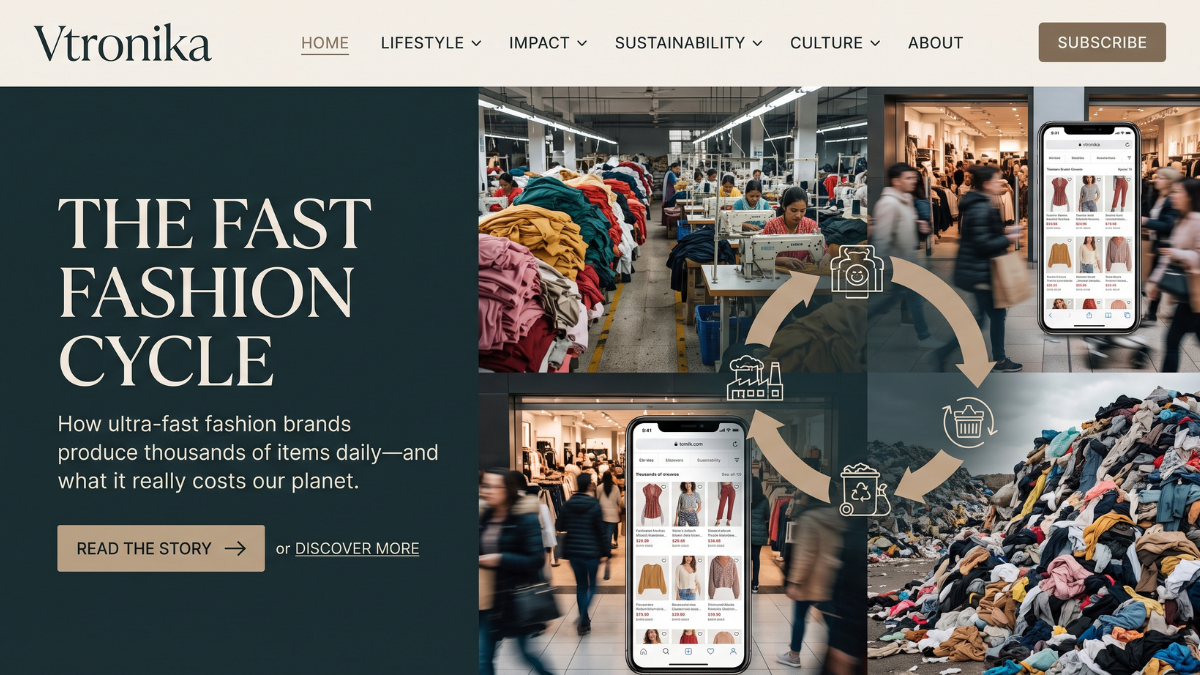
Historically, distinct fashion decades carried cohesive visual identities: the 1960s mod shift, the 1970s flare, the 1980s power silhouette, and the 1990s slip dress. The rise of social media algorithms, big data web-scraping, and ultra-fast fashion supply chains has fragmented this linear timeline. Today, trends no longer dominate an entire decade; they are consumed and discarded as fast-moving internet aesthetics within months.
This algorithmic compression forces disparate fashion eras to coexist simultaneously. A single runway season or digital feed might showcase 1920s drop waists, 1950s full skirts, and 2000s cargo trousers side-by-side. While this gives consumers broad stylistic freedom, it also risks aesthetic fatigue. The rapid churn strips historical subcultures of their context, reducing rich cultural movements into interchangeable digital novelties.
- The Micro-Aesthetic Machine: Algorithms repackage complex fashion movements into bite-sized internet tags (“Cottagecore,” “Indie Sleaze,” “Corpcore”) for quick turnover.
- Loss of Context: Detaching clothing silhouettes from the social rebellions, political contexts, and musical scenes that originally birthed them.
- Visual Overload: The continuous cycling of past eras creates consumer burnout, driving interest toward minimal, enduring wardrobe basics.
Article 10: Gender Fluidity and Historical Subversion — Reclaiming the Corset
Historical garments originally designed to enforce rigid gender codes or restrict physical mobility are often reclaimed on modern runways as vehicles of bodily autonomy. The corset is the clearest example of this evolution. Once a restrictive, boned undergarment designed to mold the female torso to patriarchal standards, the corset has been reinterpreted on modern runways into a confident, standalone statement piece.
Designers across modern luxury houses have freed corsetry from its oppressive past. Constructed with flexible synthetic boning, technical stretch fabrics, and outer zippers, contemporary corsets are styled over oversized shirts, paired with relaxed denim, or worn by all genders. This subversion transforms an artifact of historical confinement into a modern symbol of body positivity, sexual agency, and deliberate self-expression.
- Subverting the Undergarment: Bringing structural lingerie to the outside of everyday clothing breaks down traditional private/public boundaries.
- Deconstructing Structural Confinement: Replacing rigid historical steel boning with ergonomic, body-inclusive construction that prioritizes comfort.
- Sartorial Irony: Reclaiming historical symbols of control and transforming them into modern tools of personal empowerment.
Article 11: Archival Resale & Fashion Curation — Escaping the Disposable Present
The relentless pace of modern trend cycles has sparked a major movement among fashion collectors, stylists, and conscious consumers: archival fashion collecting. Rather than buying fresh seasonal collections, fashion enthusiasts are seeking out original runway pieces from pivotal eras, such as late-1990s Prada, mid-2000s Nicolas Ghesquière for Balenciaga, or early Margiela.
Archival fashion functions as an antidote to fast-fashion homogeneity. Wearing an original vintage piece connects the wearer to fashion’s cultural lineage, rewarding historical literacy and patient curation over impulsive spending. In an era where digital feeds make all clothing look similar, owning a rare, tangible artifact from a bygone decade is the ultimate expression of personal discernment.
- The Cult of Provenance: Valuing a garment’s specific runway season, design history, and original fabric over brand-new retail releases.
- Material Superiority: Older designer garments often feature superior hand-finished details, heavier natural textiles, and artisanal construction that outlasts modern mass manufacturing.
- Wardrobe as Gallery: Treating the personal closet as an evolving art collection that retains financial and emotional value over time.
Article 12: Reinterpretation vs. Pure Copying — The Future of Retro Runways
The central question in fashion history remains: is the runway simply repeating itself out of creative exhaustion, or is it engaged in a continuous, necessary dialogue with the past? While fast-fashion brands often rely on flat visual imitation, leading luxury ateliers practice reinterpretation. Designers deconstruct past silhouettes, filtering them through modern textile engineering, contemporary values, and modern cultural challenges.
When a historical design element returns to the modern runway, it carries new context. A Victorian silhouette reimagined in biodegradable mushroom leather, a 1940s zoot suit re-tailored for non-binary proportions, or a 1970s safari jacket spun from ocean-bound recycled plastics are not mere copies of the past. They represent fashion’s defining strength: its ability to honor where we have been while crafting an intentional visual language for where we are heading.
- Material Innovation: Updating historical cuts with modern sustainable fabrics, technical weatherproofing, and comfortable stretch fibers.
- Inclusive Proportions: Adapting vintage silhouettes to fit a broader spectrum of natural body shapes and gender identities.
- Cultural Dialogue: Using historical references to comment on modern politics, technology, and social issues through wearable design.