


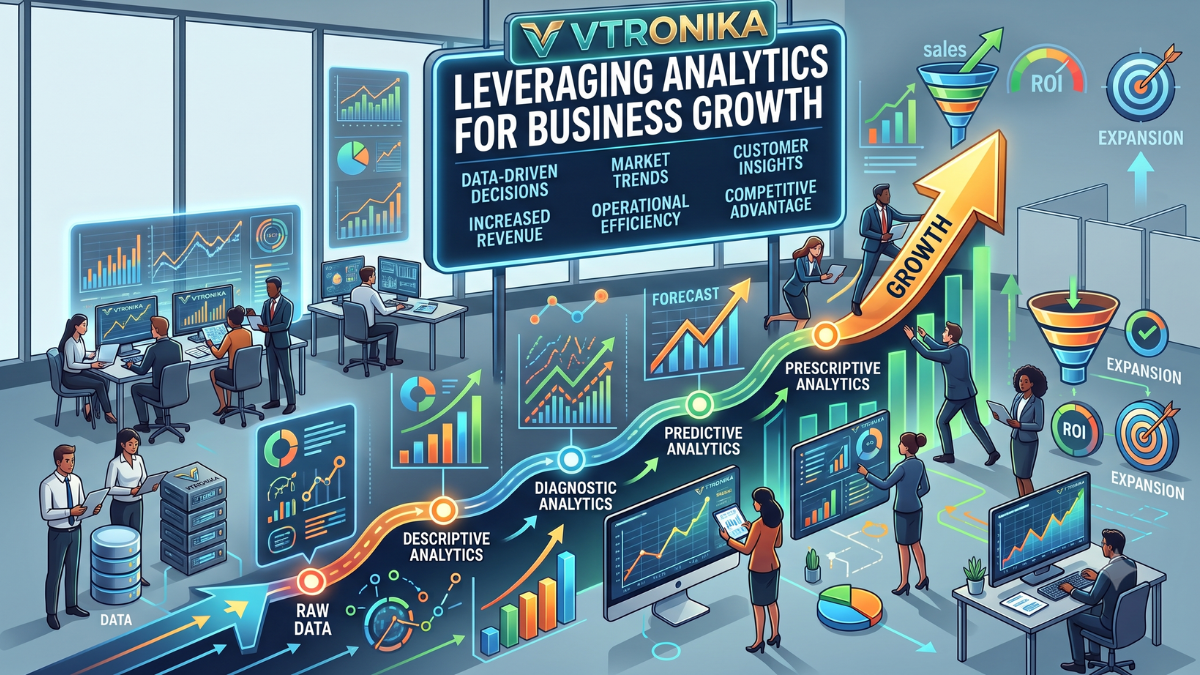
Article 1: The Modern Foundation of Business Scaling
Turning Raw Numbers into Strategic Power
In the contemporary corporate world, data is often compared to crude oil, meaning that it holds immense potential value, but it is entirely useless until it is refined through analytics. Leveraging data analytics involves taking the massive amounts of information generated by daily operations, website visits, and financial transactions, and converting them into clear, actionable roadmaps. For small startups and massive conglomerates alike, this process removes the dangerous element of guesswork from decision-making, allowing leaders to execute growth strategies based on empirical facts rather than volatile human intuition.
Furthermore, a data-driven business structure promotes a culture of continuous improvement, where every experiment, marketing campaign, or product feature is carefully measured. By analyzing performance metrics in real time, companies can immediately identify what is working, scale up successful projects, and quickly kill failing initiatives before they drain valuable capital. This level of agility is crucial in today’s fast-moving market, ensuring that a business remains resilient, highly responsive to industry disruptions, and consistently positioned for sustainable long-term expansion.
Article 2: Decoding the Consumer Mind
Customer Analytics and Personalized Experiences
The primary driver behind any successful business growth strategy is a deep, uninterrupted understanding of the target audience, which is exactly what customer analytics provides. By tracking digital footprints, social media engagements, and historical buying patterns, companies can build highly detailed customer profiles that reveal hidden preferences, frustration points, and emotional triggers. This allows businesses to move away from expensive, generalized marketing, allowing them to communicate with consumers through personalized offers and tailored messaging that resonate on an individual level.
When a company utilizes analytics to anticipate a customer’s needs, the overall consumer experience improves dramatically, leading to higher satisfaction scores and deeper brand loyalty. Retaining existing customers is significantly cheaper than acquiring new ones, meaning that data-driven customer loyalty directly maximizes profit margins. Ultimately, leveraging analytics to foster strong, personalized relationships creates a reliable, recurring revenue stream that fuels steady corporate growth year after year.
Article 3: Streamlining the Engine
Operational Efficiency Through Data Scrutiny
While outward growth and sales are vital, a business cannot scale successfully if its internal operations are plagued by waste, confusion, or structural bottlenecks. Operational analytics focuses inward, meticulously evaluating supply chain logistics, manufacturing pipelines, employee productivity, and administrative workflows to ensure maximum efficiency. By exposing hidden delays, duplicate processes, or underutilized resources, analytics empowers managers to restructure daily operations, turning a sluggish organization into a lean, high-performing machine.
For example, in inventory management, relying on historical averages can lead to devastating stockouts or expensive overstocking situations that lock up vital cash flow. By leveraging predictive inventory analytics, businesses can forecast demand with incredible geographic and seasonal accuracy, ensuring that the right products are always available at the perfect time. This optimization reduces overhead costs, frees up working capital, and creates a highly stable infrastructure capable of supporting rapid business expansion.
Article 4: Maximizing Marketing ROI
Precision Budget Allocation and Performance Tracking
Historically, marketing was an unpredictable gamble, famously summed up by the old saying that half of all advertising money is wasted, but nobody knows which half. Today, digital marketing analytics completely solves this dilemma by providing total transparency, allowing companies to track the exact journey of every dollar spent from the initial ad click to the final purchase. By analyzing conversion rates, cost-per-acquisition, and channel performance, marketing teams can stop bleeding money on low-performing ads and double down on highly lucrative platforms.
In addition to optimizing current campaigns, analytics enables sophisticated A/B testing, where multiple variations of an advertisement, landing page, or email subject line are compared simultaneously. This data-driven experimentation reveals precisely what visual imagery or copywriting moves the audience to action, maximizing the return on investment (ROI). Consequently, leveraging analytics allows businesses to grow aggressively without exponentially increasing their marketing budgets, ensuring highly cost-effective scaling.
Article 5: Financial Forecasting and Risk Mitigation
Predictive Analytics as a Corporate Crystal Ball
Long-term business growth requires careful financial planning, which becomes exceptionally difficult during times of economic instability, market inflation, or shifting regulatory landscapes. Financial analytics leverages historical data and predictive algorithms to simulate various economic scenarios, helping executives project future cash flows, revenue targets, and investment returns with high accuracy. This analytical foresight acts as a protective shield, allowing companies to identify potential financial vulnerabilities well before they turn into devastating crises.
Moreover, when a business decides to enter a new market, launch an innovative product, or acquire a competitor, analytics evaluates the associated risks with mathematical precision. By weighing the probability of success against potential financial downsides, decision-makers can confidently allocate capital to high-reward opportunities while avoiding catastrophic investments. In essence, leveraging predictive analytics replaces anxiety with calculating confidence, ensuring that corporate growth is backed by sound financial logic.
Article 6: The Evolution of Product Development
Creating Data-Backed Solutions for the Market
Launching a new product or service is naturally risky, yet continuous innovation is mandatory for any business that wishes to maintain its growth trajectory over a decade. Product analytics drastically reduces this inherent risk by analyzing how consumers interact with existing market solutions, highlighting feature gaps, usability complaints, and unmet desires. Instead of designing products in an isolated vacuum, design teams can utilize real-world user data to build features that the market is actively craving.
Once a product is launched, post-launch analytics tracks user adoption rates, feature engagement, and drop-off points in real time, providing immediate feedback for development cycles. This allows companies to release rapid software updates, refine physical manufacturing designs, or adjust service blueprints to continuously delight users. By leveraging data to guide product development, businesses ensure that their innovations are highly relevant, immediately competitive, and capable of capturing substantial market share.
Article 7: Human Resources and Talent Optimization
Workforce Analytics for Higher Corporate Productivity
A company’s ultimate growth potential is heavily limited by the quality, motivation, and alignment of its workforce, making human resource management a critical area for analytics integration. Workforce analytics examines employee performance metrics, recruitment channels, turnover rates, and workplace satisfaction surveys to optimize talent acquisition and retention. By identifying the traits of top-performing employees, hiring managers can refine their interview processes to select candidates who are mathematically more likely to succeed and stay long-term.
Furthermore, analytics can detect early signs of employee burnout, sudden drops in engagement, or structural friction within specific departments, allowing leadership to intervene before valuable talent resigns. Replacing skilled employees is incredibly expensive and disrupts operational momentum, which directly hinders corporate scaling. By leveraging people analytics to maintain a highly motivated, stable, and efficient workforce, businesses build a rock-solid human foundation capable of driving continuous organizational growth.
Article 8: Competitive Intelligence and Market Positioning
Outsmarting the Competition with External Data
Business growth does not happen in a vacuum; it requires constantly outmaneuvering aggressive competitors who are fighting for the exact same market share and customer attention. Competitive analytics involves systematically gathering and interpreting external data points, such as competitor pricing adjustments, social media sentiment, search engine rankings, and public financial disclosures. This continuous monitoring reveals the strengths and weaknesses of rival companies, giving observant businesses a massive strategic advantage.
For instance, if data analytics reveals that a major competitor is facing severe customer backlash due to a drop in product quality or a pricing hike, a nimble business can instantly launch a targeted counter-campaign to capture those disgruntled clients. Additionally, tracking macroeconomic data helps companies spot emerging industry trends, niche markets, or unserved geographical regions before anyone else. Leveraging analytics for competitive intelligence ensures that a business is never blindsided, allowing it to maintain an aggressive, market-dominant position.
Article 9: Revolutionizing Pricing Strategies
Dynamic Analytics for Maximum Revenue Optimization
Pricing is one of the most powerful, yet frequently neglected, levers for business growth, as even a small percentage increase in price can directly skyrocket net profits if implemented correctly. Pricing analytics utilizes complex algorithms to analyze consumer demand elasticity, competitor pricing shifts, seasonal cycles, and real-time inventory levels to determine the absolute optimal price point for a product. This moves companies away from rigid cost-plus pricing structures, transitioning them into highly profitable, dynamic monetization models.
In industries like e-commerce, travel, and ride-sharing, dynamic pricing analytics adjusts prices fluidly based on current supply and market urgency, maximizing revenue during peak hours while offering attractive discounts to clear slow inventory during off-peak times. Even for traditional B2B businesses, historical transaction analytics can reveal the maximum price a specific client profile is willing to pay without walking away. Leveraging pricing analytics ensures that a company never leaves money on the table, extracting maximum profitability to fund future growth.
Article 10: Building a Data-Driven Culture
The Ultimate Competitive Advantage for Modern Enterprises
Implementing expensive software tools is only half the battle; true, explosive business growth occurs when data analytics is embedded directly into the cultural DNA of the entire organization. A data-driven culture means that from front-line customer service agents to executive board members, every individual uses data to inform their daily tasks and larger responsibilities. This democratizes information, breaking down corporate silos and encouraging cross-departmental collaboration that accelerates innovation and problem-solving.
When an entire enterprise respects data, internal political arguments, ego-driven decisions, and executive biases are replaced by collaborative, objective analysis. Employees feel empowered because they can easily prove the value of their creative ideas through clear metrics and pilot tests, boosting morale and internal entrepreneurial spirit. Ultimately, leveraging analytics at an organizational, cultural level transforms a rigid, traditional business into an unstoppable, self-correcting organism that is perfectly optimized for continuous, profitable growth.




































https://shorturl.fm/JyiGz