1. Separation of Powers: The Three Pillars of Modern Governance
The separation of powers, originally codified by Enlightenment thinker Montesquieu, divides state power into three distinct branches: the legislature, the executive, and the judiciary. The legislative assembly deliberates and passes statutory law; the executive branch administers state policy, defense, and public services; and the judicial bench resolves legal disputes and interprets constitutional limits.
Without this clear demarcation, authority concentrates into an autocratic center, stripping ordinary citizens of recourse against state overreach. The accompanying mechanism of checks and balances ensures that no single branch operates unimpeded. The executive holds veto mechanisms or enforcement discretion, the legislature holds budgetary power and impeachment oversight, and the judiciary exercises judicial review to invalidate unconstitutional acts. This structural friction prevents authoritarian consolidation, anchors public administration in institutional law, and guarantees that state policies undergo collective scrutiny rather than unilateral whim.
2. The Social Contract and Constitutions: The Foundation of Citizen Rights
The constitutional foundation of modern nations traces directly to the social contract tradition formulated by Thomas Hobbes, John Locke, and Jean-Jacques Rousseau. In this framework, individuals surrender an absolute, uncoordinated freedom in exchange for collective security, civic stability, and institutional justice provided by the state.
A written constitution represents the definitive legal articulation of this compact. It acts not merely as a registry of state powers, but as a binding limitation on what government may lawfully do to its people. By entrenching fundamental rights—such as freedom of speech, assembly, privacy, and due process—the constitution insulates individual liberties from shifting parliamentary majorities and executive fiat. When citizens master constitutional fundamentals, they recognize that civic rights are not conditional privileges granted by politicians, but non-negotiable legal protections that governments are bound to respect and defend.
3. Electoral Systems Compared: First-Past-The-Post vs. Proportional Representation
Electoral systems define how ballots translate into governing seats, directly shaping a country’s party ecosystem, policy stability, and representative fidelity. The two dominant models globally are First-Past-The-Post (FPTP) and Proportional Representation (PR).
| Dimension | First-Past-The-Post (FPTP) | Proportional Representation (PR) |
| Mechanics | Plurality wins the single-member district; highest vote-getter takes the seat. | Seats awarded in proportion to the nationwide or regional vote share won by each party. |
| Typical Outcomes | Manufactured single-party majorities, stable governments, two-party dominant landscapes. | Coalition governments, broader party diversity, minority viewpoint representation. |
| Key Advantage | Clear local representative accountability and decisive legislative governance. | Minimal “wasted votes”; accurate reflection of the entire electorate’s ideological spectrum. |
| Key Vulnerability | Disproportionate outcomes; a party can win a majority of seats with well under 50% of the vote. | Coalition paralysis, disproportionate leverage held by small kingmaker parties, weaker local constituency ties. |
An informed citizen evaluates these trade-offs to understand why their parliament behaves as it does—whether driven by two-party zero-sum competition or multi-party coalition compromises.
4. Political Ideologies: Deconstructing the Spectrum Beyond Left and Right
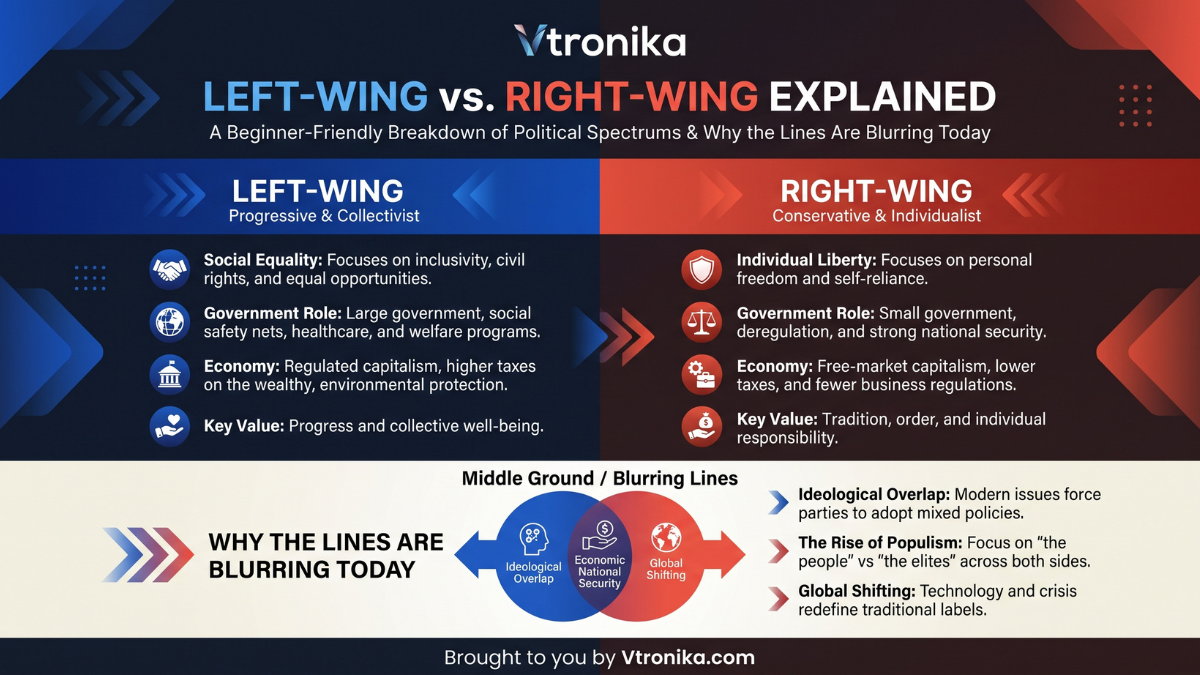
Political ideology provides the conceptual lens through which societies define justice, economic distribution, and the appropriate scope of state power. Modern politics extends far beyond a crude, one-dimensional left-right binary into multi-axis philosophical traditions:
- Classical Liberalism & Modern Progressivism: Focuses on individual autonomy, personal freedoms, and civic equality. Classical variants emphasize free markets, minimal state intervention, and private property rights, whereas modern progressivism argues that genuine individual liberty requires state intervention to guarantee public education, healthcare, and progressive economic equity.
- Conservatism: Prioritizes social order, institutional continuity, organic community norms, and time-tested customs over radical social engineering. Conservatives generally favor fiscal restraint, private enterprise, and intermediate community institutions (family, civic associations, religious bodies) as counterweights to state hegemony.
- Socialism & Democratic Socialism: Argues that unchecked market capitalism generates systemic wealth inequality and worker exploitation. Proponents advocate for democratic public ownership or tight regulation of key economic sectors, strong labor union protections, robust wealth redistribution, and universal social safety nets to ensure human dignity over private profit.
- Libertarianism: Maximizes individual sovereignty and economic deregulation while seeking to reduce the state to a minimalist “night-watchman” role focused exclusively on physical protection, contract enforcement, and property rights.
5. The Rule of Law and Judicial Independence: Anchoring Equal Justice
The rule of law asserts that every individual, regardless of wealth, social status, or executive power, is equally subordinate to established, publicly promulgated laws. It stands in direct opposition to rule by law, where arbitrary decrees and politicized legal instruments are wielded selectively to target political opponents and protect allied elites.
True judicial independence is the linchpin of the rule of law. Judges must be shielded from external political retribution, executive influence, and legislative coercion through secure lifetime or fixed tenure, protected compensation, and transparent appointment processes. When the bench operates without partisan intimidation, it can faithfully apply the law, protect minority rights against majoritarian tyranny, and issue binding rulings against government misconduct. For ordinary citizens, an impartial judicial system is the ultimate safeguard against arbitrary arrest, systemic corruption, and bureaucratic overreach.
6. How a Bill Becomes Law: The Legislative Lifecycle and Public Scrutiny
Statutory laws directly govern criminal justice, economic commerce, public health, and social welfare, yet the process of drafting and passing them is often misunderstood. Far from being a ceremonial rubber stamp, passing legislation involves multiple stages designed to invite scrutiny and debate:
First Reading (Draft Introduction)
       │
       ▼
Second Reading (Debate on Core Principles)
       │
       ▼
Committee Stage (Evidence Gathering, Public Hearings, Clause-by-Clause Amendments)
       │
       ▼
Report & Third Reading (Final Debate & Chamber Vote)
       │
       ▼
Bicameral Review / Upper House Concurrence
       │
       ▼
Executive Assent / Signing into Law
The committee stage is arguably the most vital point of intervention for informed citizens. Here, specialized legislative committees interrogate legal language, review empirical data, and hear testimonies from civil society, academic experts, and affected communities. Tracking this lifecycle allows citizens to pinpoint exactly when, where, and how legislation can be amended, challenged, or supported before it becomes binding statutory policy.
7. Media Literacy and Political Propaganda: Navigating the Information Ecosystem
An effective democracy requires an accurately informed public, making the media landscape a primary battleground for civic power. As information consumption has shifted from vetted public-interest newsrooms to algorithmic, attention-driven digital platforms, citizens face sophisticated challenges:
- Confirmation Bias and Filter Bubbles: Algorithmic feeds optimize for emotional engagement—frequently outrage—trapping users in homogeneous echo chambers that reinforce preconceptions and suppress contradictory factual evidence.
- Disinformation vs. Misinformation: Misinformation involves the accidental spread of inaccurate reporting, whereas disinformation is the deliberate, organized manufacture of false narratives to destabilize public trust, scapegoat vulnerable groups, or manipulate electoral outcomes.
- Propaganda Framing: Public debates are regularly manipulated through rhetorical tactics such as false balance (presenting scientific consensus alongside fringe conspiracies as equal viewpoints), whataboutism (deflecting scrutiny through counter-accusations), and loaded language designed to bypass critical reasoning.
Civic literacy requires rigorous media consumption habits: corroborating claims across independent sources, verifying the pedigree and funding of political commentators, and differentiating factual reporting from opinion punditry.
8. Civil Society and Grassroots Movements: Power Beyond the Ballot Box
Civic participation does not begin and end on election day. Civil society encompasses the dense network of non-governmental organizations, trade unions, student groups, community associations, and faith-based collectives that operate independently of commercial interests and state control.
Historically, systemic civic progress—including universal suffrage, workplace safety standards, civil rights expansions, and environmental protections—was not initiated inside legislative chambers, but forced onto public agendas by grassroots movements. Through coordinated organizing, strategic boycotts, peaceful civil disobedience, investigative whistleblowing, and public advocacy, ordinary citizens create countervailing power against state authority and corporate monopolies. A vibrant civil society prevents public disengagement, trains future community leaders, and ensures that institutional policy remains responsive to grassroots needs.
9. Fiscal Policy and Public Budgets: Understanding Where Public Money Goes
A government budget is fundamentally a moral and philosophical document that reveals a state’s true priorities far more clearly than campaign manifestos. Fiscal policy governs how the state extracts resources through taxation and how it redistributes or invests that capital back into society.
- Taxation Models: Regressive taxes (such as general sales taxes) place a heavier proportional burden on lower-income households, whereas progressive taxation models (such as bracketed income and capital gains taxes) extract higher percentages from higher earners to fund public goods and reduce social inequality.
- Public Expenditures: State budgets allocate capital across essential areas including infrastructure maintenance, public healthcare, national defense, education, social welfare nets, and sovereign debt servicing.
- Deficits and Public Debt: When expenditures exceed tax receipts, the state issues treasury bonds and borrows capital. While strategic borrowing can finance critical long-term productivity assets like transportation and energy grids, unsustainable debt burdens can lead to austerity measures, inflationary pressures, and reduced funding for vital public programs.
Mastering budgetary basics enables citizens to evaluate policy claims realistically, assessing whether proposed initiatives are fiscally sound, appropriately funded, and equitably distributed.
10. Local Government: Why Municipal Politics Directly Impacts Daily Life
While national and federal politics dominate daily headlines, local and municipal governance exerts an immediate, tangible impact on day-to-day life. Municipal authorities make decisions that determine community health, environmental quality, and economic opportunity:
- Urban Planning and Zoning: Local councils determine land-use policies, housing affordability guidelines, commercial developments, and the availability of green public spaces.
- Essential Utilities and Services: Potable water delivery, sewage processing, solid waste management, municipal road maintenance, and local transit systems fall directly under municipal administration.
- Public Safety and Education: Local school boards, district clinics, emergency management services, and community policing protocols are predominantly managed and financed through local property taxes and municipal boards.
Voter turnout in local elections is routinely far lower than in national races, creating an outsized opportunity for organized citizen participation. A small coalition of engaged local citizens can attend council meetings, review zoning permits, contest municipal expenditures, and directly shape their immediate living conditions.
11. International Relations and Geopolitics: The Global Forces Shaping Domestic Policy
No sovereign nation exists in isolation; international treaties, foreign policy, and global alliances directly shape domestic economic health, energy access, and national security. Three major theoretical schools explain international state behavior:
- Realism: Views the global international system as fundamentally anarchic, lacking a centralized global authority. Realists argue that nation-states operate as rational, self-interested actors whose primary imperative is survival, security, and the accumulation of military and economic power to deter rivals.
- Liberal Internationalism: Contends that international cooperation, democratic governance, multilateral institutions (such as the United Nations and the World Trade Organization), and open economic trade can mitigate anarchy, foster interdependent stability, and prevent armed interstate conflict.
- Constructivism: Argues that global politics is shaped not merely by material capabilities, but by evolving social norms, historical identities, cultural narratives, and international legal values that determine how states perceive friends, threats, and legitimate action.
Understanding these international forces equips citizens to critically assess trade agreements, military interventions, climate treaties, and international supply-chain vulnerabilities that influence domestic consumer prices, employment rates, and civic liberties.
12. Digital Rights, Surveillance, and the Future of Democracy
The digitization of public life and government administration has created a new frontier for civil liberties, citizen privacy, and democratic integrity. The convergence of algorithmic data analytics, facial recognition, and pervasive digital monitoring brings structural risks to democratic norms:
- The Surveillance State: Governments increasingly deploy biometric data gathering, predictive policing algorithms, and bulk internet communications surveillance under the justification of public safety, frequently eroding constitutional protections against unreasonable search and seizure.
- Corporate Data Extractivism: Monopolistic digital platforms collect, profile, and monetize personal behavior patterns, deploying micro-targeted advertising models that can be weaponized by domestic factions and foreign actors to polarize electorates and suppress voter turnout.
- Digital Enfranchisement and Cybersecurity: Critical civic processes—from digital voting infrastructure to national identity registries and public benefit disbursement—face systematic threats from cyber warfare, data breaches, and arbitrary administrative exclusion.