1. Modernizing Legacy Systems: The Anchor of Enterprise Agility
Legacy software stacks, fragmented on-premise servers, and manual data-entry workflows create chronic operational bottlenecks that silently drain profitability. Digital transformation begins by auditing these technical friction points and migrating outdated architectures to unified, interoperable digital frameworks. By establishing microservices and automated API integrations, organizations decouple critical business logic from monolithic codebases. This foundational shift eliminates inter-departmental silos, accelerates feature release cycles, and ensures internal systems can adapt to evolving market demands in days rather than quarters.
2. Multi-Cloud Architecture: Building Resilient, Borderless Infrastructure
Relying on a single physical location or rigid server footprint exposes an organization to severe downtime, localization limits, and steep capital expenditure. Adopting a multi-cloud strategy (leveraging IaaS, PaaS, and SaaS) allows enterprises to dynamically distribute computing loads, optimize latency, and maintain business continuity across international borders. Cloud-native architectures scale compute and storage resources automatically during peak traffic surges, freeing internal engineering teams from hardware maintenance and redirecting focus toward core product innovation.
3. Cloud Governance, Compliance, and Zero-Trust Cybersecurity
Accelerated digital adoption expands an enterprise’s attack surface, turning cybersecurity and data sovereignty into core commercial priorities rather than afterthoughts. A mature cloud transformation implements a comprehensive Zero-Trust security model, enforcing continuous identity verification, granular role-based access controls, and end-to-end data encryption in transit and at rest. Coupled with automated regulatory compliance tracking, these protocols protect proprietary intellectual property and customer records from ransomware threats, mitigating liability and fostering deep institutional trust.
4. Continuous Integration and Automated Cloud Workflows
Operational drag often peaks in the gap between business strategy and IT deployment. By integrating DevOps principles, containerization (such as Docker and Kubernetes), and automated CI/CD pipelines into cloud ecosystems, enterprises standardize the entire software delivery lifecycle. Repetitive testing, environment provisioning, and compliance checks occur programmatically, drastically minimizing human error. This engineering rhythm reduces time-to-market for digital customer touchpoints and ensures updates roll out smoothly without service disruptions.
5. Advanced Business Intelligence: Transforming Raw Data into Strategic Clarity
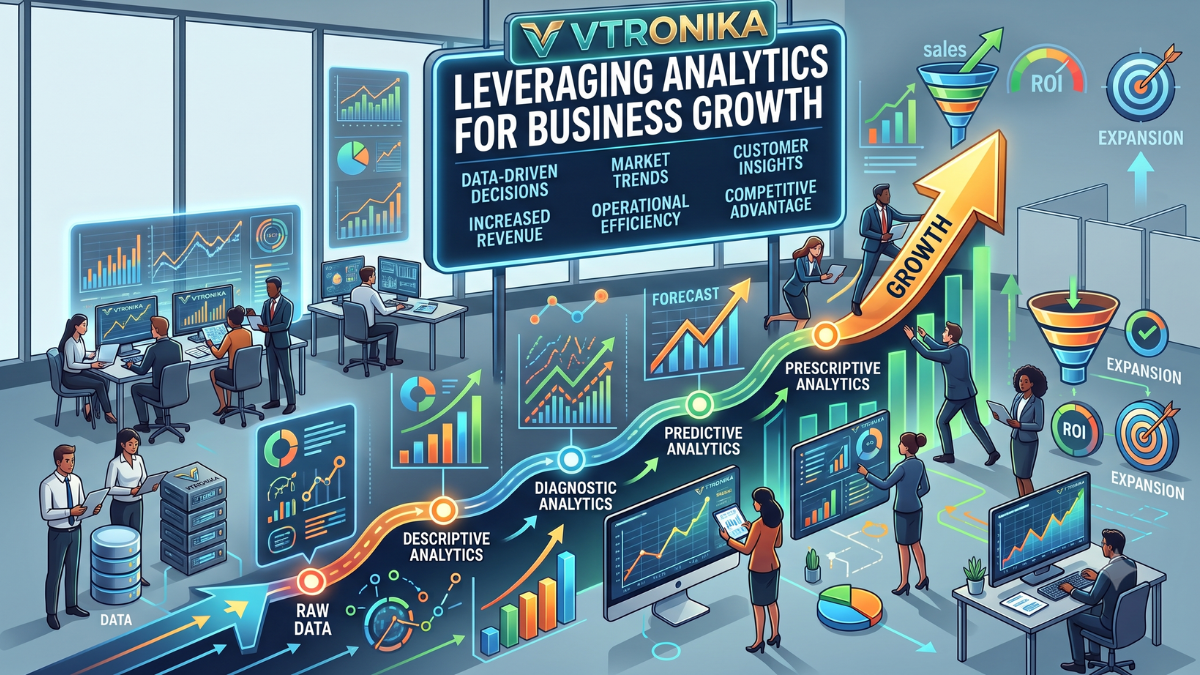
Modern businesses capture petabytes of transaction logs, customer interactions, and operational metrics, but raw data alone is merely an administrative cost center. Business Intelligence (BI) pipelines transform unstructured logs into centralized, queryable data lakes and real-time executive dashboards. By replacing lagging end-of-month financial spreadsheets with live key performance indicators, leadership gains panoramic visibility into micro-fluctuations in gross margin, regional churn, and operational overhead, enabling proactive decision-making over reactive damage control.
6. Predictive Analytics and Machine Learning for Market Forecasting
While traditional descriptive analytics explains what has already happened, predictive modeling uses statistical algorithms and machine learning to project future operational realities. Enterprises utilize predictive analytics to anticipate supply chain disruptions, optimize inventory replenishment schedules, and forecast demand spikes with remarkable accuracy. This analytical capability allows leadership to allocate capital pre-emptively, eliminating excess holding costs and ensuring operational readiness ahead of macroeconomic shifts.
7. Hyper-Personalization: Maximizing Customer Lifetime Value
Sustainable revenue growth depends on an organization’s capacity to deliver relevant, tailored experiences to individual consumers across every touchpoint. By unifying customer data platforms (CDPs) with predictive recommendation engines, businesses analyze purchasing history, engagement frequency, and behavioral intent in real time. This analytical synthesis enables dynamic website experiences, hyper-targeted retention messaging, and personalized product bundles, which substantially lowers customer acquisition costs while driving lifetime value.
8. Strategic Capital Allocation and ROI Engineering
Expanding an enterprise requires disciplined resource management to avoid the cash traps common to rapid scaling. Business analytics provides financial teams with granular visibility into unit economics, customer acquisition payback periods, and channel-by-channel return on ad spend (ROAS). Rather than relying on intuition or broad industry benchmarks, executive leadership deploys growth capital based on statistically validated returns, ensuring that expansion budgets fuel profitable customer segments without diluting overall enterprise margins.
9. Organizational Alignment and Data-Driven Culture
The most sophisticated cloud architectures and analytical models will fail if the human workforce resists change or remains data-illiterate. Strategic growth requires an organizational culture shift where every team—from marketing and sales to customer support and human resources—is empowered with accessible, self-service analytical tools. By dismantling protective knowledge silos and cultivating data literacy, companies decentralize decision-making, allowing front-line staff to resolve client bottlenecks and innovate rapidly within defined guardrails.
10. The Unified Growth Flywheel: Converging Cloud, Analytics, and Strategy
Long-term commercial dominance is realized when digital transformation, cloud resilience, and business analytics merge into a unified, compounding flywheel. Elastic cloud infrastructure handles surging operational scale without degrading performance, while continuous analytics extracts behavioral signals from that scale to inform executive strategy. This alignment transforms business growth from a series of disjointed, high-risk gambles into an engineered, repeatable operational engine capable of scaling sustainably in any economic climate.