

Article 1: The Virtual Fitting Room — Overcoming the E-Commerce Return Crisis
Online apparel retail has historically operated under a costly flaw: consumer sizing uncertainty. With standard e-commerce return rates hovering between 30% and 40%—primarily driven by incorrect fit, unflattering drape, and color discrepancies—brands lose billions annually in reverse logistics, repackaging, and unsellable inventory. Augmented Reality (AR) fitting rooms are emerging as the technical solution to this friction.
By utilizing smartphone camera arrays, depth sensors, and spatial computing algorithms, virtual try-on software maps precise anatomical landmarks across the shopper’s body. The software generates a dynamic 3D mesh that mirrors real-world movement and posture. Instead of guessing between small, medium, or large based on arbitrary size charts, consumers view real-time representations of how a specific garment rests on their exact body dimensions before completing a purchase.
- Reverse Logistics Reduction: Accurate sizing visualization reduces return volumes by up to 25%, protecting retail operating margins and cutting transit waste.
- Volumetric Body Mapping: Mobile software capturing height, shoulder span, inseam, and waist measurements without physical tape measures.
- Conversion Acceleration: Interactive AR try-ons increase checkout conversion rates by giving shoppers direct visual confidence in garment fit.
Article 2: Real-Time Cloth Physics — Simulating Drape, Tension, and Shear
The realism of modern virtual fitting rooms depends entirely on advanced computational physics. A static 3D model overlaid onto a video feed looks unnatural; real fabric moves dynamically with the human body. Next-generation AR try-on engines run complex particle simulation algorithms that calculate textile physics in real time.
Physics engines model specific material parameters: mass density, tensile elasticity, bending stiffness, and shear resistance. When an avatar walks, turns, or bends, the software calculates how a heavy 400 GSM wool overcoat behaves differently from a fluid 16mm silk slip dress. Dynamic strain heatmaps show the user where a shirt pulls too tight across the shoulders or bunches uncomfortably around the armpits.
- Stress and Strain Heatmaps: Color gradients displaying real-time fabric tension, pinpointing tight or loose zones across the torso and limbs.
- Material-Specific Coefficients: Simulating individual textile behaviors, from rigid denim twill to four-way performance stretch spandex.
- Collision Detection Algorithms: Preventing digital cloth from clipping through avatar skin meshes during complex movement and posing.
Article 3: Digital-Only Haute Couture — High Fashion Beyond Physical Constraints
While AR try-ons serve physical retail, a parallel creative movement treats digital fashion as an independent, non-physical discipline. Digital-only fashion houses (such as The Fabricant, Tribute Brand, and Republic) create garments that exist exclusively on digital screens, social media feeds, and virtual reality spaces, completely separated from physical fabric production.
Freed from gravitational, structural, and material limitations, digital designers craft garments impossible to execute in the physical world: iridescent liquid metals, floating glass corsets, pulsating bioluminescent trails, and garments that alter color based on ambient digital audio. Consumers purchase these virtual assets, submit a high-resolution photograph, and receive a customized image featuring the digital garment fitted to their image with matching lighting, shadow, and perspective.
- Gravitational Freedom: Designing sculptural, fluid, or kinetic silhouettes unconstrained by seams, gravity, or structural boning.
- Zero Material Footprint: Purely digital design requires no agricultural land, water consumption, chemical dyes, or assembly line labor.
- Social-First Wardrobes: Catering to internet cultures where outfits are often purchased solely to be photographed once for a digital feed.
Article 4: The Gaming Crossover — Skin Economies and Avatar Self-Expression
Video games have evolved from casual entertainment into expansive social environments where millions socialize, attend virtual concerts, and express personal style. Within ecosystems like Fortnite, Roblox, and League of Legends, an avatar’s visual appearance is the primary vehicle for social signaling, status, and subcultural belonging.
The commercial value of this space is massive. Game developers generate billions annually solely through cosmetic character “skins” that provide zero competitive gameplay advantage. Players value virtual items with the same emotional attachment historically reserved for physical luxury goods, proving that identity in digital worlds requires intentional sartorial curation.
- Cosmetic Monetization: Digital skin sales driving multi-billion-dollar annual revenues across major multiplayer titles.
- Social Capital in Digital Spaces: Rare, limited-edition virtual skins functioning as digital status symbols among peer networks.
- Virtual Youth Culture: Younger demographics increasingly prioritizing digital avatar aesthetics alongside real-world wardrobes.
Article 5: Luxury Houses in the Metaverse — Brand Heritage Enters Virtual Worlds
Global luxury heritage brands—such as Gucci, Balenciaga, Louis Vuitton, and Ralph Lauren—are actively establishing commercial footholds inside virtual gaming worlds. Rather than treating games as promotional novelties, luxury houses view metaverses as essential channels for engaging younger demographics and creating high-margin digital revenue streams.
Collaborations range from custom Balenciaga armor sets in Fortnite to immersive virtual brand spaces like “Gucci Town” on Roblox. In these digital environments, users explore branded architecture, interact with virtual runway collections, and purchase exclusive avatar items. Virtual luxury products carry profit margins approaching 90% because they eliminate raw material, warehousing, and shipping costs.
- Virtual Brand Worlds: Constructing branded 3D digital environments for interactive storytelling, runway streaming, and virtual commerce.
- High-Margin Digital Goods: Monetizing brand intellectual property without physical supply chain overhead or deadstock risk.
- Early Demographics Engagement: Cultivating brand recognition and prestige with Gen Z and Gen Alpha consumers inside their native digital hangouts.
Article 6: Phygital Fashion & Digital Twins — Connecting Physical Clothing to Virtual Assets
The long-term trajectory of digital style is not an either-or choice between physical garments and virtual files, but an integrated “phygital” model. Pioneering streetwear and luxury brands now issue physical collections accompanied by authenticated “digital twins”—exact 3D virtual counterparts designed for use across virtual worlds and social platforms.
A consumer purchasing a limited-edition physical jacket receives an NFC-linked microchip embedded directly into the garment’s cuff or care label. Scanning the chip with a smartphone verifies ownership on a decentralized ledger and unlocks the digital twin inside compatible gaming engines and AR apps. This dual-ownership structure doubles the garment’s visibility and functional utility.
- Embedded NFC Microchips: Physical textiles integrated with hardware chips that connect garments directly to digital interfaces.
- Dual-World Utility: Wearing a physical garment in urban street settings while dressing an avatar in the identical 3D asset online.
- Secondary Market Provenance: Immutable digital ownership records simplifying authentication and secondary resale on collector platforms.
Article 7: Camera Filters & Instant AR — Daily Wearable Tech on Social Feeds
The most accessible entry point for digital fashion is not high-end VR headsets or gaming consoles, but native camera filters across platforms like Snapchat, TikTok, and Instagram. Augmented reality lenses allow hundreds of millions of smartphone users to try on virtual makeup, experimental headwear, sunglasses, and outerwear instantly.
Facial and body-tracking algorithms continuously map 3D assets to the user’s camera feed at 60 frames per second. For beauty and accessory brands, these interactive filters function as high-conversion digital sampling tools. Users can test different lipstick shades, optical frames, or designer jewelry against their skin tone in real time, sharing the results with friends and checking out directly from the app.
- Instant Camera Try-Ons: Using native social media lenses to test accessories, eyewear, and cosmetics without downloading external software.
- Peer-to-Peer Social Virality: Interactive filters designed to be shared across user stories and video feeds, generating organic brand discovery.
- Frictionless In-Filter Checkout: Integrated shopping buttons allowing users to purchase the physical product while trying on the digital filter.
Article 8: 3D Atelier Software — Behind the Scenes of Digital Pattern Making
Behind every digital garment lies specialized computer-aided design (CAD) software that bridges traditional pattern drafting with 3D simulation. Industry-standard platforms—such as CLO 3D, Browzwear Lotta, and Style3D—have transformed how both physical and virtual fashion ateliers operate.
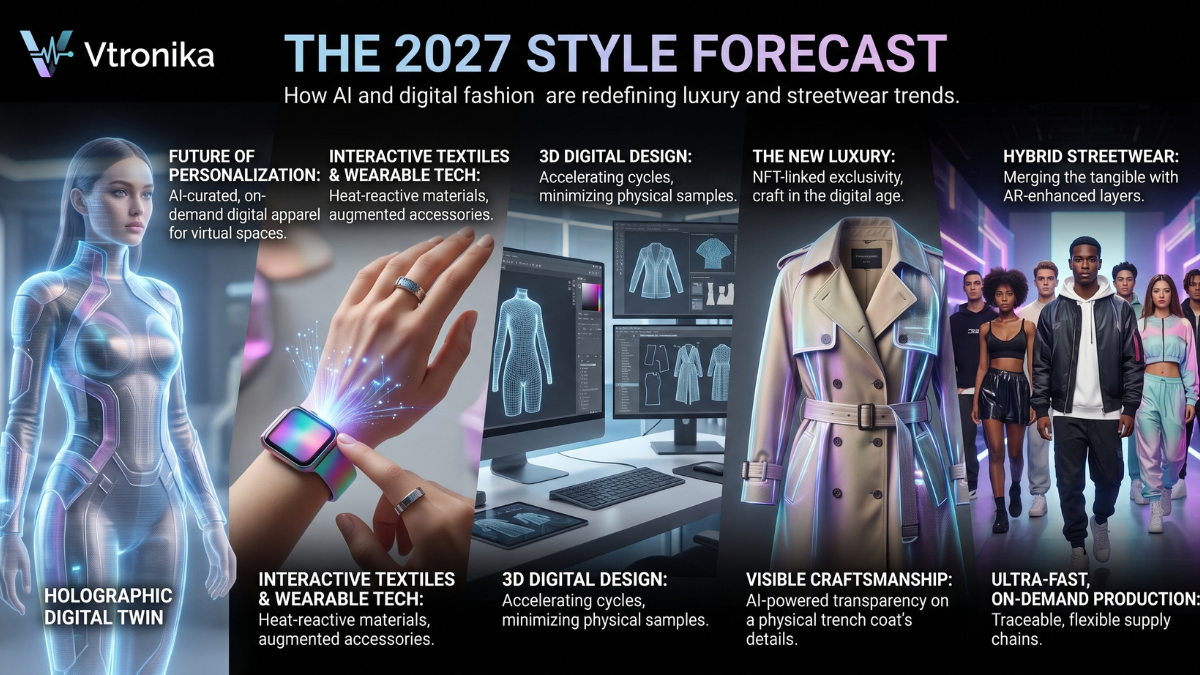
Designers in these programs work across two simultaneous viewports: a 2D window where pattern pieces are drafted, darted, and graded, and a 3D window where those patterns are virtually sewn onto a customized avatar. Changes made to a 2D pattern piece instantly update the 3D physical simulation. This workflow eliminates paper patterns, minimizes physical muslin prototypes, and shortens design iterations from weeks to minutes.
- Dual-Viewport Patterning: Synchronized workflows connecting 2D sewing pattern drafting directly to 3D volumetric draping.
- Parametric Sizing Avatars: Customizing avatar bust, waist, hip, and limb lengths to test pattern grading across diverse body types.
- Automated Production Exports: Exporting approved 3D digital patterns into computerized DXF cutting files ready for physical factory machinery.
Article 9: Interoperability Challenges — Standardizing 3D Garments Across Platforms
The primary technical bottleneck facing digital fashion is interoperability: the ability to move a digital garment seamlessly between different game engines, social apps, and virtual environments. Currently, a 3D jacket designed for a Roblox avatar cannot be worn directly in Fortnite or imported into an Unreal Engine cinematic without extensive re-rigging and file conversion.
Proprietary game engines use differing polygon budgets, rigging skeletons, texture mapping formats, and lighting algorithms. To build a unified digital fashion economy, industry consortiums and tech firms are working to standardize open 3D formats—such as glTF, USDZ, and VRM. Achieving universal file standards will allow digital clothing to function like real-world garments, portable across all digital environments.
- Polygon Budget Constraints: Balancing high-fidelity photorealistic meshes with low-poly optimization required for mobile games.
- Avatar Skeletal Rigging: Adapting digital garments to fit varying bone structures and animation skeletons across proprietary game engines.
- Open File Formats: Developing universal asset extensions (glTF, USDZ) to enable cross-platform digital wardrobe portability.
Article 10: Environmental Realities — Is Digital Fashion Genuinely Sustainable?
Digital-only apparel is frequently marketed as a completely green, zero-waste alternative to physical manufacturing. Because virtual clothing eliminates agricultural irrigation, toxic dye runoff, fabric cutting waste, and overseas maritime shipping, its direct physical footprint is undeniably lower than traditional garment manufacturing.
However, a comprehensive lifecycle assessment requires evaluating the computational energy powering the digital ecosystem. Rendering complex 3D cloth physics, training generative AI models, running cloud server infrastructure, and processing blockchain transactions demand significant electrical power. For digital fashion to deliver genuine sustainability, software providers and cloud data centers must run on renewable energy grids, proving that digital solutions solve environmental issues rather than transferring them to the electrical grid.
- Elimination of Physical Waste: Zero fabric off-cuts, zero microplastic shedding, and zero post-consumer landfill accumulation.
- Data Center Energy Overhead: Evaluating the electricity demands of continuous 3D cloud rendering and machine learning infrastructure.
- Renewable Tech Pipelines: Shifting computational fashion workflows toward carbon-neutral cloud providers and energy-efficient algorithms.