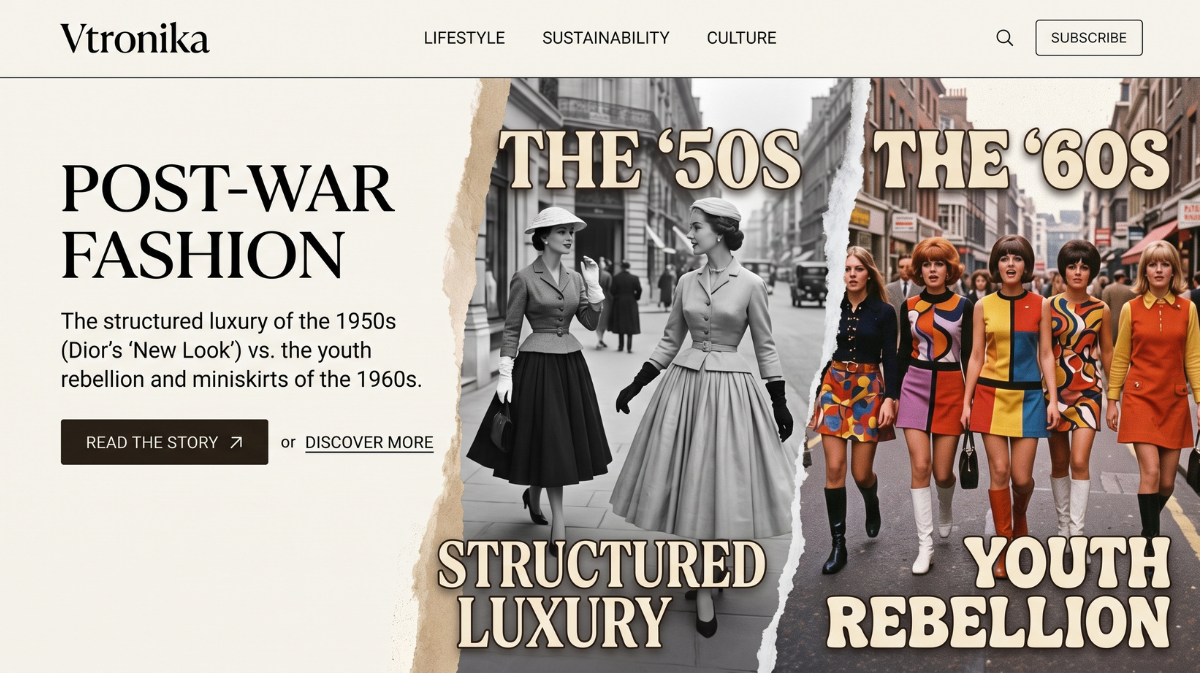
Article 1: Christian Dior’s “New Look” — The Architecture of Post-War Reassurance
In February 1947, Christian Dior unveiled his debut haute couture collection in Paris, christened by Carmel Snow of Harper’s Bazaar as the “New Look.” Following years of strict wartime fabric rationing, boxy utility suits, and emotional austerity across Europe and North America, Dior’s Corolle silhouette arrived as an unapologetic shock of pure romance and architectural volume.
The collection discarded utilitarian rationing in favor of sloped, unpadded shoulders, tightly cinched “wasp” waists, and sweeping pleated skirts constructed from up to twenty yards of luxurious silk and wool. This aesthetic was not merely decorative; it was a psychological anchor designed to restore formal elegance and traditional domestic ideals to an exhausted post-war society eager for stability and visible prosperity.
- The Hourglass Blueprint: Emphasizing extreme waist reduction, padded hip basques, and rounded bust lines to celebrate hyper-feminine proportions.
- Fabric Extravagance: Defiantly rejecting wartime thrift with lavish layers of tulle, heavy petticoats, and silk taffeta.
- Reclaiming Paris: Re-establishing Paris as the undisputed epicenter of luxury craftsmanship after wartime isolation and military occupation.
Article 2: The Undergarment Armory — Girdles, Bullet Bras, and the Sculpted Body
The polished elegance of 1950s womenswear was entirely dependent on what lay beneath the dress. Unlike modern clothing designed to adapt to natural human proportions, mid-century couture demanded that the wearer’s body be physically remolded to fit an unyielding architectural pattern.
To achieve the desired tiny waist and rigid posture, women wore an elaborate armory of foundational garments every morning: boned corsetry, rigid step-in rubber girdles, pointy conical “bullet bras,” and multi-layered nylon petticoats. These undergarments restricted natural lung expansion and abdominal movement, signaling that post-war decorum and social respectability required literal physical constraint.
- The Conical Silhouette: Bullet bras engineered with concentric spiral stitching to project a sharp, defined, and rigid bustline.
- The Boned Guêpière: Waist-cinchers (or “waspies”) laced tightly to compress internal organs and subtract inches from the natural waist.
- The Performance of Polished Decorum: Complete morning dressing rituals taking hours, reinforcing traditional domestic gender roles.
Article 3: Cristobal Balenciaga & Hubert de Givenchy — The Masters of Sculptural Restraint
While Christian Dior championed tightly corseted nostalgia, Spanish couturier Cristóbal Balenciaga and French aristocrat Hubert de Givenchy approached 1950s luxury through structural architecture and fabric manipulation. Balenciaga systematically discarded restrictive underpinnings, pioneering radical silhouettes that stood away from the natural body.
Throughout the decade, Balenciaga introduced revolutionary forms: the barrel line, the balloon jacket, the cocoon coat, and the 1957 “sack dress.” By mastering heavy, stiff textiles like silk gazar, Balenciaga and Givenchy proved that luxury could be defined by sculptural geometry, drape, and physical ease rather than tight cinching, paving the conceptual way for the loose shift dresses of the coming decade.
- Architectural Separation: Crafting garments with deliberate space between the textile and the skin, allowing fluid physical movement.
- Material Mastery: Utilizing structured textiles like silk gazar and double-faced wools that held volumetric shape independently.
- The Sack Dress Prelude: Balenciaga’s waistless 1957 sack dress, which faced initial media outrage but foreshadowed 1960s minimalism.
Article 4: The Birth of the Teenager — Subcultural Fractures in the Late 1950s
Prior to the mid-1950s, the concept of the “teenager” as an independent demographic did not exist. Young people transitioned directly from children’s clothes into miniature versions of their parents’ three-piece suits and twinsets. However, post-war economic growth and youth employment created the first generation of adolescents with disposable income and leisure time.
This economic independence fueled subcultural rebellion. In Britain, working-class youth adopted the Teddy Boy look—subverting Edwardian dandy tailoring with drape jackets, drainpipe trousers, and creepers. In the United States, motorcycle leather jackets, denim jeans, and rock-and-roll records signaled a growing rejection of suburban conformity, creating the initial fissures that shattered the mid-century fashion consensus.
- Disposable Youth Income: Teenagers spending wages on fashion, records, and motorbikes rather than contributing directly to household survival.
- The Teddy Boy Subversion: Working-class youth adopting aristocratic Savile Row cuts to provoke polite society.
- Denim as Rebellion: Transforming utility workwear jeans and white tees into symbols of adolescent defiance and anti-establishment solidarity.
Article 5: London’s Youthquake & Carnaby Street — Moving Away from Couture Salons
By the early 1960s, the center of global fashion influence shifted from the elite, hushed couture salons of Paris to the bustling streets of London. Christened the “Youthquake” by Vogue editor Diana Vreeland, this movement was driven by working-class art school graduates, musicians, and young entrepreneurs who demanded clothing that was affordable, playful, and irreverent.
Carnaby Street and the King’s Road in Chelsea emerged as vibrant epicenters of retail innovation. Small boutiques like John Stephen and Barbara Hulanicki’s Biba replaced traditional department stores with loud pop music, velvet drapery, and low-cost fast-changing inventory. For the first time in modern history, fashion trends were traveling from the street up to the runway rather than trickling down from aristocrats.
- The Boutique Revolution: Small, atmospheric shops offering weekly style updates tailored directly to young urban consumers.
- Music-Driven Style: Bands like The Beatles, The Rolling Stones, and The Who dictating men’s and women’s clothing choices.
- Democratization of Fashion: Shifting from expensive bespoke couture commissions to accessible, mass-manufactured ready-to-wear pieces.
Article 6: Mary Quant & The Miniskirt — Kinetic Freedom and Feminist Autonomy
No single garment represents 1960s liberation more clearly than the miniskirt. Popularized by British designer Mary Quant from her iconic Chelsea boutique, Bazaar, the miniskirt pushed hemlines several inches above the knee, creating an international cultural sensation that scandalized the traditional fashion establishment.
Quant maintained that it was the young women on the King’s Road who demanded shorter hemlines so they could run, dance, and catch a bus without restriction. Coupled with the invention of cheap, colorful nylon tights, the miniskirt freed women from garter belts and heavy stockings. This hemline revolution coincided with the approval of the oral contraceptive pill, making the miniskirt a visible symbol of second-wave feminist bodily autonomy.
- The Slogan of Speed: Quant engineering clothes specifically designed for dynamic physical mobility and uninhibited movement.
- The Pantyhose Breakthrough: Replacing complicated garter straps and girdles with lightweight, seamless elastane tights in vibrant colors.
- A Symbol of Autonomy: Women asserting direct ownership over their bodies, sexuality, and public presentation free from patriarchal constraints.
Article 7: Twiggy and the Waif Aesthetic — The Rejection of Maternal Voluptuousness
The hourglass, maternal ideal of the 1950s—epitomized by Marilyn Monroe, Grace Kelly, and Sophia Loren—was replaced in the mid-1960s by a radical new physical aesthetic: the waifish, androgynous mod. The breakthrough came in 1966 when fifteen-year-old Lesley Hornby, known as Twiggy, was named the “Face of ’66” by the Daily Express.
With her slender frame, cropped gamine haircut, painted spidery lower eyelashes, and wide eyes, Twiggy looked like a playful adolescent rather than a traditional society matron. This new visual standard matched the geometry of unconstructed A-line shifts, shift pinafores, and flat go-go boots, breaking away from the curvaceous post-war requirements of girdles and waist trainers.
- The Androgynous Shift: Moving away from heavy bust-and-hip padding toward youthful, linear geometry.
- Graphic Eye Aesthetics: Distinctive makeup routines using white eyeliner, false lashes, and painted lower-lid strokes.
- The Flat Footwear Transition: Replacing painful stiletto heels with flat Mary Janes and low-heeled vinyl go-go boots.
Article 8: Space Age Futurism — Cardin, Courrèges, and Rabanne
As the United States and the Soviet Union competed in the Cold War Space Race, high fashion turned its focus from the past to the cosmos. Designers André Courrèges, Pierre Cardin, and Paco Rabanne rejected natural fabrics and vintage silhouettes, introducing “Space Age” collections that reimagined fashion through an optimistic, technological lens.
André Courrèges introduced the “Moon Girl” look in 1964, featuring stark white A-line shifts, geometric slit goggles, and architectural helmets. Pierre Cardin developed heat-molded synthetic fabrics (Cardine) with circular cutouts, while Paco Rabanne constructed non-sewn dresses from linked aluminum discs and industrial rhodoid plastics. Fashion was no longer a historical craft; it was a forward-looking industrial design discipline.
- Architectural Shifts: Sharp, unlined A-line tunics constructed from heavy wool crepes that held geometric triangular forms.
- Cosmic Accents: Bonnets inspired by astronaut helmets, stark white go-go boots, and circular geometric cutouts exposing skin.
- Metallic and Industrial Fabrication: Replacing needles and thread with pliers, rivets, and metal rings to assemble futuristic evening armor.
Article 9: The Synthetic Revolution — Vinyl, PVC, and the Plastics Boom
The 1950s prized traditional natural fibers—fine worsted wools, raw silks, Irish linens, and cotton velvets—which required skilled labor, starching, and delicate dry cleaning. In contrast, the 1960s celebrated the chemistry of petrochemicals and synthetic plastics as symbols of modern, democratic progress.
Designers integrated shiny wet-look vinyl, clear polyvinyl chloride (PVC), acrylic knitwear, and polyester lurex into daily wardrobes. Raincoats became transparent, boots shone like lacquered enamel, and paper dresses—meant to be worn once and cut with scissors to alter the hem—entered the market. Synthetic textiles made bright pop-art colors colorfast and kept garments affordable for the average youth paycheck.
- Wet-Look Vinyl & PVC: Shiny plastic textiles used for slickers, miniskirts, and thigh-high boots that repelled water and caught strobe lights.
- Disposable Paper Apparel: Scott Paper Company’s printed cellulose dresses, highlighting early experiments with disposable, low-cost clothing.
- Pop Art Vibrancy: Synthetic dyes allowing bright neon yellows, oranges, and acid greens that were impossible on unbleached natural fibers.
Article 10: The Peacock Revolution — Reclaiming Color in Post-War Menswear
The sartorial contrast between the 1950s and 1960s was just as pronounced in menswear. Post-war men’s fashion was defined by corporate uniformity: gray flannel suits, narrow conservative ties, white shirts, and fedoras—a style designed to project dependable, emotionless stability in corporate hierarchies.
In the mid-1960s, British menswear erupted into the “Peacock Revolution.” Led by designers like Michael Fish and Carnaby Street boutiques, men discarded dull tailoring in favor of Edwardian velvet jackets, floral silk shirts, kipper ties, Cuban-heeled boots, and flared trousers. Men’s fashion reclaimed bright color, sensory texture, and romantic swagger, breaking decades of rigid corporate dress codes.
- Dismantling the Flannel Uniform: Men swapping muted charcoal and navy suits for jewel-toned velvets and paisley brocades.
- The Regency Dandies: Resurrecting ruffled ascots, wide lapels, Nehru collars, and tailored frock coats worn with rock-and-roll ease.
- Blurring Gender Boundaries: Men growing out their hair into mop-tops and shags while wearing pastels, scarves, and jewelry.
Article 11: The Subcultural Fracture — Mods vs. Rockers on the British Coast
The tension between the lingering utility of post-war workwear and the modernism of the 1960s played out physically in British seaside towns like Brighton and Margate during the Whitsun weekend riots of 1964. The clash between “Mods” and “Rockers” illustrated how deeply fashion was tied to identity and social belonging.
The Rockers represented an evolution of 1950s American grease culture: riding heavy British Triumph motorbikes, wearing oil-stained leather jackets with metal studs, selvedge denim, and heavy engineer boots. The Mods represented European modernism: riding Italian Lambretta or Vespa scooters, wearing custom tailored three-button Italian mohair suits, Clark’s desert boots, and protective US military M-51 fishtail parkas. Fashion had become a subcultural uniform for working-class tribal loyalty.
- The Rocker Aesthetic: Raw leather, denim turn-ups, pompadours, and grease—grounded in mid-century American rockabilly.
- The Mod Precision: Slim-fitting Italian-cut suits, clean lines, French crew cuts, and soul music—celebrating sharp continental modernism.
- The M-51 Fishtail Parka: Military surplus adopted functionally by Mods to protect their expensive bespoke suits from scooter road grime.
Article 12: The Enduring Runway Dialectic — Structure vs. Liberation
The transition from the 1950s to the 1960s remains one of the most defining dialogues in modern fashion history. The movement from Dior’s tightly corseted structure to Mary Quant’s loose, kinetic freedom established a creative polarity that designers continue to explore on international runways today.
Contemporary fashion continuously reinterprets these two eras. Designers regularly contrast 1950s peplum tailoring, structured bustiers, and full skirts with 1960s geometric A-line shifts, optical block prints, and micro hemlines. This ongoing conversation demonstrates that fashion is an enduring push-and-pull between our desire for tailored, reassuring structure and our urge for rebellious, uninhibited freedom.
- The Tailoring Dialectic: Modern collections frequently open with 1950s structured suiting before transitioning into 1960s relaxed, short silhouettes.
- Reclaiming Structure Without Pain: Using modern stretch textiles and ergonomic boning to capture 1950s elegance without physical restriction.
- The Ageless Shift Dress: The simple 1960s A-line tunic remaining a universal staple across both fast fashion and luxury runways decades later.