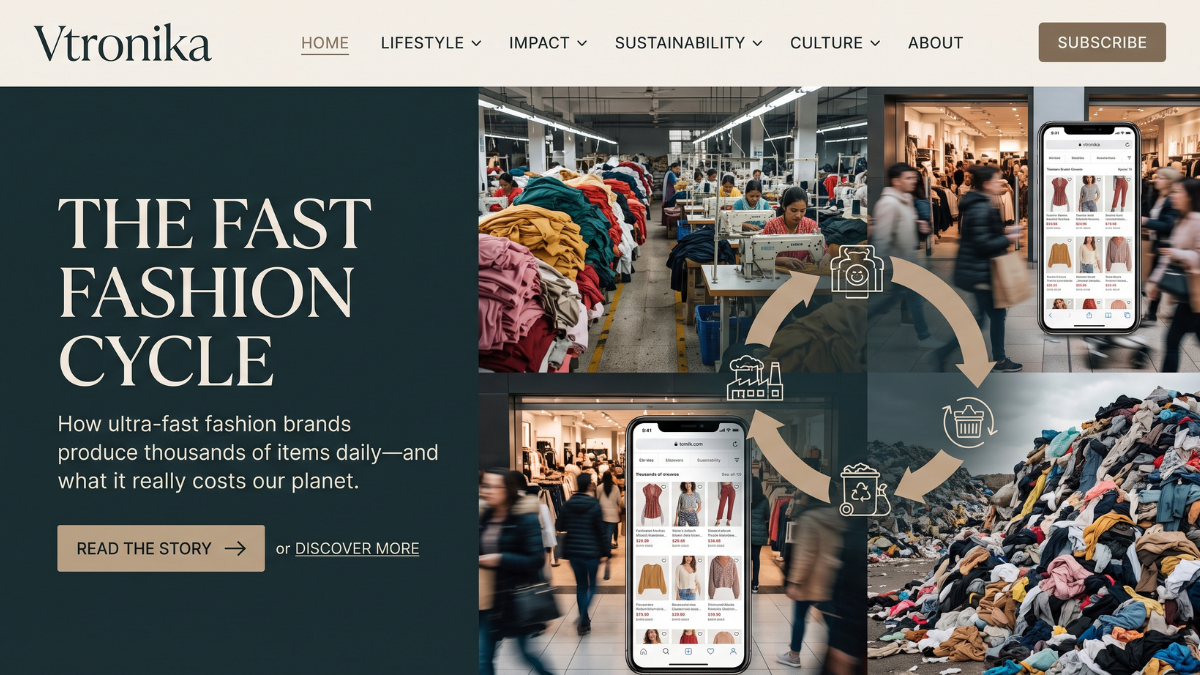
Article 1: From Runway to Screen in 72 Hours — The Evolution of Ultra-Fast Fashion
Traditional apparel retail historically operated on four primary seasonal collections: Spring/Summer, Autumn/Winter, Resort, and Pre-Fall. Pioneered in the early 2000s, fast fashion brands compressed this cycle to bi-weekly store drops. Today, ultra-fast fashion has rendered the concept of seasons obsolete, deploying algorithmic platforms that upload between 3,000 and 10,000 unique SKUs (Stock Keeping Units) every single day.
This transition from physical retail chains to pure-play mobile apps has eliminated store real estate constraints. Because digital shelf space is infinite, brands no longer need to curate an edited collection. Instead, they treat the storefront as an expansive live experiment where algorithms test thousands of micro-trends directly against global consumer click-through rates.
- Timeline Compression: Design-to-door cycles have dropped from nine months in traditional fashion to under five days in ultra-fast operations.
- Infinite Catalogs: Major platforms maintain over 500,000 active listings at any given moment, far outpacing brick-and-mortar inventories.
- Mobile-First Dominance: Over 80% of sales occur inside proprietary gamified mobile apps driven by continuous flash sales and countdown timers.
Article 2: The Data Scraping Engine — Predictive AI and Social Listening
The design genesis in ultra-fast fashion rarely starts with a sketchpad or a creative runway concept; it begins with raw code. Proprietary automated scrapers comb TikTok feeds, Instagram explore pages, Google search queries, celebrity fan pages, and competitor websites around the clock to detect viral visual patterns.
When an aesthetic—such as “balletcore,” “coastal grandma,” or a specific cutout dress worn at a red carpet event—sees a sudden spike in engagement metrics, computer vision models dissect the garment’s exact attributes. The software maps color palettes, neckline cuts, sleeve lengths, and hemlines directly into digital 3D CAD files within hours, bypassing human trend forecasters entirely.
- Automated Attribute Tagging: AI parses millions of social images hourly to identify micro-trends before they reach mainstream retail.
- 3D Virtual Sampling: Designers generate digital 3D garment renders without fabricating physical prototypes, cutting weeks of sampling time.
- Predictive Demand Scoring: Machine learning models assign probability scores to styles based on click-through rates and “add-to-wishlist” velocity.
Article 3: Micro-Batching & The “Test-and-Reorder” Agile Supply Chain
The core operational breakthrough behind ultra-fast fashion is the small-batch on-demand manufacturing framework, commonly referred to as the “test-and-reorder” model. Legacy apparel manufacturers require minimum order quantities (MOQs) of 1,000 to 5,000 units per style to achieve economies of scale. Ultra-fast fashion platforms, by contrast, commission initial test runs of just 50 to 100 pieces.
Once an initial batch goes live, the platform tracks real-time customer behavior: scroll stoppages, zoom interactions, cart additions, and early sales. If a style generates low engagement within 48 hours, the listing is automatically deprioritized or discounted with negligible financial loss. If an item sells out rapidly, digital procurement software triggers immediate automated mass orders of several thousand units.
- Sub-100 MOQs: Initial production runs are small enough that unsellable deadstock is kept to an industry-low single-digit percentage.
- Algorithmic Automated Reorders: Factory machines begin sewing reorders automatically based on data triggers, without human buyers intervening.
- Decentralized Workshop Networks: Production is distributed across thousands of small, agile workshops rather than massive, centralized factories.
Article 4: The Digitized Factory Ecosystem — Software-Controlled Subcontractors
The operational backbone making micro-batching possible is a dense network of tier-two and tier-three garment workshops clustered in manufacturing hubs like Guangzhou, China, and Southeast Asia. These independent workshops are bound to the parent company via proprietary Manufacturing Execution System (MES) software installed on mobile devices and workstations.
The platform provides shop owners with pre-purchased raw fabrics, standardized patterns, and explicit digital assembly steps. In exchange, the platform monitors factory floor capacity, scrap rates, cutting speeds, and daily output in real time. This vertical software integration transforms fragmented, low-tech sewing workshops into a unified, responsive industrial cloud.
- Centralized Material Banks: The parent platform bulk-buys universal polyester rolls and trims, distributing them to workshops on demand.
- Performance-Ranked Workshops: Workshops receive algorithmic performance scores; higher quality and faster turnarounds unlock larger subsequent production orders.
- Zero Middlemen: Intermediary agents and independent wholesalers are eliminated, keeping gross margins high despite sub-$10 retail pricing.
Article 5: Synthetic Dominance — The Chemistry of Polyester and Micro-Costs
Producing garments priced below $10 requires aggressive material cost reduction. Ultra-fast fashion is overwhelmingly made from synthetic, petroleum-derived textiles—predominantly virgin polyester, nylon, acrylic, and elastane. Polyester costs roughly half as much as conventional cotton and can be spun, knit, chemically dyed, and machine-cut at high industrial speeds without snagging.
Synthetic fabrics are engineered for rapid visual impact on high-resolution smartphone screens rather than physical longevity. Thin polyester knits hold screen-printed graphics and vibrant dye sublimation well, making garments photograph attractively under studio lighting. However, these materials pill rapidly, trap odor-causing bacteria, and deteriorate after only a handful of wash cycles.
- Petrochemical Reliance: Over 65% of all fibers used in ultra-fast fashion are derived from crude oil extraction and refining.
- Fiber Degradation: Synthetic garments lack tensile durability, leading to seam splitting, pilling, and shape loss after two to five washes.
- Color Fastness Shortcomings: Cheap disperse dyes used on synthetic fabrics frequently bleed, leach into wash water, and irritate sensitive skin.
Article 6: Labor Realities and Piece-Rate Pressures in Fragmented Hubs
The intense speed and thin margins of the ultra-fast fashion loop place heavy pressure on factory workers. While parent companies maintain polished vendor codes of conduct on their websites, day-to-day manufacturing frequently relies on informal, subcontracted workshops operating outside standard regulatory scrutiny.
Garment workers in these clusters often operate on a “piece-rate” compensation system, earning pennies per completed sleeve, hem, or zipper rather than a fixed hourly living wage. To earn a baseline income, laborers work 12- to 15-hour shifts during peak production runs, with minimal days off. The relentless demand for rapid turnaround times incentivizes workshops to bypass local overtime limits and basic occupational safety standards.
- The Piece-Rate System: Pay tied strictly to physical unit output incentivizes hazardous production speeds and continuous overtime work.
- Subcontracting Loopholes: Primary audited suppliers routinely offload difficult or sudden surges to unmonitored home-based or informal workshops.
- Lack of Collective Bargaining: Fragmented production across thousands of small facilities makes unionization and collective wage negotiation difficult.
Article 7: Tax Arbitrage and Cross-Border Air Freight Logistics
Legacy clothing brands ship garments via maritime cargo containers, which takes three to six weeks to move across oceans before goods are unloaded into regional fulfillment centers. Ultra-fast fashion brands avoid maritime transit entirely, relying instead on high-frequency international air cargo flights to deliver customer orders directly from factory-adjacent distribution hubs.
This logistics model exploits a key customs loophole: the de minimis trade threshold (such as Section 321 in the United States). Under these rules, individual shipments addressed to private consumers valued below a statutory limit (e.g., $800 in the U.S. or €150 in the EU) enter duty-free and bypass rigorous commercial customs inspections. This regulatory arbitrage saves ultra-fast platforms billions in import tariffs while accelerating shipping times.
- Air Cargo Dominance: Major ultra-fast retailers charter daily commercial air freighters, consuming significant shares of global trans-Pacific air-cargo capacity.
- Direct-to-Consumer Routing: Orders bypass domestic intermediate warehouses, moving straight from Chinese packing facilities to international doorsteps.
- The De Minimis Advantage: Exemption from standard tariffs allows cross-border retailers to undercut domestic brick-and-mortar pricing by 20% to 30%.
Article 8: Algorithmic Dopamine — Gamified E-Commerce and Haul Culture
The success of ultra-fast fashion relies just as much on behavioral psychology as it does on supply chain logistics. Platforms borrow mechanics from video games, casinos, and social apps to stimulate impulse buying. Daily login bonuses, wheel spins for discount points, countdown flash deals, and tailored push notifications keep consumers in a continuous buying loop.
Concurrently, social platforms have normalized “haul culture.” Content creators receive free clothing boxes or affiliate commissions, filming unboxing videos where they try on dozens of cheap outfits in minutes. This dynamic reframes clothing as disposable digital content: garments are bought to be photographed once for a TikTok video or Instagram post, then permanently discarded.
- Variable Reward Mechanisms: In-app mini-games and countdown clocks trigger dopamine surges that encourage checkout urgency.
- Affiliate Micro-Influencer Armies: Thousands of small-scale content creators drive sales via personalized discount codes in exchange for free inventory.
- The “Single-Use” Mindset: Surveys indicate that younger demographics increasingly consider wearing an outfit more than twice on social feeds a fashion faux pas.
Article 9: The Ecological Aftermath — Microplastics, Landfills, and the Global Waste Trade
The environmental footprint of the ultra-fast loop extends long after an order is delivered. Because items are sold at single-digit price points, processing returns costs more than the item is worth. Many returned garments are never restocked; they are routed directly to liquidators, incinerated, or dumped into municipal landfills.
Furthermore, laundering synthetic garments sheds hundreds of thousands of non-biodegradable microplastic fibers per wash cycle, contaminating municipal water systems and marine food chains. Discarded clothes exported under the banner of “secondhand clothing trade” routinely overwhelm import markets in the Global South—such as the Kantamanto market in Ghana or the Atacama Desert in Chile—where mountains of synthetic waste pollute coastlines and burn in open-air pits.
- Microfiber Pollution: Synthetic apparel shedding accounts for an estimated 35% of all primary microplastics entering marine ecosystems.
- The Return Dilemma: Up to 30% of online fashion purchases are returned, with a large fraction sent to landfills because reverse logistics are unprofitable.
- Global South Waste Colonialism: Developing nations import millions of tons of unwearable Western textile cast-offs annually, turning local ecosystems into waste basins.
Article 10: Regulatory Pushback — Extended Producer Responsibility and the Future of Fashion
The uninhibited growth of the ultra-fast fashion sector is meeting increasing legislative and consumer resistance worldwide. Regulatory bodies are recognizing that voluntary corporate social responsibility (CSR) pledges have failed to curb overproduction, prompting governments to draft binding, enforceable legislation.
Policy initiatives are advancing rapidly across Europe and North America. France has passed landmark legislation penalizing ultra-fast fashion retailers with environmental surcharges per item, while banning their advertising on social channels. Concurrently, the European Union’s Extended Producer Responsibility (EPR) mandates and Digital Product Passports (DPPs) are set to force brands to pay for garment lifecycle waste and verify supply chain transparency from fiber to scrap.
- Extended Producer Responsibility (EPR): Legislation requiring fashion brands to pay waste management fees on every unit manufactured to fund textile recycling infrastructure.
- The French Fast-Fashion Surcharge: Progressive ecological levies on cheap, high-turnover apparel intended to level the playing field for durable goods.
- Digital Product Passports (DPP): Mandated QR-code labels that disclose raw fiber origin, chemical usage, repairability scores, and factory certifications for every garment sold.