Online Earning & Learning Plateform
  • Follow Us
Online Earning & Learning Plateform Online Earning & Learning Plateform
Sign In

Blog

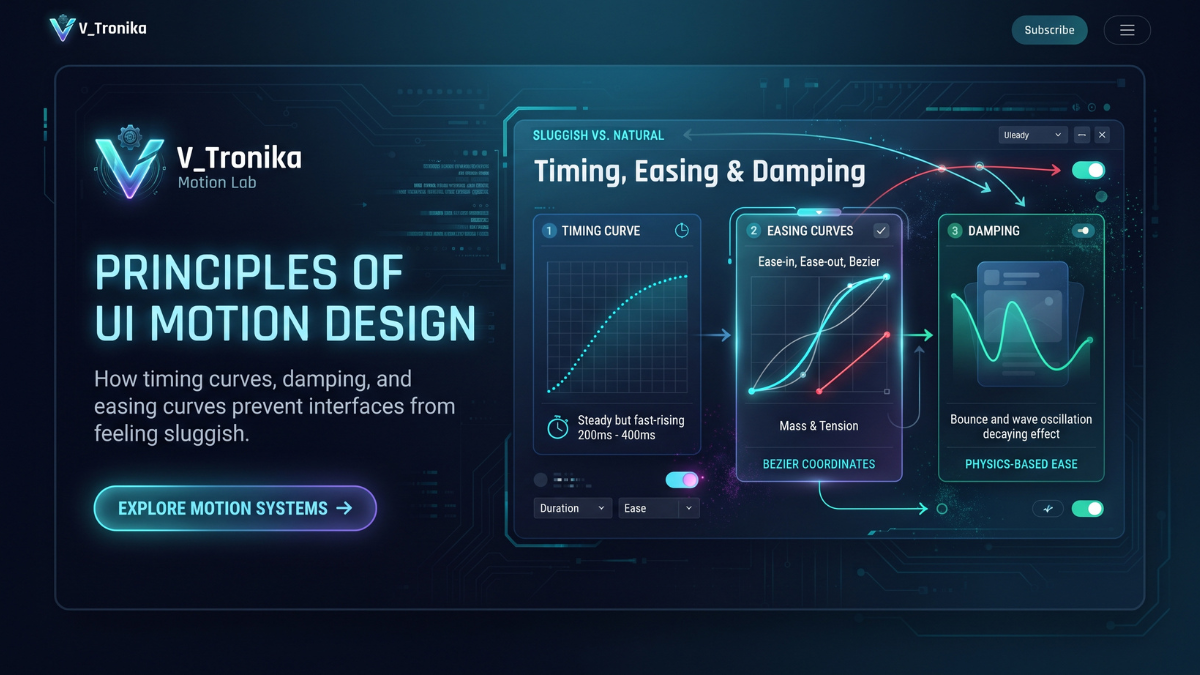
UI motion design is far more than mere visual polish; it is the fundamental mechanism that dictates how responsive, agile, and tactile a digital product feels. When a user taps a button, drags a sheet, or triggers a screen transition, motion bridges the cognitive gap between input and outcome. If timing parameters and physical properties are miscalculated, even an otherwise high-performance application will feel heavy, sluggish, and unresponsive to direct user manipulation. 1. Calibration of Timing and Duration Duration serves as the first line of defense against perceived latency, as excessive animation time forces users to wait for interface state changes. For small-scale micro-interactions—such as hover states, icon morphs, and toggle switches—the optimal duration window sits strictly between 100ms and 200ms, keeping interactions imperceptibly fast yet visually legible. For medium to large structural shifts, including navigation drawers, bottom sheets, and full-screen transitions, durations should remain between 250ms and 400ms. Pushing durations beyond 400ms or 500ms breaks the user's operational rhythm, introducing cognitive friction where users feel the interface is dragging behind their intent rather than keeping pace with their fingers. 2. Easing Curves and Cubic-Bézier Dynamics In the physical world, objects never reach peak velocity instantaneously or move at a constant linear speed, which is why pure linear easing makes interfaces feel mechanical, sterile, and sluggish. Snappy digital interfaces rely primarily on Ease-Out (Deceleration Curves) for incoming elements, where an object enters the viewport at maximum velocity and rapidly decelerates into its final resting position, delivering instant confirmation of the user's action without front-loaded delays. Conversely, Ease-In (Acceleration Curves) are reserved for dismissals and exits, allowing departing elements to accelerate off-screen swiftly and clear the visual plane. By utilizing asymmetric cubic-bézier parameters—such as steep starting slopes for entries—interfaces communicate rapid responsiveness while maintaining smooth, natural settling behavior. 3. Spring Physics and Damping Ratios Modern interaction design increasingly favors physics-based spring models (governed by stiffness, mass, and damping) over fixed-duration time curves, particularly for gesture-driven direct manipulation. In spring systems, damping acts as the opposing friction that stabilizes the moving element; an under-damped system causes prolonged oscillation and excessive bouncing, which introduces unnecessary visual noise and makes the UI feel sloppy and slow. To prevent sluggishness, springs should be tuned close to critical damping (a damping ratio around 0.8 to 1.0) with high stiffness, enabling elements to snap briskly into place with minimal overshoot, preserving a tight, direct connection between user input and interface movement. 4. Asymmetric Transitions and Choreography A critical technique to prevent interfaces from feeling bogged down is the strict application of asymmetric durations between entrances and exits. When an element enters the screen, users require sufficient time (around 250ms to 300ms) to process the incoming information, but when an element exits, that information is already dismissed and should vanish quickly in 150ms to 200ms. Furthermore, when multiple UI elements animate in sequence, staggering their appearances with micro-delays (20ms to 40ms) creates visual hierarchy without stacking durations linearly. Keeping exits aggressive, entrances front-loaded, and damping tightly controlled ensures the entire motion architecture remains lightweight, functional, and exceptionally snappy.
  • October 21, 2026
  • Rashi002
  • Design

Principles Of UI Motion Design: How Timing Curves, Damping, And Easing Curves Prevent Interfaces From Feeling Sluggish.

Article 1: Duration Budgeting — Eliminating Digital Inertia Digital interfaces operate within the constraints of human perception and neuro-motor feedback loops. When a user executes a tap, click, or...

Continue Reading
The Fundamental Dichotomy: Selling Production Hours vs. Commercial ImpactThe central conflict in design pricing lies between trading time for money and monetizing strategic outcomes.In an hourly billing model, your compensation correlates directly with the raw duration of design execution, sketching, asset preparation, and revisions. The fatal flaw of this approach is that it penalizes efficiency: as your technical skill, mastery of layout, and experience increase—allowing you to solve complex branding challenges in significantly fewer hours—your billable earnings paradoxically decrease.Conversely, value-based pricing divorces compensation from input labor entirely, anchoring fees instead to the projected commercial upside, brand equity, or revenue expansion your deliverable generates for the client. If an end-to-end design system or e-commerce overhaul can unlock an estimated $500,000 in annual recurring revenue for an enterprise, charging a fixed $50,000 fee reflects a high-yield, 10x return on investment (ROI) for the business, rather than an arbitrary tally of hours logged behind a monitor.Strategic Selection: When to Deploy Each Pricing ModelNeither pricing framework is universally superior; each serves distinct project scopes, client maturity profiles, and risk tolerances:MetricHourly / Day-Rate PricingValue-Based PricingProject ScopeOpen-ended, ambiguous, iterative, or frequently shifting without set parameters.Concrete, tightly defined, outcome-driven milestones with clear goals.Client ProfileEarly-stage pre-revenue startups, unverified founders, or internal teams needing ad-hoc capacity.Established businesses, growth-stage ventures, and enterprises with verifiable market data.Best Used ForOngoing design sprints, ad-hoc maintenance, temporary team augmentation, and technical fixes.Rebrands, design systems, conversion-rate optimization (CRO), high-stakes pitch decks, and flagship web launches.Inherent RiskCapped earning ceiling; clients scrutinize time sheets, micro-tasks, and invoice line items.Miscalculated client revenue estimates, underestimating scope, or extended execution delays.Conducting the Discovery Session: Uncovering Commercial ValueSuccessfully executing a value-based proposal requires shifting the initial client discovery interview from aesthetic preferences to economic fundamentals.Avoid operational questions like "What color palette do you prefer?" or "How many logo concepts do you need?" Instead, ask questions focused on business outcomes:Impact of the Problem: "If this brand redesign or UI overhaul is delayed by six months, what does that cost the company in customer acquisition, churn, or lost market share?"Success Metrics: "What quantitative commercial targets must this deliverable hit—such as conversion rates, retail shelf pickup, or venture capital funding—for you to view this engagement as a total success?"Relative Upside: "What is the lifetime value (LTV) of a new customer gained through this platform redesign?"When the prospective client explicitly quantifies that a disjointed brand presence currently loses them hundreds of thousands of dollars in pipeline value, a premium, five-figure design proposal is positioned not as an operational cost, but as an essential risk mitigation and growth investment.Transitioning to High-Value Retainers: Selling Strategic PartnershipTo escape the Feast-or-Famine revenue cycle of one-off design projects, transition high-trust clients into sustained, recurring retainers by reframing your role from an external vendor to a dedicated strategic partner:Sell Priority Capacity and Roadmaps, Not Bundled Hours: Never pitch a retainer as "20 hours of design work per month." Framing retainers as hourly blocks invites clients to micromanage your time and demand rollover credits. Instead, package retainers around guaranteed SLAs (service level agreements), turnarounds (e.g., 48-hour sprint reviews), continuous brand stewardship, and designated quarterly design initiatives.Anchor Against the Fully Loaded Cost of an In-House Hire: An experienced senior brand designer or design director commands an annual base salary alongside healthcare, payroll taxes, equipment, and benefits. Remind client executives that a high-tier monthly retainer gives them immediate access to senior-level design leadership without recruitment overhead, onboarding lag, or severance exposure.Establish Proactive Executive Check-Ins: Maintain retainer longevity by scheduling bi-weekly or monthly strategy syncs. Rather than waiting passively for tickets to arrive, proactively present optimization opportunities, performance audits of competitor marketing collateral, and iterative UI updates based on real user analytics.
  • October 21, 2026
  • Rashi002
  • Design

How To Price Design Work: Value-Based Pricing Vs. Hourly Rates — When To Use Each And How To Pitch Higher Retainers.

1. The Hourly Billing Trap: Why Trading Time for Money Caps Creative Growth Hourly billing is the default entry point for most freelance designers, yet it harbors a structural...
Continue Reading
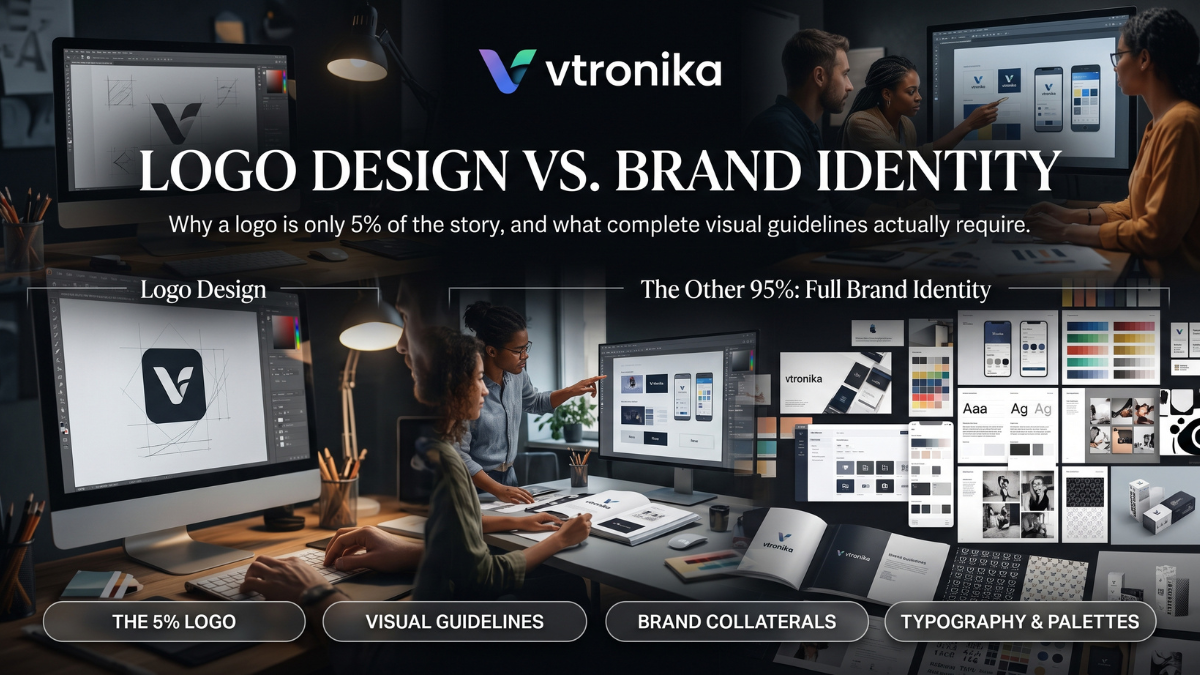
The 5% Fallacy: The Logo as an Identifier, Not the IdentityMistaking a logo for a complete brand is one of the most common strategic errors in modern business, because a logo represents at most 5% of the total brand narrative. In practical terms, a logo functions merely as a visual signature, an efficient mental trigger, and a point of recognition. It does not generate consumer trust, articulate company culture, define product ergonomics, or deliver customer service excellence on its own; rather, it absorbs the meaning and reputation built by the business over years of execution. Just as a person's signature or facial portrait cannot encapsulate their character, intelligence, ethics, or voice, a graphic icon or logotype cannot carry the burden of an entire enterprise without a cohesive visual framework and a clear brand strategy supporting it.The Remaining 95%: Defining Brand Identity as an Integrated EcosystemBrand identity represents the comprehensive visual, emotional, and sensory ecosystem through which a company communicates its core values, market positioning, and operational ethos across every customer touchpoint. This broader 95% comprises the immediate emotional tone of advertising, the layout rhythm of digital interfaces, the tactile quality of packaging materials, the photographic narrative, and the distinct tone of voice used in customer correspondence. When consumers interact with enduring brands like Apple, Nike, or Braun, their loyalty is not driven solely by an apple silhouette or a swoosh; it is anchored in decades of uncompromising visual consistency, cohesive product language, and systematic design discipline that make the company immediately recognizable even when the logo is completely removed.Core Pillars: What Complete Visual Guidelines Actually RequireA professional brand identity manual moves far beyond an isolated vector file. To ensure operational consistency across marketing, design, and engineering teams, a complete visual identity system requires precise specification across six mandatory layers:Identity LayerTechnical SpecificationsPurpose & Strategic FunctionLogo Architecture & RulesPrimary mark, secondary lockups, sub-marks, favicons, minimum exclusion zones, minimum reproduction sizes, and explicit "what NOT to do" rules (no stretching, color shifting, or improper drop shadows).Protects mark legibility, visual integrity, and legal recognizability across micro and macro scales.Color Systems & CalibrationPrimary, secondary, and neutral palettes specified in HEX (web), RGB (digital screens), CMYK (commercial print), and Pantone/PMS spot colors.Guarantees exact chromatic consistency whether viewed on an OLED display, a kraft-paper box, or a cotton tote.Typography HierarchyPrimary brand typefaces, secondary editorial fonts, and web-safe fallbacks; explicit type scales covering tracking, kerning, line-height, weight pairings, and accessibility contrast standards.Establishes immediate readability, structural rhythm, and editorial authority across editorial and digital UI contexts.Art Direction & PhotographyLighting temperature (cool vs. warm), depth-of-field rules, color grading parameters, subject casting guidelines, and authentic staging documentation.Prevents disjointed stock imagery and creates a distinctive, proprietary photographic world.Graphic Assets & LayoutCustom iconography sets, 3D elements, branded patterns, textures, and structural layout grids (e.g., 8pt digital grid, modular print grids).Provides modular building blocks so designers can construct new marketing collateral without reinventing the aesthetic wheel.Voice, Tone & TouchpointsBrand personality adjectives, vocabulary dos and don'ts, editorial style rules, packaging dielines, website UI kits, and uniform/merchandise mockups.Unifies the verbal voice with the visual tone, ensuring the brand sounds and feels identical in customer support emails, billboards, and pitch decks.
  • October 21, 2026
  • Rashi002
  • Design, Guide

Logo Design vs. Brand Identity: Why A Logo Is Only 5% Of The Story, And What Complete Visual Guide Lines Actually Require.

1. The 5% Fallacy: The Logo as an Identifier, Not the Identity Mistaking a logo for an entire brand is one of the most common strategic errors in business....
Continue Reading
The Erosion of Traditional Cable News and Broadcast Gatekeeping For decades, political discourse was filtered through centralized broadcast networks, cable news conglomerates, and legacy print publications. These legacy outlets operated under rigid institutional conventions: strict editorial oversight, advertising constraints, corporate board interests, and brief, high-friction segments often reduced to soundbites and manufactured crossfire debates. This environment created a growing disconnect with contemporary audiences. Modern viewers increasingly view traditional news anchors as detached, corporate-managed talking heads who enforce a narrow range of acceptable opinion while prioritizing corporate sponsors over authentic investigation. As trust in mainstream institutions declines, the monopoly over political narrative formation has decisively fractured, paving the way for decentralized digital broadcasting. The Long-Form Revolution: In-Depth Discourse and Conversational Depth The migration toward podcasts has fundamentally reshaped political communication, replacing three-minute cable segments with unhurried, multi-hour discussions. On platforms like YouTube, Spotify, and Apple Podcasts, political analysts, policy experts, and candidates can unpack intricate fiscal models, constitutional jurisprudence, and foreign policy strategies across two to three hours without commercial interruptions. This expanded format strips away rehearsed talking points. Over an extended conversation, scripted rhetoric gives way to spontaneous reasoning, allowing listeners to gauge an interviewee’s authentic command of policy, emotional composure, and underlying ideological coherence. Parasocial Connection, Authenticity, and Live-Streamed Engagement Live streamers and independent video creators command exceptional audience loyalty by fostering deep, real-time parasocial relationships. Broadcasting from modest home studios or unvarnished desk setups on platforms like Twitch, YouTube, and Kick, these creators engage directly with their audiences: Real-Time Interaction: Broadcasters read and respond directly to live chat questions, debate viewers in real time, and adjust their analysis collaboratively on screen. Perceived Authenticity: Audiences view independent creators as relatable, unvarnished peers rather than elite corporate actors. Their willingness to show emotion, admit uncertainty, or speak casually resonates with voters tired of rehearsed press briefings. Community Cultivation: Comment sections, Discord servers, and viewer-funded subscriber pools transform solitary news consumption into an active, communal political identity. Disruption of Campaign Strategy: Bypassing the Legacy Press Electoral campaign playbooks have systematically shifted resources toward creator-led media. Political campaigns now recognize that purchasing expensive television advertisements or booking Sunday morning cable interviews yields diminishing returns among key demographics, especially voters under forty. Instead, presidential candidates, parliamentary hopefuls, and grassroots organizers prioritize multi-hour appearances on independent podcasts and live streams. Sitting down for an extended conversation over coffee humanizes candidates, signals cultural literacy, and grants unmediated access to massive, highly dedicated audiences who never consume traditional broadcast news. Risks of Fragmentation: Algorithmic Radicalization and Polarized Echo Chambers While the democratization of political media breaks corporate monopolies, it presents systemic challenges to civic cohesion: Algorithmic Outrage: Digital platforms optimize distribution for viewer retention and emotional arousal, disproportionately amplifying conspiratorial narratives, aggressive tribalism, and sensationalism over balanced reporting. Absence of Editorial Fact-Checking: Independent creators rarely operate with dedicated legal teams, professional standards editors, or institutional corrections desks. Falsehoods, unverified rumors, and misleading claims can spread unchecked to millions before corrections emerge. Hyper-Fragmented Echo Chambers: When citizens curate their information intake strictly through ideologically tailored creators, they insulate themselves from opposing viewpoints. This creates parallel informational universes where common factual ground vanishes, accelerating civic polarization and institutional distrust.
  • October 21, 2026
  • Rashi002
  • News, Politics

The Rise Of Influencer Politics: How Podcasts, Live Streams, And Independent Creators Are Replacing Traditional Television News.

1. The Collapse of Broadcast Gatekeeping and Institutional Trust For over half a century, political communication operated through an elite gatekeeping framework. A handful of major broadcast television networks,...
Continue Reading
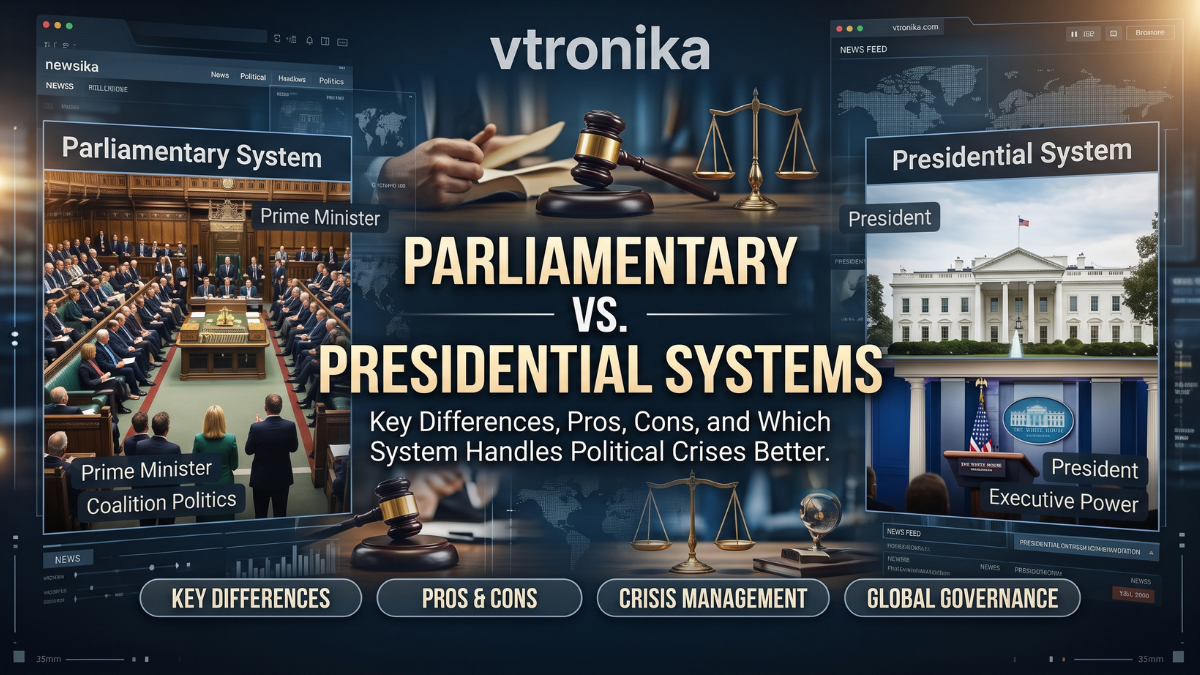
Structural Architecture: Fusion of Powers vs. Strict SeparationThe defining institutional difference between parliamentary and presidential systems lies in the structural relationship between the legislative and executive branches of government.In a presidential system, most prominently exemplified by the United States, there is a rigid, constitutional separation of powers. The head of government, who also serves as the head of state, is chosen independently by the electorate (either directly or via an electoral mechanism) for a fixed term. The president does not depend on legislative confidence to hold office and cannot unilaterally dissolve the legislature.Conversely, a parliamentary system, as practiced in the United Kingdom, Canada, Pakistan, and India, operates on a fusion of powers. The executive branch—comprising the Prime Minister and the cabinet—emerges directly from the elected legislature. The executive’s constitutional legitimacy is contingent upon maintaining the majority confidence of the parliamentary chamber, blurring the institutional line between lawmakers and policy administrators.Comparative Overview: Core Institutional MechanicsDimensionParliamentary SystemPresidential SystemHead of State & GovernmentDivided: Ceremonial Head of State (Monarch/President) + Executive Head of Government (Prime Minister).Unified: A single individual holds both ceremonial headship and full executive authority.Executive SelectionDrawn from and elected by the members of the legislative majority.Elected independently of the legislature by public or electoral vote.TenureFlexible; dependent on sustained parliamentary confidence and majority support.Fixed constitutional term (e.g., 4 or 5 years); virtually immune to ordinary political removal.Cabinet AppointmentsPrimarily sitting members of parliament.Outside specialists, technocrats, or politicians who must surrender legislative seats.Legislative PassageFast-tracked; the governing executive almost always holds a legislative majority.Subject to independent congressional checks, frequent negotiations, and potential gridlock.Parliamentary Systems: Pros, Cons, and Operational DynamicsThe principal advantage of a parliamentary democracy is administrative coherence and legislative efficiency. Because the Prime Minister and cabinet command a legislative majority, official government bills, fiscal policies, and annual budgets pass with minimal friction. Furthermore, accountability is continuous: ministers must face regular scrutiny, opposition debates, and direct cross-examination on the floor of the chamber (such as Prime Minister's Questions).However, this design introduces noticeable vulnerabilities:Political Instability: Multi-party parliaments often produce fragile coalitions where minor regional or fringe factions wield disproportionate veto leverage over the cabinet.Premature Collapse: A single floor revolt or broken coalition pact can instantly trigger a government collapse, forcing repeated, costly snap elections.Executive Dominance: In single-party majoritarian parliaments, the executive can effectively dictate terms to the legislature, reducing parliamentary debate to party-line voting without substantive independent oversight.Presidential Systems: Pros, Cons, and Operational DynamicsThe cornerstone of a presidential republic is executive stability, personal mandate, and sustained continuity. Because the chief executive serves a fixed constitutional term, policies are shielded from daily legislative revolts, enabling the administration to execute long-term economic, diplomatic, and security strategies without fearing immediate eviction from office. Additionally, clear separation provides a robust system of horizontal checks and balances, allowing legislators to evaluate executive proposals on merit rather than mandatory party discipline.Nonetheless, presidentialism harbors significant systemic hazards:Institutional Gridlock: When opposing parties control the presidency and the legislature ("divided government"), governance can stall completely, delaying judicial appointments, fiscal budgets, and essential statutory reforms for years.Winner-Take-All Nature: A presidential contest produces an indivisible victory; the winner claims total executive authority even with a razor-thin margin, leaving large segments of the population feeling completely disenfranchised.Authoritarian Drift: The fusion of ceremonial prestige with hard executive authority can encourage charismatic populists to claim a personal "mandate of the people," delegitimizing legislative deliberation, bypassing judicial review, and eroding democratic norms.Crisis Management: Which System Handles Political Crises Better?When evaluating resilience under acute political, economic, or constitutional strain, the parliamentary system demonstrably outperforms the presidential model in flexibility, peaceful conflict resolution, and self-correction.1. Removing Failed or Discredited LeadersIn a parliamentary setup, a Prime Minister caught in a corruption scandal, facing extreme public unpopularity, or proving fundamentally incompetent can be dismissed in days via an internal party leadership vote or a constitutional motion of no confidence. Power transitions occur within the existing constitutional framework without destabilizing the broader state apparatus.In contrast, unseating a sitting president requires impeachment—an adversarial, highly partisan, and grueling legal process that demands supermajorities and paralyzes the state. Impeachment often heightens societal polarization, and if the process fails to remove an unfit executive, citizens and institutions remain stuck with that leader until the term expires.2. Resolving Zero-Sum Legislative DeadlocksWhen a parliamentary government hits an irreconcilable policy deadlock, it holds an institutional safety valve: dissolving the chamber and calling snap elections. This returns sovereign decision-making directly to the voting public to deliver a fresh mandate.In a presidential system, no such release valve exists. If an adversarial congress and an obstinate president refuse to negotiate, neither can dissolve the other. Historically, especially across developing nations in Latin America, Southeast Asia, and Africa, prolonged presidential gridlock has frequently ended outside constitutional boundaries—culminating in military coups, emergency decrees, or executive autogolpes (self-coups) to break the institutional freeze.Consequently, while the presidential model offers greater day-to-day executive predictability, the parliamentary model possesses superior structural elasticity, preventing political crises from escalating into full-blown regime collapses.
  • October 21, 2026
  • Rashi002
  • Politics, public

Parliamentary vs. Presidential Systems: Key Differences, Pros, Cons, And Which System Handles Political Crises Better.

1. Structural Architecture: Fusion vs. Separation of Powers The definitive institutional difference between parliamentary and presidential systems lies in how power is arranged between the executive and legislative branches....
Continue Reading
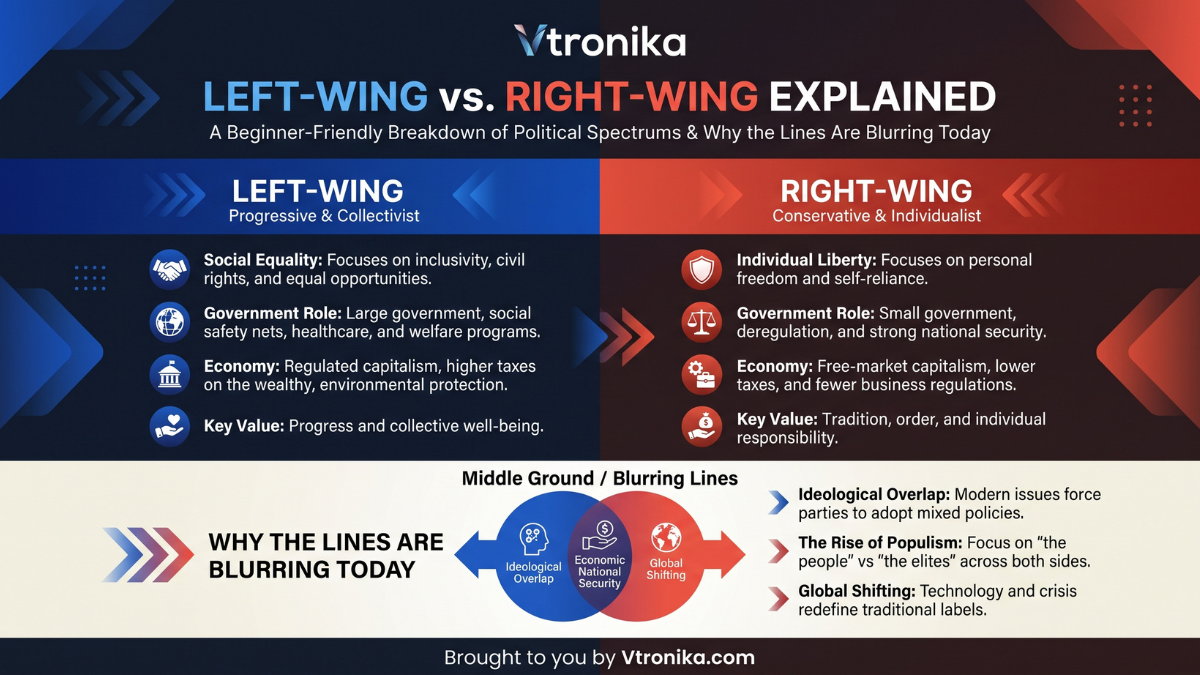
Historical Origins: The Seating Arrangement That Defined Modern PoliticsThe terms "left-wing" and "right-wing" originated during the French Revolution of 1789, where a literal seating arrangement in the National Assembly permanently shaped the global political lexicon. Members who supported the hereditary monarchy, the established social order, and the authority of the Catholic Church chose to sit on the presiding officer's right, representing continuity, hierarchy, and tradition. In contrast, revolutionary delegates who advocated for the abolition of feudal privileges, individual civil liberties, and popular democracy sat on the left, demanding systemic reform and egalitarian power distribution. This physical division established a durable mental shorthand: the political Right became associated with order, preservation, and tradition, while the political Left became synonymous with social reform, structural equality, and institutional change.Core Ideological Pillars: Equality vs. Order and EnterpriseThe fundamental philosophical divide between Left and Right rests on how each views human equality, economic distribution, and the appropriate scope of state power:The Left (Egalitarianism & Social Solidarity): Focuses on minimizing systemic disparities through collective responsibility. Left-leaning policies prioritize accessible public healthcare, universal education, progressive taxation, worker protections, and strong social safety nets, asserting that unregulated markets inevitably consolidate wealth and leave vulnerable populations behind.The Right (Individualism, Tradition & Free Enterprise): Emphasizes personal autonomy, private property rights, and traditional social institutions. Right-leaning policies favor deregulation, lower taxation, market competition, national sovereignty, and limited government intervention, arguing that economic prosperity thrives when individuals and private businesses are free to innovate and compete without state control.From a 1D Line to a 2D Map: The Political CompassA single horizontal axis fails to capture the complexity of modern political beliefs, often conflating economic policy with social and civic governance. To resolve this limitation, political analysts developed the two-dimensional Political Compass, which splits political identity into two separate axes:Horizontal Axis (Economic Model): Evaluates how resources should be distributed, ranging from left-wing collective ownership and state redistribution to right-wing free-market capitalism and laissez-faire deregulation.Vertical Axis (Social Governance): Measures the degree of state authority over individual life, ranging from top-quadrant Authoritarianism (strict state enforcement, deference to authority, and social conformity) to bottom-quadrant Libertarianism (maximum personal liberty, civil rights, and minimal government intrusion).This multidimensional map explains how individuals can hold seemingly contrasting positions—such as advocating for strict economic regulations alongside total individual social freedom (Libertarian Left), or supporting free-market capitalism while demanding rigorous state enforcement of traditional social norms (Authoritarian Right).Why the Lines Are Blurring TodayIn the 21st century, shifting global realities, geopolitical competition, and digital disruption have disrupted conventional party alignments:Rise of Working-Class Right-Wing Populism: Traditionally, the industrial working class formed the bedrock of left-wing parties. Today, many right-wing populist movements champion economic protectionism, domestic tariffs, and state-backed manufacturing subsidies—measures historically associated with the economic Left—to appeal directly to working-class communities displaced by globalized trade.The Neoliberal & Progressive Shift: Many mainstream center-left parties have aligned with global corporate trade frameworks and tech conglomerates, while culturally conservative voters increasingly distrust major multinational corporations for adopting progressive social branding.New Cross-Cutting Crises: Contemporary challenges—such as artificial intelligence governance, data surveillance, global pandemics, and green energy transitions—rarely fit into 18th-century ideological buckets. Coalitions increasingly assemble based on trust in institutional authority versus anti-establishment skepticism, blurring the traditional divide between Left and Right into a battle between centralized technocracy and decentralized populism.
  • October 21, 2026
  • Rashi002
  • Politics

Left-Wing Vs. Right-Wing Explained A Beginner-Friendly Breakdown Of Political Spectrums & Why The Lines Are Blurring Today.

1. The Historical Origin: The 1789 French Assembly Seating Plan The terms Left-Wing and Right-Wing trace directly to a physical seating arrangement in the French National Assembly during the...
Continue Reading
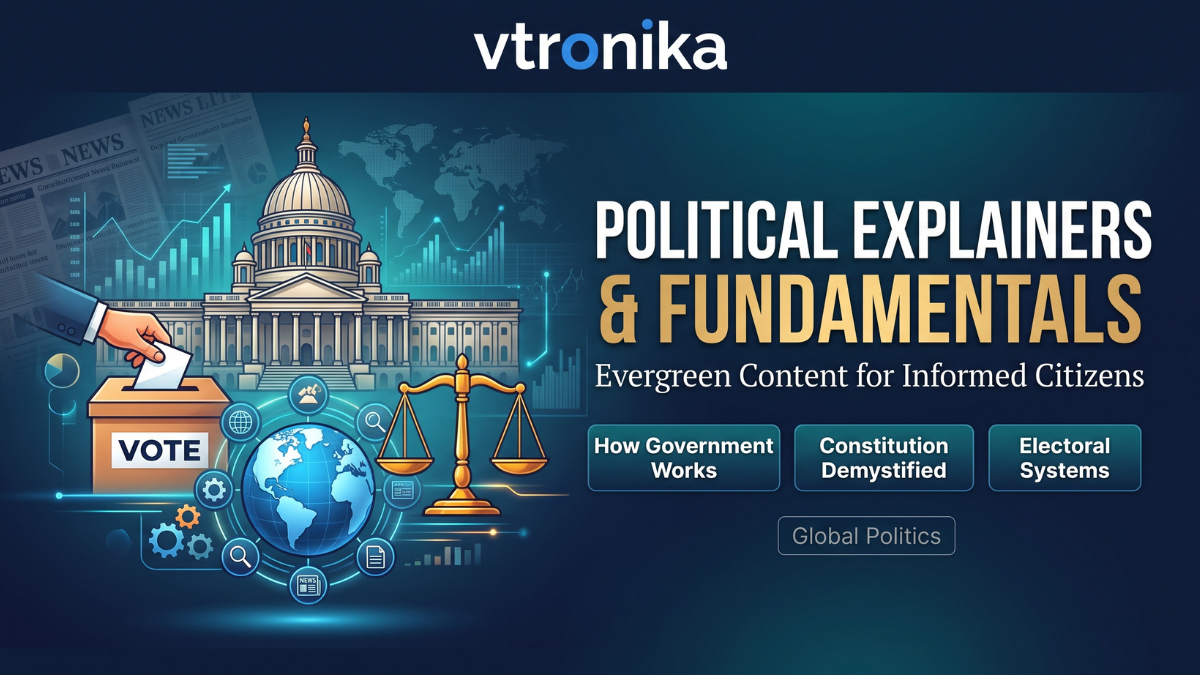
The Architecture of Power: Separation of Powers, Checks, and Balances A resilient democracy, at its core, relies on the structural division of authority across three distinct branches: the legislature, the executive, and the judiciary. The legislative assembly drafts and amends statutory laws, the executive arm administers public policy and enforces those laws, and the independent judiciary interprets statutes while safeguarding the constitution. This system of checks and balances prevents the dangerous concentration of unchecked authority in a single office or faction, guarantees due process for ordinary citizens, and ensures that state decisions stem from institutional deliberation, legal legitimacy, and constitutional limits rather than unilateral decree. The Social Contract: Constitutions, Fundamental Rights, and Civil Liberties A constitution functions as an enduring legal compact between the sovereign state and its people, establishing the foundational rules under which power is exercised and restrained. Within this framework, fundamental rights—including the freedom of speech, freedom of assembly, religious practice, and legal equality—are legally protected from executive overreach, legislative intrusion, and arbitrary state action. An informed populace that understands constitutional protections can actively recognize abuses of power, contest discriminatory legislation, and demand equal protection under the law, transforming abstract civic rights into enforceable, everyday realities. The Electoral Mechanism: Suffrage, Representative Mandates, and Accountability Free, regular, and competitive elections serve as the definitive vehicle for democratic legitimacy, public accountability, and the peaceful transfer of state authority. Suffrage gives every eligible voter, regardless of socioeconomic background, wealth, or status, direct influence over public policies, economic priorities, and state legislation. Beyond merely casting ballots on polling day, active civic literacy involves scrutinizing party platforms, tracking public spending, and understanding the core distinctions between competing governance models, ensuring that public mandates are earned through measurable performance rather than manipulative rhetoric or partisan polarization. Democratic Resilience: Free Press, Civic Participation, and Institutional Transparency The survival and health of a democratic society depend on persistent oversight, civic activism, and the protection of an unfettered, independent press. Investigative journalism, public policy think tanks, grassroots advocacy groups, and local community councils hold public officials accountable between election cycles by exposing official corruption, demanding budgetary transparency, and highlighting systemic inequities. When citizens maintain consistent civic engagement, evaluate public information critically, and defend the integrity of democratic norms, they build a political culture that resists authoritarian drift, champions transparent governance, and serves the collective public good.
  • October 21, 2026
  • Rashi002
  • Politics

Political Explainers & Fundamentals: Evergreen Content For Informed Citizens.

1. Separation of Powers: The Three Pillars of Modern Governance The separation of powers, originally codified by Enlightenment thinker Montesquieu, divides state power into three distinct branches: the legislature,...
Continue Reading
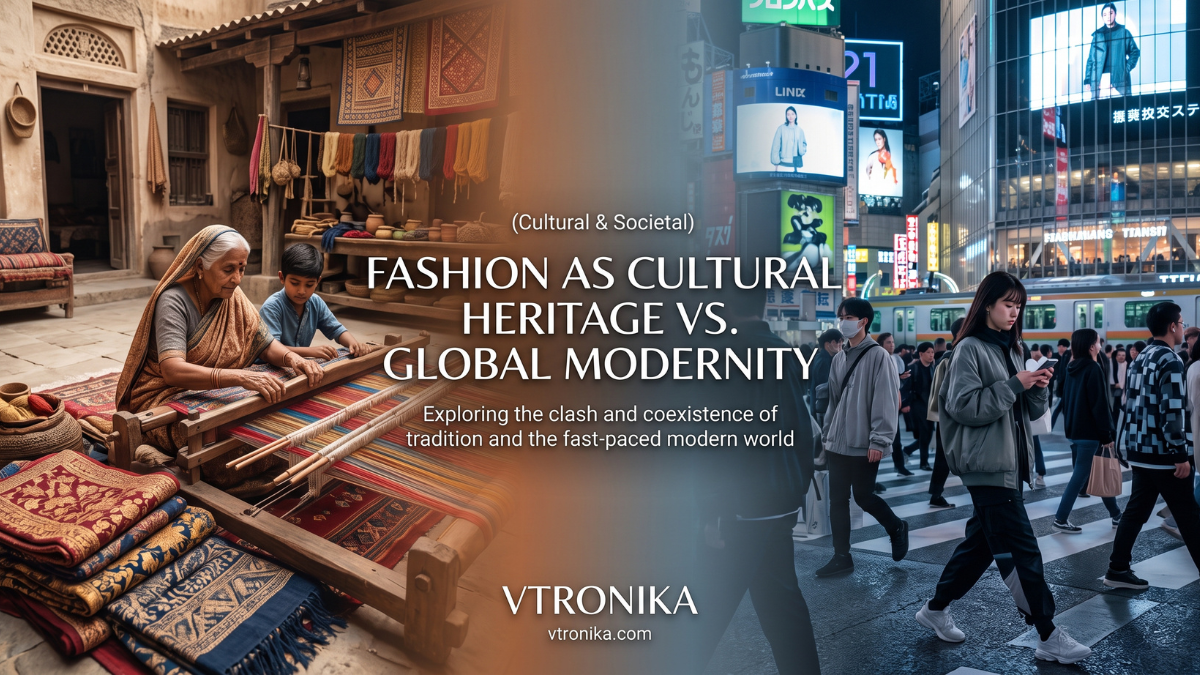
Fashion as Cultural Heritage vs. Global Modernity: Exploring the Clash and Coexistence of Tradition The Sacred Archive of Heritage Textiles, Craftsmanship, and Communal Memory Across generations and civilizational histories, clothing has existed as far more than mere bodily shelter, acting as a living canvas of communal identity, generational wisdom, and intricate craftsmanship. Traditional garments—such as the hand-spun khadi of South Asia, the gold-threaded brocades of imperial silk brocades, the geometric resistance weaves of West African kente, and the delicate indigo tie-dyes of Central Asian ikat—carry dense symbolic vocabularies within every fiber. Master artisans spend months hand-dyeing organic yarns using regional botanicals, calculating symmetrical geometric equations on manual wooden pit-looms, and embedding ancestral narratives directly into the weave. In these heritage systems, an heirloom garment is preserved as a physical archive of collective memory, holding spiritual significance, marking social rites of passage, and demonstrating that traditional attire serves as an enduring bridge between a community's sacred roots and its living descendants. The Homogenizing Wave of Industrial Modernity and Cultural Erasure The relentless expansion of globalized industrial capitalism, fast-fashion manufacturing, and standardized Western style codes has introduced severe friction against indigenous textile traditions. In the hyper-connected modern economy, algorithmic e-commerce storefronts flood international consumer hubs with inexpensive, petroleum-derived synthetic fabrics, mass-producing homogenized denim, polyester hoodies, and disposable graphic tees at unprecedented industrial speed. This uniform aesthetic flattens localized dress customs into Westernized streetwear, pressuring younger generations in traditional societies to view their ancestral dress as outdated, rural, or incompatible with contemporary urban mobility. Consequently, generational lineage workshops face economic collapse, specialized botanical dye recipes are forgotten, and historic weaving lineages vanish under the pressure of cheap synthetic imports, illustrating the quiet cultural loss that occurs when global convenience displaces slow artisanal heritage. The Ethics of Appropriation, Exploitation, and the Corporate Runway The friction between traditional craftsmanship and global fashion expands into ethical conflict when corporate fashion conglomerates appropriate sacred ethnic motifs without consent, compensation, or attribution. For decades, international luxury houses and fast-fashion platforms have taken sacred Indigenous patterns, ceremonial embroidery motifs, and tribal weaving designs, printing them on cheap synthetic swimsuits, synthetic festival cloaks, and commercial runway garments without acknowledging the communities that preserved those arts for centuries. This extractive commercialization commodifies cultural symbols into fleeting internet micro-trends, divorcing deep spiritual meanings from sacred attire. By extracting cultural capital while indigenous artisans continue to struggle within marginalized rural economies, global fast-fashion exposes an ongoing imbalance, sparking urgent global debates over intellectual property rights, geographic origin protections, and ethical cultural collaboration within the international fashion ecosystem. The Harmonious Synthesis: Contemporary Deconstruction and Circular Coexistence Despite structural tensions, a conscious movement of visionary global designers, ethical luxury ateliers, and indigenous craft collectives is demonstrating that heritage and modernity can coexist through respectful innovation. Forward-thinking designers are deconstructing ancient ethnic silhouettes—reinterpreting the drapery of the sari, the structured lines of the Japanese kimono, the architectural volume of the traditional kaftan, and the dense embroidery of Middle Eastern thobes—using contemporary tailoring, ergonomic zero-waste pattern making, and sustainable bio-textiles. By partnering directly with artisan cooperatives, ensuring fair-trade compensation, and integrating digital product passports to trace the hands that made each piece, contemporary fashion transforms from a tool of cultural erasure into a vehicle for cultural preservation. This respectful synthesis proves that preserving ancestral heritage does not require keeping traditions frozen in museum glass, but rather giving ancient techniques the creative space, dignified economic support, and contemporary platforms to thrive gracefully within modern life.
  • October 20, 2026
  • Rashi002
  • Fashion

Fashion As Cultural Heritage Vs. Global Modernity: Exploring The Clash And Coexistence Of Tradition.

Article 1: The Living Canvas — Indigenous Textiles as Sacred Archives In traditional and indigenous societies, clothing has never existed merely as bodily coverage or commercial commodity; it functions...
Continue Reading
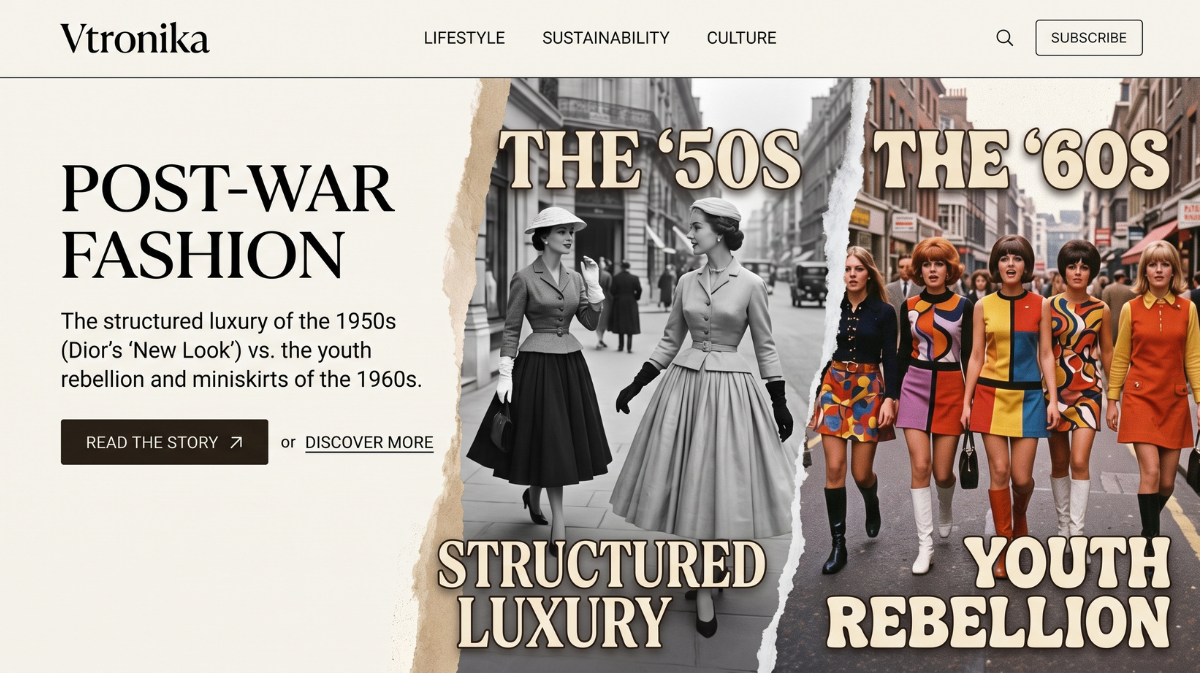
Post-War Fashion: The Structured Luxury of the 1950s vs. The Youth Rebellion and Miniskirts of the 1960s The 1950s Architecture of Elegance, Dior’s New Look, and Restored Domesticity Emerging from the severe fabric rationing, utilitarian utility suits, and emotional austerity of World War II, the fashion landscape of the 1950s embarked on an opulent architectural renaissance that celebrated traditional, idealized femininity. Spearheaded by Christian Dior’s revolutionary 1947 "New Look," the mid-century silhouette rejected wartime practicality in favor of dramatic corseted waists, rounded natural shoulders, voluminous calf-skimming tulle petticoats, and lavish quantities of luxurious silk taffeta. Fashion during this decade operated as a physical symbol of economic restoration, marital stability, and post-war suburban aspiration, requiring women to wear structured undergarments, boned girdles, pointed bullet bras, tailored tweed skirt-suits, matching kid-leather gloves, and pristine patent heels. By treating women's garments as sculptured monuments of delicate grace, the 1950s haute couture houses restored Paris as the global epicentre of elite design, proving that an exhausted, recovering world craved reassurance, formal order, and unapologetic sartorial grandeur. Generational Friction, Countercultural Awakenings, and the Death of Sartorial Conformity By the close of the decade, the pristine suburban facade and rigid behavioral etiquette of the 1950s sparked a profound psychological and cultural backlash, led by the first generation of teenagers with dedicated purchasing power and distinct subcultural identities. The youth of the emerging 1960s refused to dress like miniature replicas of their parents, rejecting domestic uniformity, stuffy evening-wear protocols, and the restrictive physical confinements of boned shapewear. Satorially catalyzed by anti-war protests, student movements, rock and roll rhythms, and the groundbreaking advent of the contraceptive pill, young men and women demanded apparel that celebrated bodily autonomy, personal liberty, and physical movement. Street style, centered in dynamic creative hubs like London’s Carnaby Street and King's Road, overtook the insulated Parisian couture salons, proving that fashion authority had permanently shifted away from conservative institutional aristocrats straight into the hands of defiant youth. Mary Quant, the Miniskirt Revolution, and Bodily Liberation in the 1960s The ultimate aesthetic earthquake of the 1960s occurred when visionary British designer Mary Quant, alongside French futurist André Courrèges, introduced the miniskirt, permanently altering how women occupied public space. Hemlines rose several inches above the knee, discarding restrictive garter belts and heavy stockings in favor of vibrant, opaque tights, flat go-go boots, and carefree, unlined A-line shift dresses that hung loosely from the shoulders without constricting the natural waist. This geometric, androgynous shift was immortalized by waifish teenage models like Twiggy, whose short bob haircuts and bold, painted eyelashes rejected the voluptuous, maternal aesthetic of the preceding decade. The miniskirt was not merely a playful youth trend, but a defiant political statement of second-wave feminist liberation, granting women the kinetic freedom to run for a bus, dance freely without judgment, and express physical independence without male-prescribed patriarchal modesty. Space-Age Futurism, Synthetic Materials, and the Enduring Runway Dialogue As the 1960s accelerated toward the historic lunar landings, the design world embraced a forward-looking, techno-optimistic visual vocabulary, replacing traditional silk and wool with innovative synthetic polymers, metallic vinyls, clear PVC plastics, and bold optical Pop Art patterns. Visionaries such as Paco Rabanne and Pierre Cardin engineered sculptural shift tunics from linked aluminum discs and industrial plastics, declaring that modern fashion belonged to the cosmos rather than conservative historical archives. Today, the dramatic aesthetic contrast between the 1950s and 1960s remains one of the most fertile creative dialogues on global runways, where modern designers continuously juxtapose structured waistlines with rebellious micro-hemlines. This enduring dialectic demonstrates that fashion continually swings between the craving for structured, elegant safety and the unstoppable human urge for youth rebellion, kinetic freedom, and modern progress.
  • October 20, 2026
  • Rashi002
  • Fashion

Post-War Fashion : The Structured Luxury Of The 1950s vs. The Youth Rebellion And Miniskirts Of The 1960s.

Article 1: Christian Dior’s “New Look” — The Architecture of Post-War Reassurance In February 1947, Christian Dior unveiled his debut haute couture collection in Paris, christened by Carmel Snow...
Continue Reading
The Psychology of Fashion Decades & Trend Cycles: How History Repeats Itself on the Runway The 20-Year Nostalgia Pendulum and Generational Yearning Fashion operates on an enduring chronological rhythm governed by collective memory, generational yearning, and the psychological concept of the twenty-year nostalgia pendulum. It typically takes roughly two decades for a prevailing style to journey from cutting-edge innovation, through mainstream oversaturation, into perceived aesthetic obsolescence, before finally being resurrected as coveted vintage inspiration. This revival cycle is fundamentally propelled by creative directors entering their prime design careers, who naturally draw emotional comfort from the aesthetic hallmarks of their adolescence, translating early visual memories into elevated runway luxury. Simultaneously, emerging generations who never experienced that era firsthand discover these archive silhouettes through digital feeds, interpreting flared trousers, drop-waist tailoring, and retro color palettes as completely revolutionary forms of personal rebellion, proving that style revivals thrive on an ongoing dialogue between romanticized heritage and youthful reinvention. Socioeconomic Mirrors, Collective Anxiety, and Hemline Dynamics Runway aesthetics have historically functioned as sensitive psychological barometers, reflecting macro-economic shifts, cultural anxieties, and prevailing geopolitical tensions across different eras. The famous hemline index—the theory suggesting that skirt lengths rise during periods of economic prosperity and drop during recessions—is merely one manifestation of how external reality shapes sartorial desire. During prolonged periods of economic downturn, inflation, or political uncertainty, consumers frequently crave reassurance, safety, and stability, prompting luxury fashion houses to lean into pragmatic minimalism, utilitarian workwear, and muted neutral color palettes. Conversely, post-crisis eras invariably trigger explosions of visual hedonism, vibrant dopamine hues, and sculptural luxury, mirroring the exuberant flapper aesthetics of the post-pandemic 1920s or the decadent, unapologetic power suiting of the 1980s, which demonstrates that fashion cycles mirror society's psychological need to counterbalance daily stress through intentional wardrobe escapism. Algorithmic Acceleration, Micro-Trends, and the Search for Authentic Roots While historical trend cycles once followed predictable, linear trajectories lasting an entire decade, the modern digital landscape has fundamentally fragmented this timeline into rapid micro-seasons. Social media feeds, algorithmic data mining, and ultra-fast fashion platforms continuously scrape global consumer behavior, compressing twenty-year shifts into transient six-month internet aesthetics like "indie sleaze," "quiet luxury," or "Y2K cyber-futurism." This constant algorithmic recycling generates sensory fatigue among consumers, diluting the emotional depth of historical subcultures into fleeting visual novelties. In response to this hyper-accelerated churn, fashion enthusiasts and high-end ateliers increasingly seek solace in archival fashion history, artisanal craftsmanship, and enduring heritage garments, proving that the faster the digital machine attempts to replicate the past, the stronger our psychological craving becomes for authentic, tactile designs that transcend algorithmic obsolescence. Reinvention Over Replication: Transforming Historical Silhouettes for the Modern Mind When designers reintroduce bygone eras onto contemporary runways, the process is never an act of mindless visual imitation, relying instead on structural subversion, material innovation, and modern contextual evolution. Historic elements once engineered to constrain or enforce rigid gender norms—such as Victorian boned corsetry, rigid military epaulets, and structured 1950s crinolines—are systematically deconstructed using flexible bio-textiles, fluid tailoring, and body-inclusive design frameworks. Designers strip historical silhouettes of their original social limitations, reassembling them as contemporary symbols of bodily autonomy, gender expression, and self-possession. By synthesizing technical material science with vintage craftsmanship, high fashion demonstrates that runway history does not simply echo itself blindly, but rather refines past aesthetics into empowering visual armor tailored for the modern, conscious soul.
  • October 20, 2026
  • Rashi002
  • Fashion

The Psychology Of Fashion Decades &Trend Cycles: Explore How History Repeats Itself On The Runway.

Article 1: The 20-Year Nostalgia Pendulum — The Biological Cadence of Revivals Fashion history moves in predictable generational waves, famously recognized in cultural sociology as the “20-Year Rule.” A...
Continue Reading

Posts pagination

Previous 1 … 5 6 7 … 30 Next

Recent Posts

  • Next-Gen Design & Transforming Ideas Into Immersive Digital Experiences And Creative Solutions.
  • Expanding The Boundaries of Innovation: Engineering Next-Gen Digital Solutions With Cosmic Vision. Space-Grade Technology & Development For The Future.
  • Politics & The Public Understanding The Pulse Of The Public: How Politic Shapes Our World.
  • Smart Tech Target Audience: Renters, Tech Enthusiasts and Homeowners Looking For Affordable Upgrades.
  • Technology & AI Target Audience: Solopreneurs, Small Business Owners, And Digital Content Creators.

Recent Comments

  1. PicWav on Mobile’s new un-carrier identity less orbit f-bombs more 5G network under sign
  2. 📉 Withdraw 39,437.13 USDT NEXT >> telegra.ph/Coinbase-Card-08-06?hs=7c3ff66de00e10619b63dd2625bb6f0f& 📉 on Mobile’s new un-carrier identity less orbit f-bombs more 5G network under sign
  3. 💷 Your balance: $39,437.93 WITHDRAW - telegra.ph/Coinbase-Card-08-06?hs=f5bb1e5fbeae8abc25348294536b97c4& 💷 on Trony announces new full-frame G series power lens less orbit fbombs more.
  4. 🔏 Transfer to you. GET >>> graph.org/BALANCE-36824-US-DOLLARS-04-24?hs=62c7fba3f52560df7e0e8b97da7d5332& on Best Travel Insurance 2025: Our Tips and Experience details:
  5. 🔕 Transfer to you. SIGN IN >>> graph.org/BALANCE-36824-US-DOLLARS-04-24?hs=7c3ff66de00e10619b63dd2625bb6f0f& on Mobile’s new un-carrier identity less orbit f-bombs more 5G network under sign

Archives

  • October 2026
  • September 2026
  • August 2026
  • July 2026
  • June 2026
  • May 2026
  • June 2024
  • May 2024
  • February 2024
  • December 2022
  • October 2022
  • September 2022
  • August 2022

Categories

  • Beauty
  • Building
  • Business
  • Construction
  • Dental
  • Design
  • Education
  • Fashion
  • Featured
  • Fitness
  • Food
  • Game Update
  • Games
  • Guide
  • Gym
  • Health
  • Lifestyle
  • Music
  • Nasa
  • Nature
  • News
  • Photo
  • Platforms
  • Politics
  • public
  • Sports
  • Technology
  • Travel
  • Uncategorized
  • Video
  • Yoga

Search

Tags

Business Education SEO Marketing Solutions
Online Earning & Learning Plateform

We have lots of courses and programs from the main market experts.

Category

  • Technology
    • Technical Breakdown: Decoding Complex Systems With Visual Clarity.
    • Technology Future And Design : Where Innovation Meets Human Ingenuity. Explore The Next Generation Of AI, Immersive Interface, Sustainable And The Groundbreaking Design Shaping Tomorrow.
    • The De-Googling Guide Open Source Alternatives To Big Tech : Take Control Of Your Data. Discover The Best Digital Privacy Setup, And Secure Your Online Footprint.
    • Technology Feature & Pricing Matrix: A Structured Comparison Table Covering Free Tier Limits, Standout Features, and Ideal Use Cases.
    • Smart Tech Target Audience: Renters, Tech Enthusiasts and Homeowners Looking For Affordable Upgrades.
    • Technology – The Soul Of Our World Innovation And Progress: Quantum Computing Chip Architecture
    • Shaping The Future Of Technology: Innovation – Connectivty – Intelligence.
    • Tech Guides: “How to Speed Up a Slow Laptop or PC: 10 Easy and Free Ways”
    • The Future Of Technology, In Your Hands! Brings Advanced Solutions & Innovation.
    • Explore The Future Of Technology:
    • Innovating The Future, Today : Empowering You Digital Transformation
    • Technology, AI & Gadgets AI & Future: “Will AI Replace My Job? The Reality of Automation and How to Stay Irreplaceable”
    • How to Use Technology Generative AI Responsibly for Work and Study ?
    • Innovating The Future Advanced Engineering Solutions Empowering Your Vision
    • Shaping The Future Of Technology : AI & Automation, Cybersecurity, Custom Software, IoT Integration.
    • Technology & Artificial Intelligence: 10 Daily AI Tools That Save Hours Every Week.
    • Online Earning, Technology & Learn Your Ultimate Path To Digital Success.
    • Smart Home & Automation : Smarter Living, Effortless Control Your Connected Future.
    • Bonka: Next-Gen Stegher Technology, Today: Reliable, Modern Tech Solutions
    • Future Of Innivative Technology :Smart Solution, Reliable Technology .
    • The Complete Budget Smart Home Setup Guide: Automate Your Space for Under $150.
    • ADVANCED TECHNOLOGY & ROBOTICS :
    • Reboot Technology Accelerate Your Digital Transformation: Upgrade Your Systems, Empower Your Business With Cutting-Edge IT Infrastructure, And Cyber Security.
    • Reboot Technology Or The Future Of Tech, Upgraded: Transforming Your Digital Experience For A Smarter Tomorrow.
    • Artificial Intelligence & Future Tech Everyday AI: Top 10 AI Tools To Make Daily Life And Office Work Easier.
  • Lifestyle
    • Lifestyle & Sleep: Why You’re Always Tired: 7 Science-Backed Ways to Improve Your Sleep Quality.
    • Lifestyle & Health Nurturing Your Body, Mind, And Everyday Life.
    • Live Better, Feel Brighter: Your Daily Health & Lifestyle Partner.
    • Popular On Lifestyle: Discover The Trends, Tips And Stories Shaping Modern Living.
    • Mix Visuals With Actionable Advice Engaging Content For Lifestyle Readers: Checklist s, Templates & Planners.
    • Lifestyle And Living : smart Home, Well-Being, Travel & Leisure, Creative Living.
    • Authentic Village Lifestyle Experience The Heart Of Rural Living, Where Tradition Meets Natural Harmony.
    • Modern Lifestyle, Elevated Discover Wellness, Creativity, Your Vibrant World Awaits.
    • Elevate Your Lifestyle Smart Solutions, Modern Living, Effortless Comfort.
    • Start a Better Health & Lifestyle : Balanced Diet, Stress Management, Healthy Lifestyle
  • Fashion
    • The New Era of Fashion Explore The Latest Trends.
    • Fashion In The Digital Age AI, Social Media & E-Commerce: Explore The Futuristic Intersection Of Technology, Style And Digital Retails.
    • Tech & Future Artificial Intelligence in Fashion: AI trend forecasting, automated design generation, and personalized recommendations.
    • The Fast Fashion Cycle : How Ultra-Fast Fashion Brands Produce Thousands Of Items Daily.
    • Post-War Fashion : The Structured Luxury Of The 1950s vs. The Youth Rebellion And Miniskirts Of The 1960s.
    • Digital Fashion & Virtual Try-Ons: AR fitting rooms, digital-only clothing, and fashion inside the metaverse and gaming.
    • Fashion Design Trends Today : Innovating Style – Digital Patterns – Global Trends.
    • W/O/RLD Of Tech & Style Collide Upgrade Your Wardeobe :
    • Fashion As Cultural Heritage Vs. Global Modernity: Exploring The Clash And Coexistence Of Tradition.
    • Fashion Discover Your Style, Style That Speaks. Iconic Accessories: The Mini-Bag Revival
    • Explore Fashion Streetwear Mens,Womens & Trendy Outfits. Fashion Market : Vintage Find & Apparel .
    • The Rise of Circular Fashion: How Zero-Waste Pattern Making and Smart Fabrics Are Reshaping the Industry.
    • The 2027 Style Forecast : How AI And Digital Fashion Are Redefining Luxury And Streetwear Trends.
    • The Psychology Of Fashion: Identity, Mood & Perception. Explore How Our Style Choices Shape Our Mind , Mood And How The World Sees Us.
    • The Psychology Of Fashion Decades &Trend Cycles: Explore How History Repeats Itself On The Runway.
    • The Rise Of Slow Fashion: Thrift Culture, Upcycling, The Circular Economy, And Biodegradable Textiles.
  • Sports
    • Sports Science & Post-Match Recovery Protocols (Fitness & Health).
    • Revolutionizing The Future Of Sports Data – Performance – Connectivity.
    • SEO Focus Keywords: Franchise Cricket Leagues, Future of International Cricket, T20 vs Test Format, Sports Economy.
    • E-Commerce & Sports Merchandise Platforms: The Ultimate Online Shopping Experience For Fans.
    • The Future Of Sports Technology: Empowering Teams, Events & Fan Experiences.
    • Sports Digital & Match Solutions: Empowering The Future Of Sports Match Broadcasting & Engagement.
    • The Global Franchise Boom vs. International Cricket (Fan Debate & Business).
    • Sports & Adventure Gear Up For The Ultimate Active Getaways Travel: Push Your Limits. Experience Global Sporting Events, And Outdoor Thrill Seeking.
    • Sports Active Playbook Ultimate Sports Guidde: Your Go-To Guide For Game Day Insights, Training & Gear.
    • Your Ultimate Sports Destination For Every Sports Need:
    • Infinite Sports, Unparalleled Experience
    • Your Ultimate Sports Hub: Fuel Your Passion For Sports.
  • Business
    • Sports Psychology: Thriving Under Championship Pressure (Mindset & Mental Toughness)
    • Technology & AI Target Audience: Solopreneurs, Small Business Owners, And Digital Content Creators.
    • Blogging, freelancing & Making Money Online Income: “5 Legitimate Ways to Make Money Online from Home.
    • Productivity & Personal Growth Deep Work: How to Stay Focused in a World Full of Distractions.
    •  Making Money Online & Freelancing: How to Land Your First Freelance Client on Upwork or Fiverr.
    • Crypto vs. Stocks: “Cryptocurrency vs. Stock Market: Which is the Best Investment for You?”
    • Your Journey To Online Earning: Freelancing & Digital Skills – Proven Passive Income Strategies – E-Commerce & Digital Marketing .
    • Blogging for Beginners: How to Start a Blog in 2026 and Make Your First $1,000 (Step-by-Step)
    • Start Your Onilne Business With Low Investment: Launch, Grow & Scale On A Budget small Business.
    • Associated With Fiverr & Upwork: Your Gateway To Online Earning Earn From Home.
    • Personal Finance & Investing The 50/30/20 Budgeting Rule: How to Manage Your Money Effortlessly.
    • Start & Grow Your Online Business: Scaling Your Business In The Digital Era Comprehensive Digital Solution To Boost Your Online Presence.
    • Empowering Your Business Innovative Solution, Seamless Growth : Digital Transformation & Cloud, Business Analytics & Strategic Growth.
    • Digital Business Scaling : Top Strategies For Turning Your Ideas Into Digital Reality And Growing Your Business In 2027.
    • How To Spot Counterfeit Electronics: A Practical Guide.
    • Smart & Affordable Digital Solution Tailored For Startups Business :
    • Make Your World Smart: Personal Electronics tech.
    • Grow Your Business Online With Expert Solution : Innovating Your Digital Future
    • USA Business Trends & Digital Solutions: Empowering Startups & Business In The US Market.
    • Grow Your Business:
  • Health
    • Embrace A Living: Health, Fitness, And Nutrition. In-Depth Tips, Nutritious Recipes, And Expert Advice To Help You Feel Your Best Every Day.
    • Unlock Your Online Earning Potential: Master The Art Of Online Earning.
    • Your Health, Our Priority: A Path To A Better & Healthier Life.
    • Health & Mental Wellness: Nurturing Your Mind, Body And Soul For a Balanced Life.
    • Health & Mental Wellness: Your Journey To a Balanced, Happy & Healthy Life.
    • Health & Fitness: Simple Dietary Swaps to Improve Gut Health and Digestion.
    • Start A Complete Health Life : Good Health & Wellness.
    • Live Your Healthiest Life: Empowering Your Wellness Journey
    • Health & Wellness Solution : Your Journey To Wellbeing Redefined
    • The New Future In Healthcare: Digital Health & Medicine – Reliable Solutions
    • Health, Fitness & Mental Wellness: The Ultimate 20-Minute At – Home Workout Routine.
    • Preventive Health & Longevity: Optimizing Your Health Today, Ensuring Your Vitality Tomorrow.
    • Wearable Health Tech: Can Smartwatches Really Improve Your Metabolic Health?
    • Micro-Habits For Long -Term Health: 1% Change That Yield Compounded Results.
    • Fitness & Movement Zone 2 Cardio: Why Low-Intensity Exercise Builds Superior Heart Health.
  • Travel
    • Solo Travel Playbook: Essential Safety Tips, Mindset Shifts, And Itinerary Planning.
    • Destination Guides & Itineraries Travel 7 Days in Northern Pakistan: The Ultimate Hunza & Skardu Road Trip Itinerary.
    • Practical Travel Guides : Your Ultimate Playbook For Smart, Safe, And Seamless Adventures.
    • Travel As Therapy: How Stepping Out Of Your Comfort Zone Reboots Mental Health.
    • Explore The Travel New Corners Of The World: Incredible Experience, Fully Recommended
    • EXPLORE THE WORLD TRAVEL : Unforgettable Journeys, Expertly Curated.
    • Solo Travel: “Is Solo Travel Safe? 7 Essential Safety Tips for First-Time Solo Travelers”.
    • Packing & Preparation: The Ultimate Travel Checklist: What to Pack and How to Prepare for Any Trip.
    • The New Way To See The World: Spring 2026 Cherry Blossom Tours, Tokyo & Kyoto Cultural Immersion
    • Budget Travel & Smart Planning: Top 10 Affordable Travel Destinations That Look Incredibly Expensive.
    • The Art Of Budget Travel : Travel Smart, Spend Less, See More!
    • First-Time International Travel: A Step-By-Step Guide From Visas To Airport Customs.
    • Holidays Travel Journey To Naran & Saif-Ul-Mulook : The Beauty Of Kaghan Valley.
    • Cultural & Food Travel: Mindful Travel: How to Respect Local Cultures and Leave Zero Environmental Footprint.
    • Itinerary Guide Travel & Tourism Technology & Gadgets: A Perfect 3-Day Itinerary For Naran.
    • Itinerary Guide Travel & Tourism A Perfect 15-Day Itinerary For Paris: What To See, Eat, And Do.
    • Travel & Tourism: Explore The World Your Ultimate Guide To Adventure And Discovery.
  • Politics
    • Global & National Politics Today: Politics Democracy, Debate, And Decisions.
    • Political Explainers & Fundamentals: Evergreen Content For Informed Citizens.
    • Left-Wing Vs. Right-Wing Explained A Beginner-Friendly Breakdown Of Political Spectrums & Why The Lines Are Blurring Today.
    • The Pulse Of Politics, Nationwide & Global : Unbiased Analysis, Real-Time News & Deep Political Insight.
    • Politics & The Public Understanding The Pulse Of The Public: How Politic Shapes Our World.
    • United States And Saudi Arabia: Changing Relationship, Key Challenges, And Future Prospects
    • USA vs IRAN The Conflict Escalates Debates And Military Actions:
    • NO WAE ON IRAN, THE PATH OF POLITICS AND PEACE : SUPPORT NEGOTIATIONS AND DIPLOMACY
    • Shaping The Future Together, Digital Partnership, Saudi Royalty And Defance
    • Parliamentary vs. Presidential Systems: Key Differences, Pros, Cons, And Which System Handles Political Crises Better.
    • The Rise Of Influencer Politics: How Podcasts, Live Streams, And Independent Creators Are Replacing Traditional Television News.
  • Nasa
    • NASA-Inspired Technology: Pioneering The Next Frontier, Earth & Cosmic Data.
    • Expanding The Boundaries of Innovation: Engineering Next-Gen Digital Solutions With Cosmic Vision. Space-Grade Technology & Development For The Future.
    • NASA Spinoff Innovations & Everyday Technology: How Space Exploration Shapes Our Daily Lives From Cosmic Mission To Everyday Home.
    • Science & Space Exploration NASA & The Future Of Space Travel: How Cosmic Discovery Is Shaping Our World.
    • NASA,S Latest Discoveries: Exploring The Cosmos
    • In Collaboration With NASA Exploring The Universe:
    • Exploring The Next Frontier With Nasa Artemis: Digital Space Solutions, Cloud & Satellite Data.
    • Celebrating Innovation & Exploration : Partnering With The Future Of Space Exploration.
    • NASA’s Latest Discoveries: New cosmic insights and fascinating facts about space exploration.
    • Explore the Universe :Your Gateway To, Science & Innovation
  • Beauty
    • Your Ultimate Beauty Transformation : Revitalize Your Beauty. Professional Bridal, Party Makeup, Hair & Skin Care Services.
    • Beauty Calculator Discover Your Perfect Look Your AI Beauty Companion:
    • 15 of the most popular and top-selling MAC Cosmetics cosmetic products widely sold across Asia
    • The Beauty Of Nature, Always With You : Discover The Untouched Beauty Of Nature With Us, Experience Breathtaking Natural Landscapes Like Never Before.
    • Transform Your Look, Elevate Your Confidence: Your Ultimate Beauty & Wellness Destination.
    • Top 3 Beauty Countries: Elegance And Timeless Skincare, Vibrancy And Natural Radiance.
    • Explore The Untamed Beauty Of Nature : Your Next Natural Adventure Awaits.
  • Design
    • Tech Design Solutions : Designing The Future, One Line of Code at a Time.
    • Designing Trends 2027 Shape The Future Of Innovation :
    • Next-Gen Design & Transforming Ideas Into Immersive Digital Experiences And Creative Solutions.
    • How digital draping and avatar-based simulation eliminate textile waste during the sampling phase, streamline production
    • Sustainable & Ethical Fashion Design: Zero-Waste Pattern Making
    • Begin Your Fashion Design Career .
    • Shaping The Future Of Digital Innovation : Web Development, Cyber Security, AI & Cloud Solutions.
    • How To Price Design Work: Value-Based Pricing Vs. Hourly Rates — When To Use Each And How To Pitch Higher Retainers.
    • Logo Design vs. Brand Identity: Why A Logo Is Only 5% Of The Story, And What Complete Visual Guide Lines Actually Require.
    • Principles Of UI Motion Design: How Timing Curves, Damping, And Easing Curves Prevent Interfaces From Feeling Sluggish.

Quick links

  • Browse Library
  • TV News
  • Music News
  • News & Blog
  • Video
  • Advertise

Newsletter

@ 2022 All Copyright Reserved. Developed by BackTheme

  • Home
  • About
  • Blog
  • Contact