
Article 1: The Mathematics of Biological Compounding: Why 1% Trumps Radical Overhauls
Human physiology does not transform through sudden, drastic overhauls; it adapts through steady, repeated biological signals. When individuals pursue sudden lifestyle shifts—such as extreme caloric restriction or exhausting seven-day workout regimens—they encounter immediate resistance from two deeply ingrained evolutionary defenses: homeostatic regulation and neural decision fatigue.
The prefrontal cortex, which governs conscious willpower, operates on limited glucose and cognitive bandwidth. Radical changes create high neuro-energetic friction, causing the brain to view the regimen as an existential stressor, elevating cortisol, and ultimately driving behavioral collapse within three to six weeks.
Radical Overhaul Strategy:
[Sudden Drastic Shift] ──> [High Neural Friction] ──> [HPA Axis Activation / Stress] ──> [Burnout & Relapse]

Micro-Habit Strategy:
[1% Daily Adjustment] ──> [Sub-Threshold Friction] ──> [Basal Ganglia Automation] ──> [Compounded Vitality]
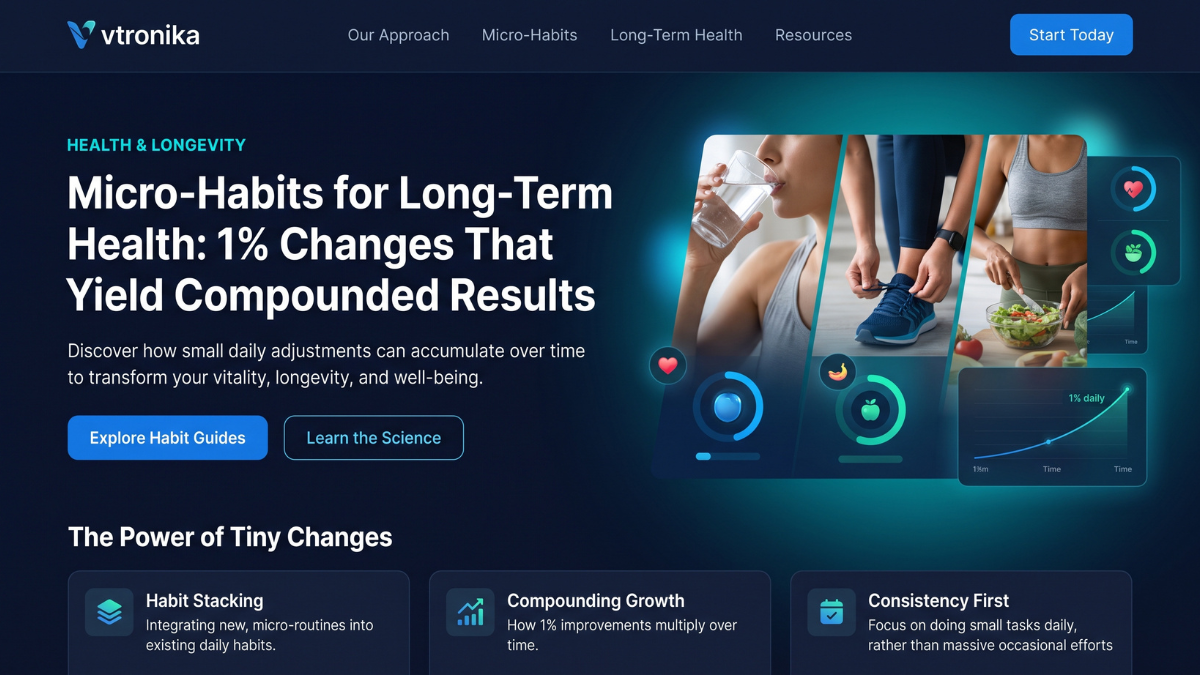
Micro-habits circumvent this failure cycle by remaining deliberately below the threshold of neural resistance. Grounded in the mathematical principle of compounding, small changes yield exponential long-term variance:
$$(1.01)^{365} = 37.78 \quad \text{versus} \quad (0.99)^{365} = 0.03$$
By shifting a single daily health variable by just 1%, you finish the year biologically thirty-seven times ahead of a baseline state. Over decades, this mathematical compounding alters gene expression, reduces cellular senescence, and preserves metabolic resilience, demonstrating that long-term vitality is not born of heroic feats, but of microscopic actions performed with relentless consistency.
Article 2: The 10-Minute Postprandial Walk: Non-Insulin Glucose Disposal
One of the most biologically efficient micro-habits is a brief, ten-minute walk completed within thirty minutes after your largest daily meal. In modern sedentary environments, the standard post-meal response involves sitting at a desk or reclining on a couch. Under these conditions, clearing circulating glucose depends almost entirely on the pancreas secreting large bursts of insulin, driving glycemic variability and gradually promoting peripheral insulin resistance.
Physical movement changes this dynamic by activating an alternative metabolic pathway:
$$\text{Skeletal Muscle Contraction} \longrightarrow \text{AMPK Activation} \longrightarrow \text{GLUT4 Translocation without Insulin}$$
Postprandial State:
  │
  ├──> Inactivity ────────> High Pancreatic Insulin Spike ──> Reactive Hypoglycemia & Fat Storage
  │
  └──> 10-Min Light Walk ──> Mechanical Muscle Contraction ──> Direct GLUT4 Glucose Uptake (No Insulin Needed)
As large muscle groups (such as the quadriceps, glutes, and soleus) contract, they mechanically translocate Glucose Transporter Type 4 (GLUT4) proteins directly to cell membranes. This process clears glucose from the bloodstream independently of insulin.
A ten-minute stroll at an easy pace (3 to 4 km/h) reduces postprandial glucose peaks by 20% to 35%, blunts the late-afternoon energy drop, and spares pancreatic beta cells decades of excessive metabolic strain.
Article 3: Circadian Photobiology: The Two-Minute Morning Sunlight Anchor
Modern indoor environments expose the human eye to artificial lighting ranging between 100 and 500 lux, while filtering out crucial portions of the solar spectrum. This creates chronic circadian disruption, blunting daytime alertness and impairing nocturnal recovery. A powerful, zero-cost micro-habit involves stepping outdoors for two to five minutes within an hour of waking to view natural, unfiltered morning sunlight.
Morning Sunlight Exposure (10,000+ Lux)
               │
               ▼
Intrinsically Photosensitive Retinal Ganglion Cells (ipRGCs)
               │
               ▼
Suprachiasmatic Nucleus (SCN) Activation
               │
      ┌────────┴────────┐
      ▼                 ▼
Morning Cortisol     Suppresses Melatonin & Starts
Peak (Alertness)     14-16 Hour Biological Timer
                        │
                        ▼
                     Optimal Nocturnal Melatonin Release
Morning photons stimulate melanopsin-expressing Intrinsically Photosensitive Retinal Ganglion Cells (ipRGCs) in the eye. These cells project monosynaptically to the Suprachiasmatic Nucleus (SCN)—the master biological clock located in the anterior hypothalamus. This light trigger delivers two critical physiological signals:
- It initiates an alert, healthy morning cortisol awakening response (CAR), raising core body temperature and elevating cognitive focus.
- It halts daytime melatonin synthesis while setting an internal 14-to-16-hour biochemical timer for nocturnal melatonin release.
Stepping outside without sunglasses—even on an overcast morning where light intensity easily exceeds 10,000 lux—anchors your cellular rhythm. This micro-habit stabilizes blood pressure, regulates metabolic hormones, and improves deep slow-wave sleep quality night after night.
Article 4: The Gastrointestinal Fiber Buffer: Adding One Handful of Raw Greens
Standard nutritional advice frequently pushes restrictive dietary elimination, which often triggers feelings of deprivation and rebound overeating. A more sustainable micro-habit focuses on an additive principle: consuming a single handful of bitter raw greens, raw vegetables, or unsweetened sprouted legumes immediately before your primary meals.
This micro-habit alters gastrointestinal mechanics via two main pathways:
Pre-Meal Raw Greens Ingestion
             │
             ├──> Forms Viscous Polysaccharide Gel ──> Delays Gastric Emptying & Slows Glucose Absorption
             │
             └──> Delivers Fermentable Prebiotics ──> Colon Microbes Synthesize Short-Chain Fatty Acids (SCFAs)
                                                                 │
                                                                 ▼
                                                  Repairs Gut Barrier & Suppresses Inflammation
- Viscous Gel Formation: Soluble and insoluble plant fibers swell in the stomach, creating a viscous gel network along the brush-border membrane of the small intestine. This physical mesh delays gastric emptying and slows enzymatic carbohydrate breakdown, preventing rapid glucose surges into portal circulation.
- Microbiome Fermentation: Raw greens supply prebiotics and polyphenols that travel undigested to the cecum and colon. There, commensal microbes ferment these fibers into Short-Chain Fatty Acids (SCFAs)—principally butyrate, acetate, and propionate.
Butyrate fuels the intestinal epithelium, tightens intercellular claudin and occludin junctions, and limits the systemic leak of inflammatory lipopolysaccharides (LPS). This simple, two-minute dietary habit continuously protects against low-grade systemic inflammation.
Article 5: Soleus Pushups: Desk-Bound Metabolic Optimization
Modern desk work locks the body into sustained, hours-long immobility. This downregulates lipoprotein lipase (LPL) activity in peripheral muscles, causing systemic fat clearance to stall and insulin sensitivity to decline. When stepping away from a workstation is impossible, a targeted micro-habit provides an effective solution: the Soleus Pushup.
Seated Position (Knees at 90°)
       │
       ▼
Raise Heels While Keeping Forefoot Planted (Soleus Shortens)
       │
       ▼
Release Downward Under Control (Soleus Lengthens)
       │
       ▼
Continuous Slow-Twitch Motor Unit Recruitment (High Glycogen Clearance, Zero Fatigue)
The soleus is a calf muscle composed primarily of slow-twitch, oxidative muscle fibers (up to 80% Type I). Unlike typical skeletal muscles that rely heavily on stored muscle glycogen and tire quickly from lactic acid buildup, the soleus efficiently extracts fuels directly from circulating blood glucose and free fatty acids:
$$\text{Continuous Soleus Contraction} \longrightarrow \uparrow \text{Local Fat \& Glucose Oxidation} \longrightarrow \downarrow \text{VLDL \& Triglyceride Accumulation}$$
Executing seated soleus pushups—raising the heel while keeping the ball of the foot planted, then releasing back down—recruits slow-twitch motor units without fatiguing the central nervous system. Integrating this quiet movement into sedentary meetings or desk work accelerates lipid clearance, keeps local enzymes active, and counters the metabolic penalties of sustained sitting.
Article 6: The Physiological Sigh: 90 Seconds to Reset Autonomic Tone
Chronic psychological stress exerts its toll not through occasional high-pressure emergencies, but through uninterrupted, low-grade sympathetic activation. When the sympathetic nervous system remains chronically switched on, elevated catecholamines constrict peripheral blood vessels, elevate baseline heart rate, and raise systemic blood pressure.
The fastest physiological mechanism to counter this sympathetic surge in real time is the Physiological Sigh, an autonomic breathing reflex:
[Inhale 1: Deep Nasal Inhalation] ──> Inflates Main Alveoli
               │
               ▼
[Inhale 2: Quick Nasal "Sniff"]   ──> Pops Open Collapsed (Atelectatic) Air Sacs
               │
               ▼
[Exhale: Slow, Extended Mouth Exhale] ──> Diaphragm Rises ──> Compresses Heart
                                                                    │
                                                                    ▼
                                                 Vagus Nerve Fires ──> Acetylcholine Released
                                                                    │
                                                                    ▼
                                                     Rapid Reduction in Heart Rate & Stress
- Take two continuous inhalations through the nose: a deep initial inhale to expand the lungs, followed immediately by a sharp, secondary “top-off” inhale without exhaling first.
- Follow with a long, slow, unforced exhalation through the mouth until the lungs are empty.
The secondary inhale re-expands collapsed microscopic air sacs (atelectatic alveoli), dramatically expanding lung surface area and clearing trapped carbon dioxide.
During the extended exhalation, the diaphragm moves upward, compressing the heart. The brain detects this pressure shift via baroreceptors, signaling the vagus nerve to release acetylcholine. Within ninety seconds, two or three physiological sighs lower heart rate, re-establish parasympathetic tone, and neutralize biological stress cascades.
Article 7: Habit Stacking: Automating Preventive Actions Without Friction
The primary obstacle to maintaining healthy habits is not lack of desire; it is cognitive friction. Every time a new action requires a conscious decision, it consumes finite willpower. Habit Stacking, a behavioral design concept pioneered by Dr. BJ Fogg and popularized by James Clear, bypasses this friction by attaching a new behavior to an established neural pathway.
Traditional Approach (Fails Easily):
"I need to remember to do balance exercises every day." ──> Requires Active Memory & Willpower

Habit-Stacked Architecture:
[Established Basal Ganglia Circuit] ──> [New 1% Micro-Action] ──> [Immediate Dopaminergic Completion]
(e.g., Waiting for Morning Kettle)       (e.g., 60s Single-Leg Stand)
The brain avoids establishing isolated neural connections when it can simply extend existing ones. By using an immutable, established daily routine as the physiological cue, the new micro-habit leverages an automated basal ganglia loop:
$$\text{Current Established Habit } [\text{Trigger}] \longrightarrow \text{New Micro-Action } [\text{Routine}] \longrightarrow \text{Sensory / Health Benefit } [\text{Reward}]$$
Practical habit stacks for long-term health include:
- Stack 1: “After I turn on the morning coffee machine, I will perform a 60-second single-leg balance to preserve neuromuscular proprioception.”
- Stack 2: “After I sit down at my desk each morning, I will fill a 1-liter water flask and drink 250 mL to restore overnight fluid balance.”
- Stack 3: “After I brush my teeth at night, I will read one page of a physical book rather than checking my phone screen.”
Eliminating the need to plan when or where an action occurs removes mental friction, turning healthy habits into automatic daily routines.
Article 8: Orthostatic Groundwork: 60 Seconds of Daily Balance Training
Age-related falls represent a primary contributor to mobility loss, hip fractures, and subsequent biological decline in later decades. While balance is often viewed as an innate physical trait, it is actually a trainable neuromuscular skill governed by the cerebellum and mediated by sensory integration across three systems:
| Sensory System | Physiological Mechanism | Age-Related Degradation Risk |
| Vestibular System | Fluid-filled semicircular canals in the inner ear detect angular acceleration and spatial orientation. | Loss of otoconia crystals, leading to dizziness, reduced spatial tracking, and slower balance recovery. |
| Visual Feedback | Retinal flow and ambient visual reference points orient the head relative to the horizon. | Degraded contrast sensitivity and depth perception make rapid balance correction harder. |
| Proprioception | Mechanoreceptors in foot soles, tendons, and joint capsules sense tension, pressure, and ankle angle. | Blunt tactile nerve endings in the feet slow reflex pathways, increasing trip risk. |
Balance degrades quietly when shoes cushion every surface and smooth floors remove the need for micro-adjustments.
A simple, sixty-second daily micro-habit—standing on one leg while brushing your teeth, alternating thirty seconds per side—retrains foot mechanoreceptors and challenges the intrinsic stabilizers of the ankle and pelvis.
Progressing to balancing with eyes closed removes visual compensation, forcing the cerebellum and vestibular apparatus to handle stability directly. This preserves the rapid motor reflexes that prevent falls long into old age.
Article 9: The Hydration Micro-Habit: Adding Electrolytes to Morning Water
During seven to eight hours of overnight sleep, the human body loses roughly 500 to 800 milliliters of water through transcutaneous evaporation and respiration. Most people wake in a state of mild hypovolemia, characterized by reduced plasma volume, concentrated blood, and lowered cellular hydration. Reaching immediately for acidic, caffeinated beverages like black coffee can irritate the gastric mucosa and accelerate urinary fluid loss before cellular hydration is restored.
Waking State:
[Overnight Fluid Loss] ──> [Reduced Blood Volume & Concentrated Plasma]
                                    │
                                    ├──> Immediate Black Coffee ──> Gastric Irritation & Heightened Diuresis
                                    │
                                    └──> 500 mL Water + Pinch of Salt ──> Rapid Osmotic Cellular Rehydration
A far more restorative micro-habit is drinking 500 mL of room-temperature water mixed with a small pinch of mineral salt (providing sodium, potassium, and trace minerals) upon waking:
- Pure water without electrolytes can dilute blood plasma too quickly, triggering the kidneys to excrete water before it fully hydrates tissues.
- Trace sodium utilizes the Sodium-Glucose Cotransporter (SGLT) mechanism in the intestinal lining, pulling water across into the bloodstream through osmotic balance.
This early-morning habit restores circulating plasma volume, reduces the heart’s pumping workload, and supports the liver and kidneys in clearing overnight metabolic byproducts.
Article 10: Thermal Conditioning: The 30-Second Cold Shower Finish
Engaging in full cryotherapy or extended ice baths requires specialized equipment, substantial time, and significant effort. Fortunately, you can capture much of the vascular and neuroendocrine benefit through a simple micro-habit: turning your regular daily shower completely cold for the final thirty to sixty seconds.
Final 30-60 Seconds Cold Water Exposure
                  │
                  ▼
   Rapid Cutaneous Vasoconstriction
                  │
                  ▼
  Peripheral Blood Shunted to Core Organs
                  │
                  ▼
Systemic Locus Coeruleus Activation ──> Sustained Elevation of Norepinephrine & Dopamine
                  │
                  ▼
  Re-Warming ──> Robust Vasodilation ──> Endothelial Elasticity & Mental Clarity
This sudden shift from warm to cold water triggers an acute vascular pump reflex:
- Cutaneous blood vessels rapidly constrict, driving blood toward deep internal organs to conserve core temperature.
- Once you step out and re-warm, peripheral capillaries dilate widely, flushing tissues with fresh, oxygenated blood and improving endothelial flexibility.
Simultaneously, cold shock proteins on the skin stimulate the locus coeruleus in the brainstem. This triggers an immediate release of norepinephrine and dopamine into the bloodstream without a significant surge in systemic cortisol.
The resulting neurochemical shift enhances alertness, elevates mood for hours, and activates brown adipose tissue (BAT) to assist with non-shivering thermogenesis—all achieved in under a minute without specialized gear.
Article 11: The Evening Digital Sunset: Dimming the Overhead Environment
The human circadian clock is particularly sensitive to the angle and intensity of light. For evolutionary millenia, the only sources of evening illumination were low-intensity, ground-level campfires and candles, both rich in soothing red and orange wavelengths. Today, bright overhead LEDs and digital screens emit high-energy visible (HEV) blue light, which tricks the brain into registering daytime conditions well past dark.
Blue wavelengths strike the eye and travel along retinohypothalamic tracts, actively suppressing melatonin production:
Overhead Blue-Shifted Lighting (Post-Sunset)
                    │
                    ▼
Persistent ipRGC Retinal Excitation
                    │
                    ▼
Inhibition of Pineal Gland Melatonin Production
                    │
                    ▼
Delayed Deep Slow-Wave Sleep Onset & Fragmented Overnight Recovery
Fixing this issue does not require living in darkness. A simple, actionable micro-habit is the Two-Hour Environmental Dim-Down:
- Two hours before bedtime, turn off harsh ceiling downlights and switch to low-placed, warm lamps (under 2700 Kelvin).
- Lower display brightness on smartphones and computers, or activate native warm-light filters.
Altering light height and color temperature creates an evolutionary twilight cue. This permits natural pineal melatonin secretion, helping you fall asleep faster and spend more time in restorative slow-wave and REM stages without sleep supplements.
Article 12: The Friction Inversion: Organizing Environments for Subconscious Health
Human behavior naturally follows the path of least resistance. In behavioral psychology, this is known as the Principle of Least Effort: when given a choice between two actions, an individual will consistently choose the one with less immediate friction.
Most people inadvertently set up their environments to encourage sedentary habits and poor dietary choices:
High-Friction Setup (Fails):
[Apple in Deep Refrigerator Drawer] ──> Requires Searching & Washing ──> Ignored
[Ultra-Processed Snack on Counter] ──> Zero Barrier to Ingestion ────> Consumed

Inverted Friction Setup (Succeeds):
[Washed Fruit in Clear Glass Bowl] ──> Zero Barrier to Ingestion ────> Consumed
[Junk Food in Hard-to-Reach Cabinet] ──> Requires Stool & Effort ───────> Ignored
The friction inversion micro-habit leverages this principle: Add three steps of physical resistance to habits you want to break, and remove three steps of resistance from habits you want to build.
- Nutritional Friction: Wash fresh berries, cut vegetables, and store raw nuts in clear glass containers right at eye level in the pantry or fridge. Place ultra-processed snacks in opaque containers on high, hard-to-reach shelves or leave them out of the house entirely.
- Movement Friction: Leave walking shoes and workout gear beside the bed or desk. Keep exercise bands in plain sight so engaging in brief movement takes less effort than hunting through a closet.
- Digital Friction: Move social media apps off your phone’s home screen into deeply nested folders, or set up a screen lock passcode that requires intentional thought.