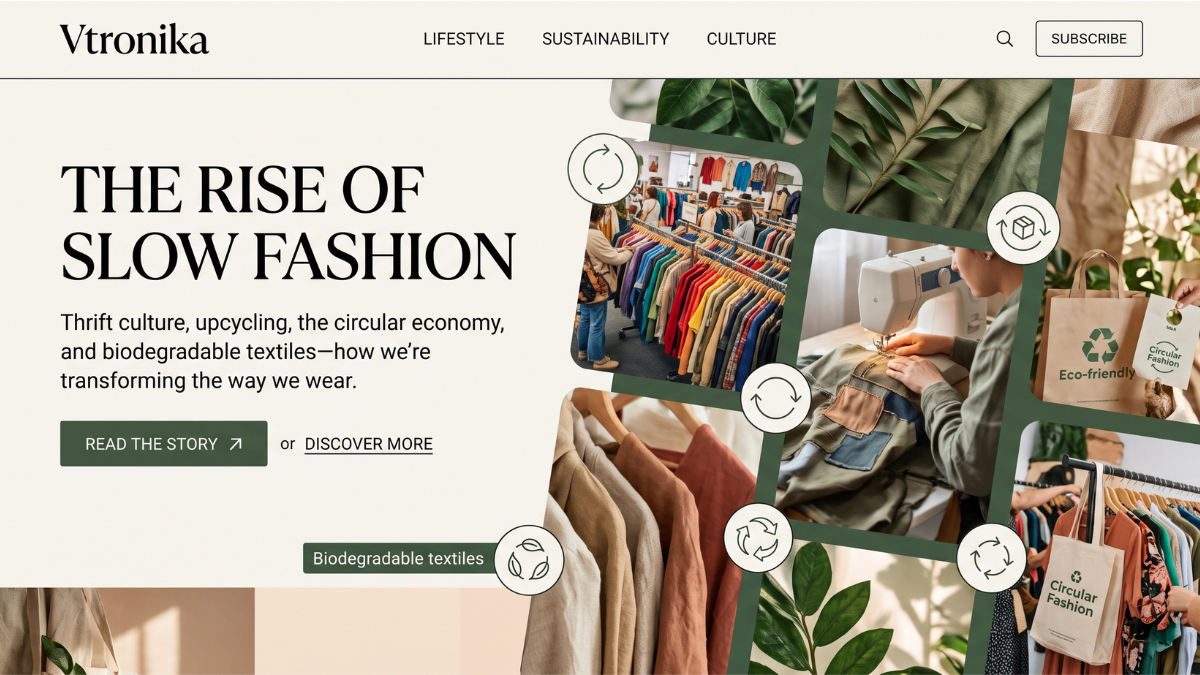
Article 1: The Slow Fashion Manifesto — Deconstructing the Hyper-Consumerist Wardrobe
Slow fashion is not merely an aesthetic preference; it is a direct philosophical challenge to the extractive logic of industrial garment production. For decades, global fashion has operated on an accelerated cycle of manufactured obsolescence, teaching consumers to view clothing as disposable commodities meant to be worn briefly and discarded. The slow fashion movement rejects this pace, advocating for a holistic relationship with apparel rooted in quality, transparency, and ethical accountability.
By slowing down production and consumption, this movement re-establishes the connection between the wearer and the maker. It questions the true cost of $5 shirts, bringing hidden environmental degradation and low-wage assembly practices into focus. Slow fashion encourages consumers to buy fewer items of superior durability, prioritize independent artisans, and develop a personal style uncoupled from algorithmic micro-trends.
- The Velocity Pivot: Shifting from weekly micro-drops to seasonless, durable collections designed for long-term wear.
- Cost-per-Wear Economics: Calculating a garment’s true financial and ecological value over dozens of wears rather than its initial checkout price.
- Supply Chain Transparency: Demanding complete visibility into every stage of production, from raw agricultural harvest to final stitch.
Article 2: The Modern Thrift Economy — From Subculture to Mainstream Retail Force
Thrifting has transitioned from an economic necessity and niche subculture into a major driver of modern retail. Led primarily by Gen Z and millennial shoppers, the secondhand apparel market is outpacing traditional fast fashion in compound annual growth. This shift is powered by a desire for individual expression, vintage nostalgia, and a conscious effort to lower personal environmental footprints.
The infrastructure supporting secondhand fashion has modernized rapidly. Alongside physical brick-and-mortar charity shops and curated vintage boutiques, peer-to-peer digital platforms (such as Depop, Vinted, Poshmark, and Vestiaire Collective) have gamified secondhand discovery. By extending the functional lifespan of existing apparel by just nine months, thrifting reduces an item’s carbon, water, and waste footprints by approximately 20% to 30%.
- Algorithmic Resale Apps: Mobile marketplaces transform closets into circular digital storefronts, empowering peer-to-peer redistribution.
- The Hunt for Vintage Quality: Older garments often feature heavier natural fiber weights, tighter weaves, and superior seam construction compared to modern mass-market garments.
- The Anti-Homogeneity Trend: Thrift shopping allows consumers to assemble distinct, individual wardrobes free from cookie-cutter retail inventory.
Article 3: The Art of Upcycling — Transforming Textile Waste into High Design
While downcycling shreds old clothing into low-grade industrial insulation or rags, upcycling takes deadstock fabrics, post-consumer garments, and discarded materials to create higher-value, design-forward items. Upcycling bridges the gap between waste management and high-end artisanal fashion, proving that sustainability and high design can coexist.
Independent designers and ateliers treat textile constraints as creative inspiration. Sourcing abandoned military surplus canvases, vintage quilts, hotel linens, and factory off-cuts, creators craft one-of-a-kind statement pieces that carry distinct character. Upcycling bypasses the resource-heavy raw fiber production phase entirely, eliminating the chemical dyeing, massive water consumption, and agricultural land use required to manufacture virgin textiles.
- Deconstruction and Pattern Engineering: Unstitching worn-out trousers, jackets, and shirts to recombine their salvageable panels into new, functional silhouettes.
- Deadstock Rescue: Partnering with traditional textile mills to claim leftover production rolls that would otherwise head to municipal incinerators or landfills.
- Zero-Waste Pattern Drafting: Designing garment patterns like geometric puzzles so that 100% of the fabric roll is used, leaving zero off-cut waste on the cutting table.
Article 4: Visible Mending and the Culture of Repair — Sashiko to Darning
In an era of hyper-disposability, repairing an existing garment is a quiet act of environmental stewardship. For generations, torn seams or frayed elbows were hidden or treated as reasons to throw an item away. The slow fashion movement embraces “visible mending,” elevating garment wear and tear into deliberate, artistic design elements.
Drawing inspiration from historic techniques like Japanese Sashiko (functional running-stitch embroidery developed by working-class artisans) and traditional wool darning, wearers reinforce weakened textiles using contrasting threads, geometric patterns, and patchwork. This tactile process changes a consumer’s relationship with their clothes; a mended jacket ceases to be an interchangeable product and becomes a unique, living record of personal history.
- Japanese Sashiko: Utilizing thick white cotton thread over indigo denim or linen patches to structurally reinforce friction zones like knees and inner thighs.
- Swiss Darning: Re-knitting worn wool sweaters and socks by replicating the original knit structure with complementary or contrasting yarn.
- Modular Hardware Replacement: Swapping broken plastic zippers and stamped buttons for durable metal hardware, horn toggles, or hand-sewn shank buttons.
Article 5: The Circular Economy Blueprint — Redefining Fashion’s Linear Lifeline
For over a century, the industrial fashion sector has operated on an extractive, linear model: take, make, use, dispose. Raw oil and water are extracted, turned into cheap synthetic clothes, worn briefly, and buried in landfills. The circular economy model aims to close this open loop, designing waste and pollution out of the system entirely from the drawing board.
In a fully circular system, every garment is engineered as an input for its next lifecycle. This requires rethinking structural construction: abandoning complex multi-fiber poly-blends that cannot be mechanically or chemically recycled, designing for easy disassembly, and establishing closed-loop chemical recycling facilities capable of breaking pure natural or synthetic fibers back down to virgin-equivalent polymers.
- Design for Disassembly: Using dissolvable sewing threads (which break down under microwave or hot-water treatments) to cleanly separate zippers, buttons, and linings in seconds.
- Monomaterial Purity: Crafting garments from 100% single-fiber origins (e.g., 100% cotton or 100% wool) to allow seamless chemical and mechanical recycling.
- Brand Take-Back Infrastructure: Establishing reverse-logistics programs where retailers buy back their worn items to integrate them into circular regeneration lines.
Article 6: Next-Gen Biomaterials — Mycelium, Agricultural Waste, and Plant-Based Leathers
Traditional animal leather carries significant environmental impacts via cattle ranching deforestation, methane emissions, and toxic chromium tanning chemistry. Synthetic vegan leathers (such as polyurethane and PVC), on the other hand, are essentially petroleum plastics that shed microplastics and persist in landfills for centuries. Material science is addressing this dilemma through innovative bio-fabricated alternatives.
Modern biotech firms are cultivating lab-grown mycelium (the root structure of mushrooms) into dense, durable sheets that closely replicate the tensile strength, grain, and hand-feel of traditional calfskin. Concurrently, engineers are turning food agriculture byproducts—such as pineapple leaf fibers (Piñatex), discarded apple skins, cactus pads, and banana plant stems—into supple, bio-based textiles that reduce waste and avoid petrochemical inputs.
- Mycelium Leather: Cultivating fungal root networks on agricultural waste trays in days, requiring a fraction of the land and water needed for livestock farming.
- Agricultural Waste Valorization: Repurposing discarded leaves and peels from commercial farming into high-tensile structural bio-composites.
- Non-Toxic Vegetable Tanning: Replacing toxic heavy-metal chromium tanning baths with natural tannins derived from tree bark, chestnut wood, and olive leaves.
Article 7: Regenerative Agriculture and the Return of Ancient Natural Fibers
Sustainable fashion requires looking at what happens on the farm just as much as in the factory. Conventional cotton cultivation consumes vast quantities of agricultural freshwater and relies heavily on chemical pesticides and synthetic fertilizers that degrade topsoil biology. The slow fashion vanguard is shifting toward regenerative agriculture and resilient heritage fibers.
Regenerative farming practices—including rotational grazing, minimal tilling, cover cropping, and intercropping—restore topsoil microbiology, increase water retention, and actively sequester atmospheric carbon into the ground. Concurrently, ancient bast fibers like industrial hemp, European flax (linen), and stinging nettle are re-emerging. These crops grow vigorously with minimal irrigation, naturally resist pests, and produce durable, long-staple fibers that soften with age.
- Industrial Hemp Resilience: Hemp yields up to three times more fiber per acre than conventional cotton while requiring roughly half the agricultural water.
- Topsoil Carbon Sequestration: Regenerative cotton farming focuses on microbial soil health, transforming agricultural fields into net-positive carbon sinks.
- Linen Longevity: Flax-derived linen offers natural thermoregulation, hypoallergenic properties, and higher tensile strength than cotton, lasting decades when cared for properly.
Article 8: Natural Dyes and Closed-Loop Textile Chemistry
The textile dyeing and finishing sector is one of the world’s largest industrial polluters of freshwater, discharging thousands of tons of synthetic azo dyes, heavy metal fixatives, and formaldehyde-based finishes into waterways across garment-producing regions. Slow fashion is addressing this ecological footprint by reviving natural botanical colorants and investing in closed-loop chemical engineering.
Artisanal dyers and clean-tech startups are harvesting colors from non-toxic, renewable sources—such as madder root, weld, indigo leaves, walnut hulls, onion skins, and food-waste avocado pits. At an industrial scale, modern innovations like supercritical carbon dioxide ($CO_2$) dyeing eliminate water from the process entirely, using pressurized recycled gas to infuse pigments deep into fabric fibers with zero wastewater discharge.
- Botanical and Earth Pigments: Extracting rich, earthy color palettes from wild-harvested roots, bark, leaves, and mineral clay without synthetic fixatives.
- Waterless $CO_2$ Dyeing: Utilizing pressurized liquid carbon dioxide as a dye carrier, which returns to gaseous form and is recycled, producing zero effluent runoff.
- Bacterial Pigmentation: Fermenting gene-edited bacteria that naturally synthesize vibrant, UV-stable pigments, dramatically cutting water and thermal energy use.
Article 9: Biodegradability and the End-of-Life Reality of Apparel
When a garment reaches the end of its functional life, its material composition dictates whether it returns safely to the soil or remains in a landfill for centuries. Millions of consumers assume that donating or discarding clothes is harmless, but garments made from synthetic blends (e.g., poly-cotton) cannot decompose or compost, shedding persistent microplastics into local ecosystems.
True slow fashion plans for a garment’s eventual decomposition. Garments made from 100% untreated natural fibers—such as raw organic wool, silk, linen, and unbleached cotton—can safely break down in managed industrial compost settings within three to six months. In decomposing, they return organic matter, nitrogen, and carbon to the earth, creating nutrient-rich humus for new agricultural cycles.
- The Blend Problem: Combining natural and synthetic fibers (like poly-cotton knits) creates hybrid materials that neither compost nor recycle easily with current technology.
- Untreated Natural Decomposition: Pure, chemical-free wool and linen break down naturally, releasing organic nitrogen into the soil as they degrade.
- Microplastic Elimination: Choosing fully biodegradable garments eliminates the shedding of synthetic polymer microfibers into municipal water systems and marine food chains.
Article 10: Digital Product Passports and the Transparent Future of Slow Fashion
The primary challenge facing the growth of slow fashion has long been consumer skepticism: distinguishing between genuine circular practices and corporate greenwashing. Without verifiable data, vague sustainability claims dilute public trust. The integration of modern track-and-trace technology is transforming supply chain accountability.
Impelled by upcoming European Union regulations, brands are adopting Digital Product Passports (DPPs). Accessed via stitched-in scannable QR codes or RFID threads, these digital certificates give buyers complete visibility into a garment’s lifecycle. Consumers can verify raw fiber origins, see audit scores of sewing facilities, check chemical dye safety, view certified repair tutorials, and access brand-backed buyback programs with a single smartphone scan.
- Scannable QR Lifecycles: Direct digital access to the specific farm origins, processing mills, and carbon emissions tied to that individual piece.
- Verification of Authenticity and Resale: Digital passports verify the provenance and authenticity of designer and luxury vintage pieces on secondary markets.
- Empowering Consumer Choice: Transparent supply chain metrics allow shoppers to reward genuinely ethical, closed-loop fashion brands while avoiding unsubstantiated greenwashing claims.